
[ad_1]
Some notes on America at 250.
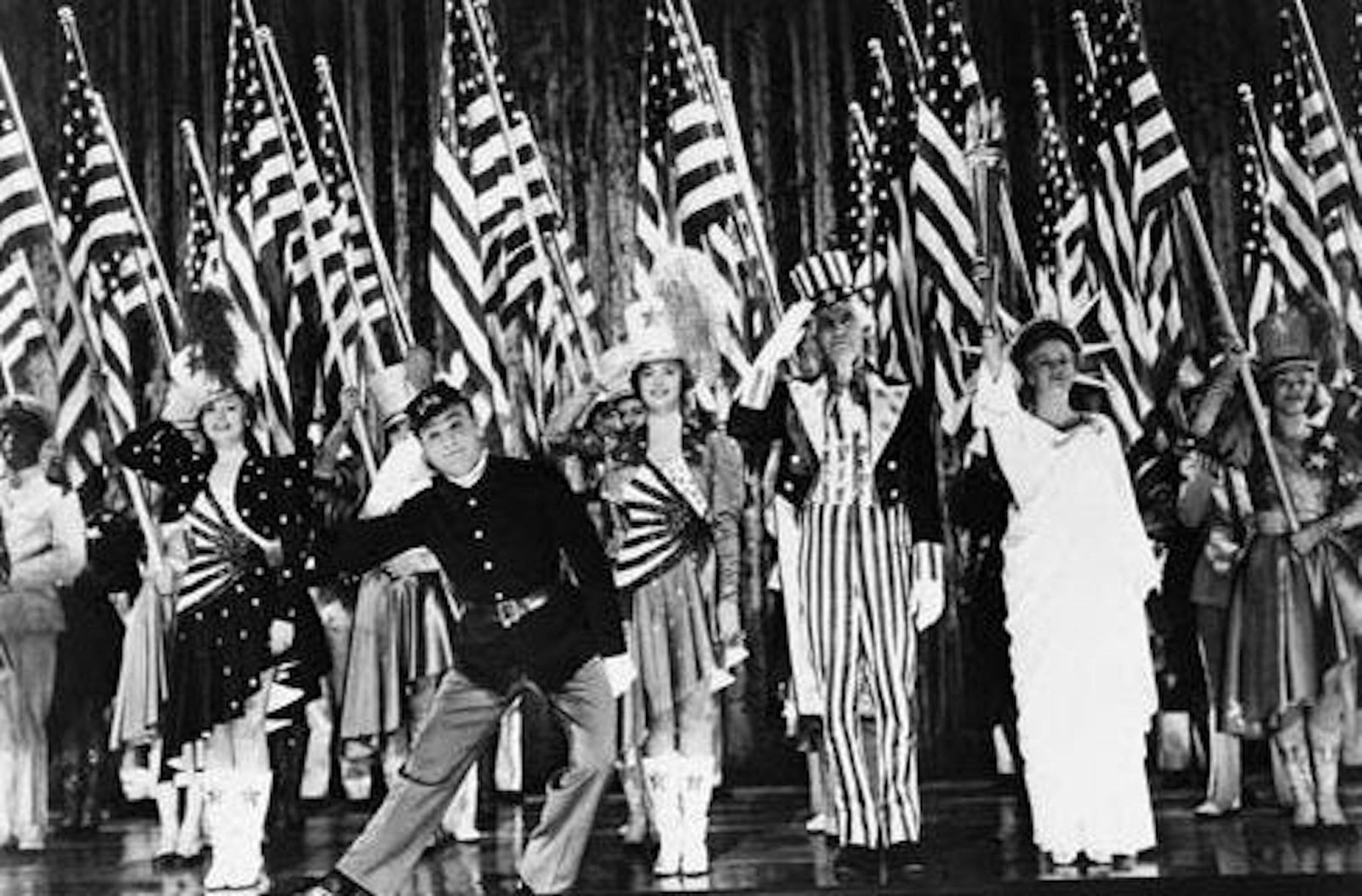
Cagney plays his role. On the film set, 1942. (Warner Brothers/ Wikimedia Commons)
By Patrick Lawrence
The Floutist

The semiology abroad these past days and weeks, as Americans prepared for the 4th—or have been prepared for it, I think is better put—has fascinated me. Amid all the images, the themes of endless commentaries, the historical citations, nothing seems to be more important than how happy Americans are as they go happily along making themselves happy. There is an absolute fixation on “the pursuit of happiness,” that phrase Jefferson made it a point to write into the Declaration.
Why is this, you have to ask. To go straight to my point, I read this as one of those occasions when what is insisted upon demonstrates precisely what it is intended to refute.
“The pursuit takes many forms,” The New York Times observed in a piece published a couple of weeks ago:
Some are relatively concrete, like chasing the enduring dream of upward mobility—material wealth, professional success, fame. But many people are engaged in far more nebulous quests, for clarity or purpose, exhilaration or serenity.
And so on. I love the list. Money, success in the pitifully empty way Americans think of it, fame of all things, and then “nebulous,” odd and hard-to-fathom things such as giving some actual meaning to one’s life.
There is a video to go along with the Times’s piece, for the paper has gone very long on American happiness. It features, among others, a paunchy fellow sitting back in a chair smoking a cigar, a slightly overweight woman holding a flower to her cheek and smiling, a hang-glider coming in over some trees for a landing. Contented satisfaction with the way things are, quiet joy in the beauty of it all, a what-fun “Yippee!” in a nation with nothing to worry about: This is what I mean by the semiology attaching to the 250th. To be noted: All of these people are alone. There is no one else with them in their contentment or joy or carefree funzies.
“The tyranny of American happiness” is my term for this kind of thing. It is in the air Americans breathe and the water they drink. You see it in every advertisement featuring anyone doing anything—fussing with a cellular telephone, staring at a computer screen, drinking a take-out coffee, driving along a highway, walking down the street in a stylish dress. You will never find an ad in which the model, man, woman, or child, is not smiling. This is how advertising works. And what has the media coverage of the 250th been these past weeks if not an advertisement for a product—at times something of a hard sell, indeed?
And what is the product? In a single word it is the ideology of American exceptionalism. It is a not-done to be American and not be happy.
“To be American, it seems, is to strive,” the Times reports in the above-linked piece. This must be our distinguishing characteristic, for how exceptional is this in a world wherein no one else seeks or aspires or strives as Americans do? Where no one else is as happy as Americans are?
How far from reality must Americans drift so as to convince themselves that their nation’s big birthday is cause for celebration.
SOME TIME AGO I developed a new habit on returning from the occasional trips I make abroad to meet professional obligations. The advertising and the media reporting—and where is the line separating the two?—are immediate assaults on the sensibility when coming back to these United States, as many others also find. You want to know your country as it truly is, I decided, look at people’s faces. And where better to study people’s faces than in the local supermarket? Mine is located in one of New England’s post-industrial towns, which makes it yet more poignant.
What truths can one find when watching compatriots while pushing a shopping cart and the others push theirs. How bitterly far are the aisles from all the imagery our country incessantly forces upon us. Advertisements, sometimes for the very products people are looking for, take on an aspect of cruelty—of a tyranny, indeed. Rarely do you come across a smile like the smiles in all the ads, and when you do it is a minor event.
What I find instead is a prevalent… let me choose these words carefully… a prevalent but never-spoken sadness among the people I see in supermarkets. I read in their faces the quiet desperation Thoreau wrote of. They are reluctant and resentful participants in the corporatization of all life—the nightmare of consumer nihilism, this is to say.
Maybe most of all, the most American aspect of my explorations in the aisles, is that their nation has stripped them of all pride, which shows in their dress and demeanor. Bereft of hope, it is their lostness that lands most squarely. I am sometime reminded, on my expeditions for lettuce, blue cheese, and a connection to America as it is, of Giacometti’s famous bronzes, emaciated in spirit, the faces lined with alienation and loneliness—an unbridgeable isolation from one to another.
No supermarket can be made to stand for America. No thought could be sillier. But my local supermarket is a vastly more accurate reflection of America on its 250th than anything I read in the media or find elsewhere in the popular, approved consciousness. Are the people in the aisles not the real, live nephews of our Uncle Sam?
A friend from Manhattan called as I was writing these notes and I told her a little about them. She sighed with the wisdom of her years, and then: “America is a nation not interested in reality. It lives on its myths. Why do you think Walt Disney has done so well for who knows how many years? They’re making myths. And we live in our myths, not in the reality of who we are.”
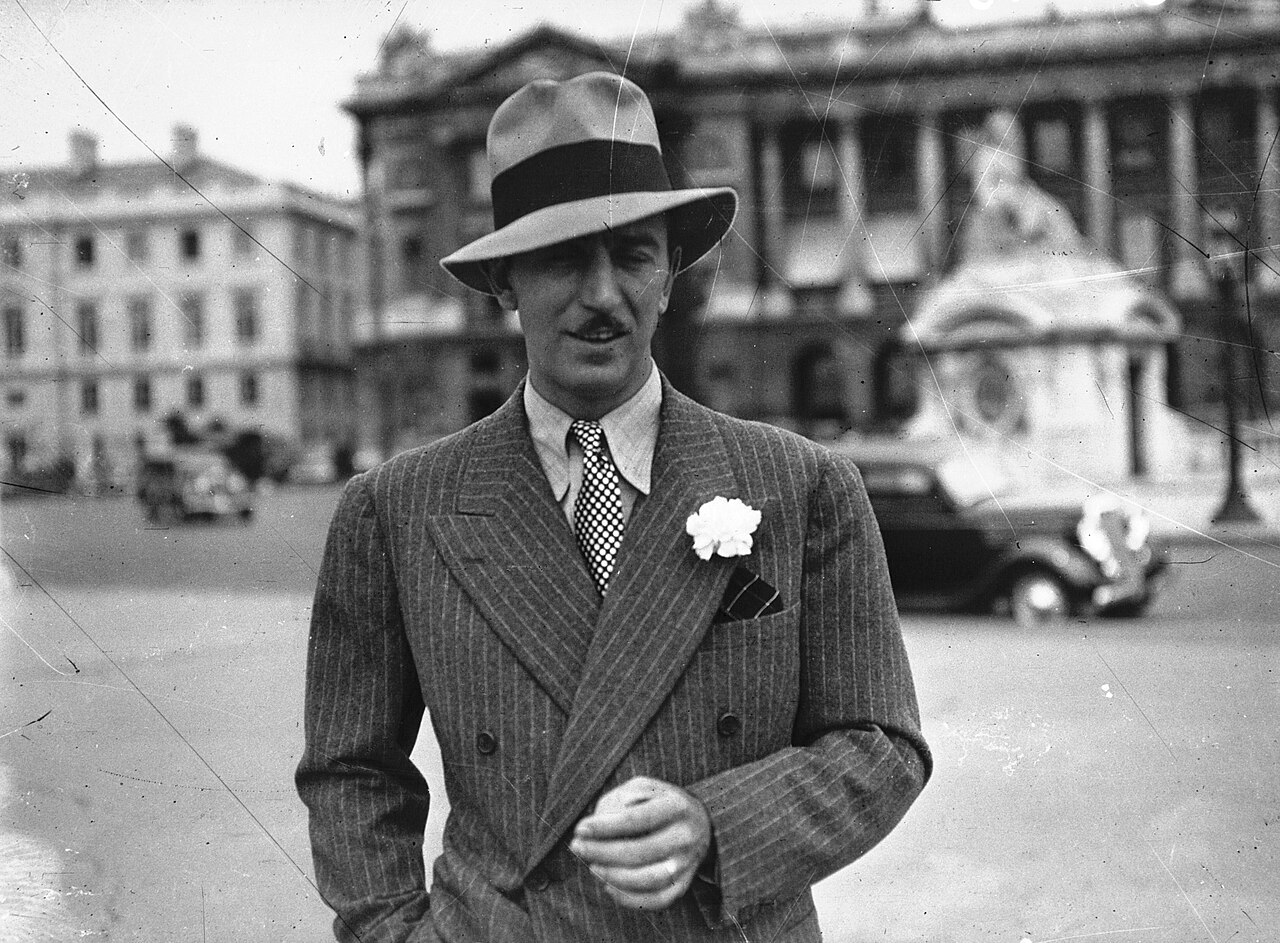
Walt Disney in 1935 on Place de la Concorde in front of Hôtel de Crillon. (Public Domain/Wikimedia)
I WROTE A BOOK some years ago, Time No longer: Americans After the American Century (Yale, 2013), in which I posited that Americans, since the events of Sept. 11, 2001, were suspended between myth and history, “the one failing us at last, the other with a beckoning finger calling us forward.” Later on I published an essay in the autumn 2019 number of Raritan called “After Exceptionalism.” The Independent republished the essay under a head that made my case well enough: “Twilight’s last gleaming: Can Americans learn to accept the notion of post-exceptionalism?”
It is a strange thing to think back, on the eve of the nation’s quarter millennial, to things I wrote years ago. We remain indeed caught between our mythologies and the forces of history, but I did not anticipate how addicted the nation remains to myths and delusions even when they are understood to be myths and delusions. Americans will someday learn to live without their exceptionalist consciousness, but this will come only when the world forces them to do so, not before.
In the meantime, all those monsters Gramsci warned us about continue to appear. America continues to sponsor and participate in the genocide of another people: I read today that the “Board of Peace” is putting in place the infrastructure needed for a full-dress ethnic cleansing: The Palestinians of Gaza are to be forced into a vast concentration camp in preparation for their removal to some other country.
The Trump regime, with the terror state that is its client and partner in West Asia, wages an illegal war of aggression against the Islamic Republic and threatens its “obliteration” if the Iranians do not submit to its list of imperialist demands. Said regime proposes to give the Pentagon $1.5 trillion in the fiscal year to come, an increase of 40–odd percent in a single year on an already obscene military budget. The Supreme Court has just authorized—lawlessness in the name of law is my term for this—the destruction of the judicial framework as provided in the Constitution. Well-timed, this last—just in time for the big day, as we are to celebrate our happiness and the endurance of our republic.
There is more, much more in this line. I mean to make this point by way of this very partial list of grotesqueries: There is a price to pay as Americans continue to shelter in their myths against history’s insistent knock and as they hold desperately fast to their claim to an exceptionalist status in the human community. Others pay this price, in blood, suffering, repression, and deprivation. And Americans pay it themselves as, just as it was with the Romans, what remains of the republic gives way to the imperatives of the empire.
This is the price of not facing up. Shame on The New York Times and all other corporate media for encouraging this collective flinch. And shame on all those who give into the flinch. There is a responsibility attaching to this.
I HAVE LONG DEFENDED a particular interpretation of postwar history and “the independence era,” when scores of nations—60–odd, I think—fought free of the colonial burden. The prevailing aspiration among them—and all over the world, in truth—has been for me unmistakable: It was for one or another kind—let a hundred flowers bloom—of social democracy. This was the world’s common aspiration after the 1945 victories.
And it was social democracy that most concerned those first giving shape to the global American imperium. Social democracy was bound to spread if it succeeded: The policy cliques feared this more than they feared Communism, in my read. Postwar Greece and Italy, Mossadegh’s Iran, Árbenz’s Guatemala, Lumumba’s Congo, and on and on: To an extent not often appreciated, it was the promise of social democracy that the new imperium most often acted against.
And now this fight comes home. Naturally: It was bound to do so since F.D.R. gave Americans a modest taste of social democracy during the Depression—this to save capitalism from collapse, ironically.
The recent primary victories of a new generation of Democratic Socialists, starting with Zohran Mamdani’s successful run for the New York City mayoralty last year, brings all the old paranoia back to life. We should pay attention to where the lines are being drawn.
Mainstream Democrats—and it is these congenitally dishonest people who prompt my contempt for American liberalism—have been in an obvious dither since the Democratic Socialists of America began making gains in primaries across the country. Late last month a group of “moderate House Democrats”—moderate as compared with what and whom?—published an open letter declaring in part, “We are capitalist, not socialist.” They titled this letter “The Promise of America.” Lots of “moderates” now makes this same point. It was a favorite of Nancy Pelosi’s, I should mention.

Zohran Mamdani at the Resist Fascism Rally in Bryant Park, Oct. 27, 2024. (Bingjiefu He/Wikimedia Commons/ CC BY-SA 4.0)
I wonder if the signatories of the open letter borrowed its title from The Promise of American Life, Herbert Croly’s celebrated (in some quarters) defense of American liberalism, published in 1909. While the irony here would be supreme, I doubt these people are so literate as to know the book. Leaving this aside, I also wonder where these people get off claiming to speak for America and its promise when they assert that it, America, is by its very definition capitalist and would not be America if it were any other. I suppose the implication is that “D–Soc,” as we used to call the Democratic Socialist party way back when, is—Take cover!—un–American.
We witness, indeed, a face-off between capitalism and socialism. I never had much faith in D–Soc’s staying power, to be honest, but this doesn’t change the truth of the moment. Can America be something other than capitalist and still be America? Prevail or go under, the Democratic Socialists have put the question back on the table for the first time in who knows how long. Good for them.
Charles Sellers’s much-celebrated The Market Revolution: Jacksonian America, 1815–1846, could scarcely be more pertinent to the argument. An historian at Berkeley, Sellers, 1923–2021, wrote it to be part of a series on American history Oxford University Press had planned, but when he submitted it his O.U.P. editors judged it far too radical. They published it separately, in 1991, and it was instantly recognized as a masterwork of revisionist history.
Sellers’s case comes to this, at the risk of simplification: America’s transformation from an agrarian to an industrial society is best understood as a fraught, intense confrontation between democracy and capitalism. The former predated the latter in the young republic—America was a democracy before it was capitalist—and the thought that it, America, was capitalist in its genetic makeup is nothing more than the snake oil of ideologues, wholly devoid of the history. By the end of Sellers’s time frame, the mid–19th century, it was plain that a democratic America and a capitalist America were inimical and that the latter had won out.
How good it is that those dedicated Democratic Socialists standing for office, and all those who work to support them, make Sellers’s point as America turns 250, whether they understand their undertaking this way or otherwise.
ON ITS 250th BIRTHDAY America is presided over by a regime whose members, the president in the lead, exhibit the characteristics of what I am taking to call an imperial personality. In this I borrow from what Theodor Adorno et al. published in 1950 as The Authoritarian Personality (Harper & Brothers). Aggressive assertions of authority but also a submission to authority, a preoccupation with unyielding hyper-masculinity, other-than-normal attitudes toward sex: These traits, among nine Adorno and his co-authors identified, are all there in Donald Trump, Pete Hegseth, and many others in the reigning regime. To these I add a prevalent tendency toward childishness, reenactments of adolescent sexuality, an obsession with death, a givenness to rebellion while insisting on rules.
Nineteen-fifty, the date Adorno’s book came out, is significant it seems to me. Five years after the 1945 victories, the United States was well on its way to constructing a global empire. The empire creates the personality type I describe and then depends on it—creating it, indeed, because it, the imperium, needs people of this kind to execute its imperatives.
This is how we find America at 250.
HOW CAN I NOT THINK, on this occasion, of Empire as a Way of Life (Oxford, 1980), the last book William Appleman Williams, 1921–1990, wrote and published? It is not ranked among his major works. Those appeared during Williams’s peak years as a an historian of foreign policy at the University of Wisconsin. But it has been major to me since I first read it. From its title on through its 240 pages, it presses the bitterest of truths upon us: Living in an empire, we all partake of its fruits. No, we are not all possessed of the imperial personality, but empire is our way of life. Short of exile this cannot, for now, be helped. Half a millennium ago the fruits of empire were gold, sugar, cotton, slaves, dominion. In our time they are oil and numerous other resources, cheap labor, favorable terms of trade, the projection of neoliberal orthodoxy, profit by way of the incessant exploitation of others.
Williams subtitled his book, An Essay on the Causes and Character of America’s Present Predicament Along with a Few Thoughts About an Alternative. America’s predicament now is the same or still graver than it was in 1980—the consequence of the shelter the nation takes in myth and delusion. Williams’s thoughts on alternatives are still worth reading and thinking about.
He urged most of all a form of social democracy—are you listening, D–Soc people?—based on radical decentralization, greater regional autonomy, more local self-government. On the foreign side this distinguished historian of American diplomacy thought the repudiation of empire was the sine qua non of any kind of national renewal, along with a commitment to authentic self-determination and a true respect for the sovereignty of all nations.
I read this now and wonder, was Ap, as we know him in our household, lost in angélisme, that wonderful French word for hopeless idealism. I reject my own charge, in the end. The extent to which an undertaking seems difficult is a measure of how urgently it is to be undertaken. I note, in this connection, Bill Astore’s latest in his Bracing Views newsletter. It is datelined today and appears under the headline, “Declaring America’s Independence from the Tyranny of Militarism and War.”
Tell me, is this the best idea you’ve heard all day or what? Is there any point submitting to the mythologies and delusions into which mainstream culture invites us?
Patrick Lawrence, a correspondent abroad for many years, chiefly for the International Herald Tribune, is a columnist, essayist, lecturer and author, most recently of Journalists and Their Shadows, available from Clarity Press or via Amazon. Other books include Time No Longer: Americans After the American Century. His Twitter account, @thefloutist, has been restored after years of being permanently censored.
The Floutist does not wish our readers a “Happy 4th,” for reasons that will be plain to anyone who has got this far. We wish all our readers a thoughtful and honorable 4th.
The Floutist publishes this piece without a paywall. A note to readers explaining our thinking on paywalls—when to use one, when not—is forthcoming. In the meantime, we ask those who are not paid subscribers to consider becoming one: We can use the support of all those who see worth in the work. A subscription is $5/month or $50/year. Every dollar is appreciated and helps keep us going. For those readers who are already subscribed, our usual and sincerest thanks.
Please Donate to
CN’s Summer
Fund Drive!


[ad_2]
Source link
