
[ad_1]
Photograph Source: cspirtos – Public Domain
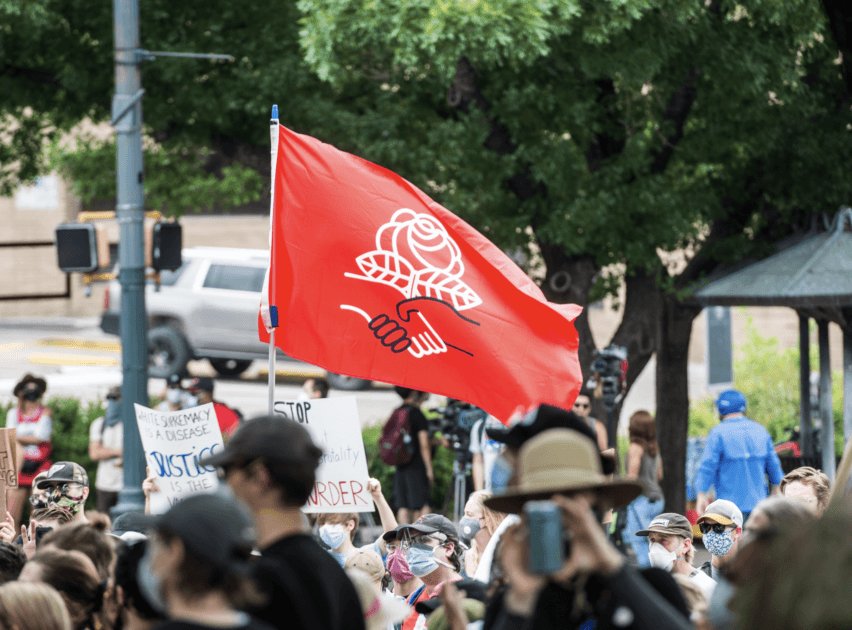
The ruling class appears shaken, their brains rattled, and their nightmare once thought vanquished—the Red Menace—appears reborn. Following the recent sweep of Democratic Socialists of America (DSA) in New York and Colorado elections, there has been a torrent of backlash and public meltdowns from President Trump claiming, “I’d be the greatest communist in history,” to humanity’s first billionaire posting the usual anti-communist nonsensical blather that communism has the “[h]ighest death count of any philosophy.” Elon Musk unabashedly cites inflated, unserious death counts that include in their tally of so-called “victims of communism” the Red Army’s liquidation of Nazis and fascists during the World War II.
Adding to the frenzy, one New York City council member even invoked the halcyon days of the FBI and the CIA, bragging that they would have “made sure unabashed revolutionaries” like the DSA National Political Community “were neutralized one way or another. In fact, that was basically the entire point of having them.” Vicki Paladino made a candid admission that domestic and foreign intelligence agencies were never designed to defend “democracy.” Rather, they were engineered as clandestine political police forces operating with lethal, counter-revolutionary violence.
And decades of disclosures and investigations reveal this. From the Church Committee convened five decades ago that investigated illegal intelligence operations to Florida Congresswoman Anna Paulina Luna’s recent hearing on the CIA’s mind control program called MK-ULTRA, domestic and foreign intelligence agencies have been mired in deeply nefarious practices, from illegal surveillance and counterintelligence operations to outright assassination. Put bluntly, the CIA and FBI, during the glory days of Cold War Red Scare politics, acted in service of capital, alleviating real or imagined threats to the profits of an increasingly paranoid ruling class, and building their own pile of bodies along the way as they waged a protracted and often secret war against those seeking to build power for the many rather than the few.
Indian Country itself paid a heavy price. And only recently have we begun to come to terms with the consequences, with the commutation of Leonard Peltier’s two consecutive life sentences for the killing of two FBI agents during the federal reign of terror waged against the American Indian Movement on the Pine Ridge reservation. While Peltier walked out of a federal prison, many more never went home and still more await justice. While we have yet to heal from the wounds of the past, this generation faces a different battle.
Putting aside whether the recent DSA electoral wins pose an existential threat to the capitalist class, the underlying fear has a material basis. As the billionaire class, and now, grotesquely, the trillionaire class, reap record profits, the quality of life in the heart of global capitalism and imperialism appears to be in rapid decline. Among the top leading causes of death for young people in the United States are drug overdoses, death by suicide, and gun deaths. Life expectancy has cratered across the board. For American Indian people, the decline in life expectancy is particularly acute, falling in recent years from an already abysmal of 71 years down to 65—with South Dakota reporting a median age of death for American Indian people of death at a staggering 58 years. Despite more than a million COVID deaths in the United States, the drop in life expectancy is caused by more than the pandemic; it includes massive inequalities and social and economic factors.
It should be no surprise this generation has little hope in the system that robbed them of a future, to say nothing of a bleak present. A poll last year by the rightwing think tank the Cato Institute found that more than a third of people under the age of 30 in the United States had a favorable view of communism. Still more, nearly two-thirds, looked kindly on socialism. While the turn towards anti-capitalism may be partially a natural reaction to the death drive of capitalism, it doesn’t mean the embrace of left wing and liberatory politics translates directly into socialist and communist movements or just societies. In fact, revolutions are quite rare events, and when they succeed or fail, they can be quite deadly, with much of the violence often stemming from the forces of counter-revolution. What is often misunderstood is that this counter-revolutionary violence doesn’t necessarily happen in the context of, or in reaction to full-blown revolution. It instead should be understood a structural phenomenon, something that is expressed in policing and intelligence agencies ready to crush even the most benign forms of resistance, such as the most recent sentencing a Prairieland defendant to 30 years in federal prison for moving a box of antifascist zines.
As historian Gerald Horne has pointed out in his aptly titled book The Counter-Revolution of 1776, the founding of the United States was borne of a counter-revolution against the abolition of slavery. Most African people sided with the British against the colonists, viewing the British empire as a more favorable ally in the ending the tyranny of chattel slavery. One might add that this counter-revolution also included the genocidal assault on Native people, whom Thomas Jefferson described as “merciless Indian savages” in the Declaration of Independence. Indigenous wars against the United States often entailed allying with the competing empires such as Britain against the American colonists, whom Indigenous nations viewed as a greater threat. This was in an effort to stave off the white invasion of Indigenous homelands. While counterfactual history has its limits, it is a worthy pursuit to examine the freedom dreams of Black and Indigenous people—and to understand exactly how U.S. imperialism has suppressed those aspirations. Those aspirations have sometimes coalesced with socialist movements and often not, but the general ignorance of their liberatory impulses is a symptom of the larger miseducation project.
To start, most people in the United States are ill-equipped to discuss the actual social policies of past or present communist societies. Decades of anti-communist indoctrination have effectively blunted the public’s ability to conceptualize alternatives to capitalism. This mass ignorance is no accident; it is the result of a deliberate miseducation that reduces socialism to a caricature of authoritarian misery, while sanitizing capitalism as a beacon of personal liberty and market choice. Consequently, history is viewed through a double standard: the structural failures of socialist states are deemed unforgivable atrocities, while the global body count of capitalism is dismissed as the unavoidable friction of an imperfect but necessary system.
These myths are supposedly backed up by the numbers, which attribute 100 million deaths to communist societies, numbers that far exceed the Nazi and fascist body counts and do not begin to offer up comparable studies of colonial and capitalist societies. It is worth noting that these overblown statistics come from the Victims of Communism Memorial Foundation, which was established by a unanimous act of Congress in 1993 and opened a museum in 2022. The foundation even counts deaths from COVID-19 as victims of communism. This asymmetric accounting leaves the capitalist empire entirely off the hook. If we apply the exact same rigorous, unforgiving metrics of state responsibility to U.S. capitalism alone, the narrative of Western benevolence completely collapses into an endless ledger of mass murder.
Factoring the true cost of U.S. capitalism and imperialism requires mapping what historian David Michael Smith terms the “endless holocausts” of U.S. empire. This global empire was built on the theft of a continent through Indigenous genocide and the theft of tens of millions of Black lives via the transatlantic slave trade. Smith places the total body count of the U.S. empire at close to 300 million dead. If we scrutinized global capitalism’s daily, preventable toll—from structural poverty and enforced starvation to imperialist wars and corporate healthcare monopolies—with the same metrics applied to communist societies, the free market might register 100 million deaths every few decades. Ultimately, the ruling class does not fear the Red Menace because they value human life; they fear it because they know their empire of accumulation by dispossession is fundamentally fragile, driving them to unleash the counter-revolutionary violence they have always weaponized to survive.
This piece first appeared on Red Scare.
[ad_2]
Source link
