
I have been seeing a lot of news about geothermal energy recently. This is partly because of the Geothermal Research and Development Act – which was passed with bipartisan support. Trump does not like wind and solar, without any rational reason that he can articulate. He mainly supports fossil fuel. Democrats, of course, favor renewable energy and want to phase out fossil fuel as quickly as possible. Republicans seem to be luke warm on nuclear – they support it but are not making massive investments. Democrats historically dislike nuclear, but now have mixed feelings. It’s better than fossil fuel, and we may need it, but renewables are better.
Both sides, however, agree that geothermal is awesome and are all in. Democrats like it because it is renewable – there is no fuel to burn and it is a low carbon source of electricity. Both sides like it because it is potentially a steady and reliable source of large amounts of electricity, with no intermittency problem. Republicans may also like it because geothermal requires drilling and perhaps fracking, which are technologies already used by the fossil fuel industry. They have the technology to drill wells that produce energy, in whatever form. Regardless of the reasons, this is an area of common ground where we can potentially make some progress.
What is the real potential of geothermal energy? Right now geothermal produces 0.4% of US electricity and 0.3% of world electricity. This is fairly insignificant – we would need a 1-2 order of magnitude increase for this to become a serious player in decarbonizing our energy infrastructure. About 93% of US geothermal comes from California and Nevada, with the rest from Utah, Hawaii, Oregon, Idaho, and New Mexico. This is because of geology – these are locations with recent volcanic activity meaning there is hot rock relatively close to the surface. To understand why this is, let’s quickly review geothermal technology.
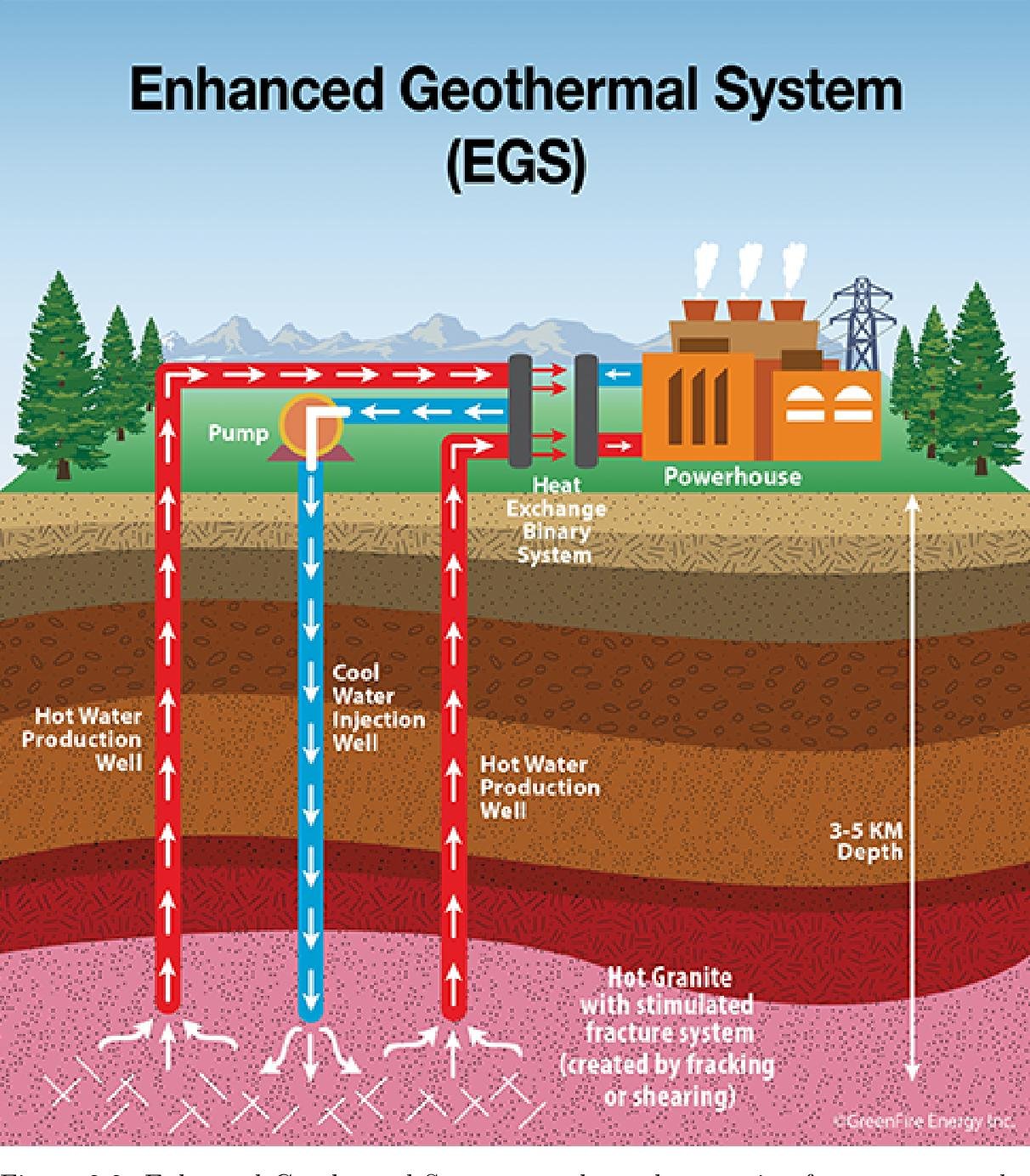
The idea is relatively simple. As you get deeper beneath the surface, the rocks get hotter. This heat can be used to make steam, which turns turbines, and makes electricity (just like most power plants, whether the heat comes from burning coal, gas, or from fusion or wind power). Geothermal plants use production wells, which bring hot water up from depths, and if necessary injection wells, which return cooler water back down to the hot zone. If there is already lots of water in the rocks you can use just production well (like tapping into a hot spring). But mostly plants need a closed loop of water being returned through injection wells.
There are two techniques that can be used here. A dry well brings up steam, and the steam turns the turbine. But the most common type of geothermal uses flash steam – hot water under pressure comes up in the production well, then the pressure is released causing it to flash steam, and the remaining water is returned through an injection well. There is also an experimental technique not yet in used called supercritical, where the water is heated beyond its critical point under pressure so that it behaves not as a fluid or a gas but a hybrid, brining more energy up and producing 4-5 times the electricity per well (it is hoped).
How hot does it need to get? At 70-100 C a binary cycle plant might be effective. These designs use the hot water only to bring up heat, which heats another fluid with a lower boiling point and gas from that fluid turns the turbine. These have two advantages – they can work at lower temperature, and the water never has to turn to steam so can remain entirely in a closed loop. Advanced binary cycle plants can operate at 70-100C, but the ideal temperature is 100-150 C. Typical flash steam systems work at >150 C. Supercritical systems will need temperatures >374 C.
When it comes to location, the critical factor is the geothermal gradient – how quickly does it getter hotter at depth? The average gradient for North America is 25-30 C/km. But this can vary wildly. Young volcanic regions like California can have a gradient of 50-100 C/km, while stable continental shelf like in the East can have 15-25 C gradients. So ultimately the viability of geothermal is all about drilling technology – the deeper you go, the hotter it gets. But also rock gets harder at depth and it is more difficult to remove any debris. The cost of drilling is therefore not linear with depth but geometric. Drilling down to 2 km might cost a few million, but 5 km can cost $20 million, and 15 km > $100 million.
As you get to hotter and hotter rock, the geothermal plant can potentially make more electricity, but the costs skyrocket. Drilling gets harder, but also the increased heat damages equipment, including pipes, drills, and electronics. The “economic sweet spot” today is between 150 – 250 C, but only in regions with relatively high geothermal gradients. And this is where the technology sits – it is economic to build geothermal plants in relatively few locations. Interest in geothermal is all about developing new technology that will allow for deeper and cheaper drilling, shifting this economic sweet spot to cover more and more territory, and potential getting to temperatures that can allow for supercritical plants (>374 C). How is that going?
Well (pun intended), it is always hard to tell how research and development will turn out. Cautionary tales from the not-so-distant past are legion – remember the coming hydrogen economy? In 20 years will we will looking back at the failed geothermal revolution, or will geothermal plants be dotted across American and the world? Deeper cheaper drilling requires several advances, including new alloys that can tolerate higher temperatures. But the one technology that is getting a lot of attention is millimeter wave drilling. This uses a gyrotron to generate powerful millimeter wavelength EMF that can be directed down metal pipes and focused on rocks to essentially vaporize them. Then pumped gas is used to remove the vaporized material.
This technology has several advantages. There are no drill bits to wear out and be replaced. You can continuously drill and remove material. This also makes it much faster and potentially can reduce costs. But this is all more hope than reality so far. Cost reduction will partly depend on mass production, and the technique needs to be proven in a variety of geological conditions. An optimistic timeline is that the company developing this technology, Quaise, will complete a 1 km test well in 2027, then multi-km drilling by 2029. If all goes well we may have a working geothermal plant in the mid 2030s, and then widespread use by the 2040s. Ideally this could mean conventional flash geothermal plants essentially anywhere, even locations with low geothermal gradients, and supercritical plants in locations with higher gradients.
This would be great, and we should definitely be investing in this technology. But we have to be realistic about the fact that it may not work out the way we wish, or may take much longer than we anticipate (that’s usually a good bet). Once again, we are looking at a multi-decade timeline before new development might have a significant impact on our energy infrastructure. The same is true of new nuclear, pumped hydro, and massive grid upgrades. Supporting industries also needs decades to ramp up, such as developing new lithium and copper sources. Meanwhile energy demand is increasing at an accelerating rate.
If our goal is to decarbonize as much as possible as fast as possible (which is absolutely should be), what can we do? We should maximize our short-term options, which means wind, solar, and existing grid storage technologies. We should phase out coal as a top priority, even if it means more natural gas in the short term. We should fast track nuclear and pumped hydro, which can be medium-term options rather than long-term options if we just streamline the red tape. Meanwhile we continue to invest in and develop medium to long term options like advanced nuclear and geothermal and new forms of grid storage and battery technology. Finally we can continue to research long to very long term options, like fusion, but we can’t pin our hopes on technology that far out.
Geothermal may turn out to be the best option in the long run, but it’s too early to say. There is enough geothermal heat at usable depth to power our civilization for millions of years – essentially bottomless. If deep drilling becomes cheap and reliable enough, geothermal might become the dominant source of electricity in the world. Or it may remain on the fringe for the foreseeable future. Time will tell.
