
[ad_1]
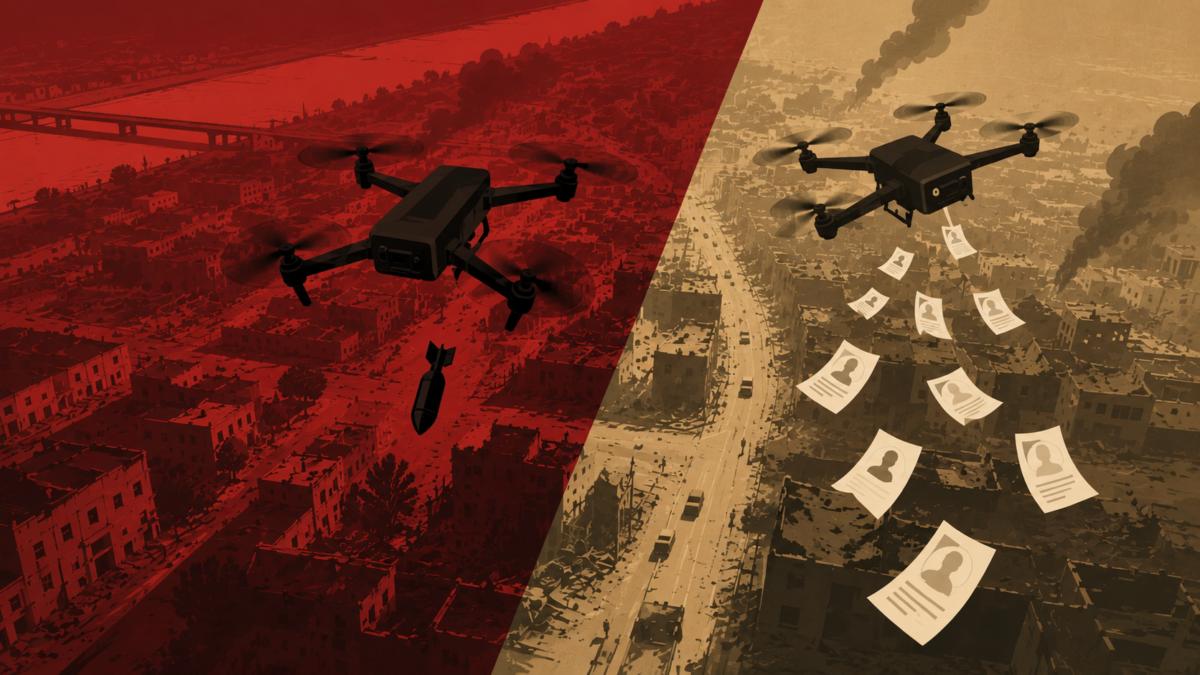
Russian First Person View (FPV) drones have become a defining feature of the war in Ukraine. The same drones used to drop explosives on civilians and military targets are also being used to distribute propaganda leaflets in frontline communities, combining physical violence with psychological warfare.
A video report from Kherson
The combination of violence and persuasion may seem contradictory, but studies of coercive control offer an explanation. The Russian tactics in Kherson and other frontline territories of Ukraine follow three conditions for brainwashing described by psychiatrist Robert Jay Lifton in Thought Reform and the Psychology of Totalism.
First comes physical pressure: artillery, FPV drones, and attacks on infrastructure create constant danger and exhaustion. Next comes information disruption: telecommunications collapse or are restricted while propaganda channels fill the vacuum. And finally comes the conditional rescue message: drone-dropped leaflets or Telegram contacts offering safety or assistance to those willing to accept the occupier’s version of reality.
A combination of manipulated milieu, restricted communication, and sustained psychological pressure undermines existing beliefs, opening the way for altering one’s worldview. In contemporary warfare, drones have become dual-use tools, carrying both threats and persuasion. In the era of AI and drone warfare, unmanned aerial vehicles carry both explosives and propaganda.
Kherson: the laboratory
Kherson offers a clear example of how this system operates in practice. The regional centre in South Ukraine – occupied by the Russian military in March 2022 and liberated nine months later – is a perfect training ground for psychological war experiments. Khersonians survived occupation, documented torture, a fabricated referendum, civilian disappearances, and child kidnappings. Since their retreat, Russian forces positioned on the occupied eastern bank of the Dnipro River have maintained continuous pressure on the city. After the Nova Kakhovka dam was destroyed in June 2023, flood waters carried bodies and debris downstream, and the surrounding fields were seeded with mines.
For over three years, artillery and drone strikes have restricted movement in Kherson. Civilian vehicles are targeted, and the streets are unsafe. Attacks on critical infrastructure leave residents without water, gas, heat, and power. Daily routines collapse. Nightly attacks lead to sleep deprivation and extreme stress. Thus, physical boundaries are violated through the control of space, time, and access to basic needs. The pressure becomes internalised.
Meanwhile, all around Ukraine, the Russian military attempts to damage telecommunications infrastructure in order to limit the Ukrainian information space and flood it with the Kremlin’s narratives through Telegram channels and radio. In Nikopol, Dnipropetrovsk region, Russian drones struck a television tower and cut the broadcasting signal before they began a leaflet campaign. Russian radio transmissions filled the gap.
In Kherson, as a part of this tactic, Russian drones operating from the left (eastern) bank of the Dnipro River have been dropping leaflets over the city:
‘Dear residents of the Kherson region! Whatever lying Western propaganda says, which throughout history has been pitting brotherly nations against each other and sowing wars all over the world, know that Russian soldiers consider you their people. Despite all the efforts of the collective West, we will liberate the right bank, help everyone, rebuild settlements, roads, bridges, demining fields and forests, restore monuments, return the familiar names to the streets, feed everyone, give housing and hope for a joyful and bright future in a free country. Do not despair, our brothers and sisters, we are close. Zelenskyy’s regime does not have long left on Kherson land. Know that even now, you are not alone. There is an underground movement in our city that opposes the Ukronazis [“Ukrainian Nazis”] and representatives of Zelenskyy’s greedy, bloody government, helping us. You can contact these guys; they will give you hope, help you survive these times, and wait for our return.’
The leaflet recycles the usual Kremlin narratives, framing the war as imposed on ‘Slavic brotherhood’ by Western powers and discrediting the Ukrainian government. Targeting people in distress, it offers food, housing, and a return to normalcy in exchange for cooperation. A QR code directs readers to a Telegram channel linked to a Russian intelligence network operating in the city. The leaflets are supposed to offer a way out, promising relief. The catch is the helping hand belongs to the system responsible for the attacks and suffering.
The leaflet circulating in Kherson follows a Soviet psychological warfare manual. It concentrates on a single idea, supports it with several arguments, and leads the reader toward one conclusion: Russia is returning, the return will be beneficial, and contact through the channel will bring hope and survival. Since these manuals were used in all Soviet republics, including Ukraine, the principles are known and used by the Ukrainian military. In May 2023, Ukrainian psychological operations specialists identified Russian leaflets being dropped over occupied territories as direct copies of Ukrainian psy-op materials. Ukrainian officials warned residents not to read them, photograph them, or share images of them online. The concern was amplification: a photograph posted on social media spreads the message far beyond the physical reach of the drone.
A new era of psychological operations has arrived: the same unmanned vehicle conducts both the strike and the message delivery. Kinetic and psychological operations converge in a single system, directed at the same population and timed to reinforce each other. Both the strikes and the messaging pursue the same objective: to break civilian resistance, reshape perception, and convert a population under pressure into one that accepts the authority of the attacking power.
An air-to-ground propaganda dissemination history
Psychological messaging delivered from the air predates drones. In medieval siege warfare, armies used ‘dual-purpose’ trebuchets to break fortifications and to send messages. During the 1346 siege of the Genoese port of Caffa (Feodosia) in Crimea, Ukraine, the Mongol army of the Golden Horde catapulted plague-infected bodies, animal carcasses, or severed heads over city walls after an outbreak of the Black Death pandemic devastated their own ranks. This is one of the earliest recorded cases of biological and psychological warfare combined, in which the projectile carried both physical harm and a message aimed to spread fear and demoralise the adversary’s army and the population.
Since then, all imaginable ways of leaflet aerial dissemination have been used, from balloons to leaflet bombs. By 1870, the French army dropped government proclamations over Prussian forces from balloons during the Siege of Paris. During the Balkan Wars of 1912–1913, balloons and early aircraft were used just as FPV drones are being used now: for observation, bombing, and leaflet distribution. In 1918, D’Annunzio, an Italian poet and future fascist, dropped over 400,000 leaflets over Vienna. The mission targeted the enemy capital rather than the frontlines, marking a milestone in psychological warfare.
Soviet psychological warfare manuals described the use of leaflets that served both as propaganda and as permits, allowing enemy soldiers to surrender without being fired upon. The first attempt to surrender to a drone was recorded in 1991, when forty Iraqi soldiers attempted to surrender to a US Navy reconnaissance drone near Kuwait City. At the time, the drone had no mechanism to accept surrender. Since the Russian full-scale invasion began, Ukraine has run a surrender programme which combines a hotline with drone operations and has also used drones equipped with speakers and microphones to broadcast surrender instructions and communicate with soldiers who respond.
The principle remains the same but the delivery is changing. The next stage of brainwashing, combined with technology, is already emerging. In March 2026, a woman from Kherson was brainwashed and recruited by the Russian military via social media. Later, an FPV drone delivered a mobile phone she had used for surveillance. AI-generated messages target chats and individual accounts on WhatsApp, Telegram, and other social media. AI-controlled drones are now programmed to wait and strike specific targets. Psychological manipulation and physical attacks are merging into a single system designed to convert civilians into instruments of war and to control both the mind and the battlefield. The result resembles a real-world version of The Matrix: a physical, psychological, and digital war in which the enemy seeks not only to destroy bodies but to capture minds and turn them into a part of the machine.
[ad_2]
Source link
