
[ad_1]
As the United States approaches its 250th birthday, it is confronting a reality that Alexander Hamilton would have recognized immediately: the so-called “rules-based international order” was never a neutral system. It was a political construction, shaped by power, sustained by incentives, and increasingly misaligned with the interests of the country that built it.
For three generations, Western policymakers advanced the idea that a dense web of institutions—the IMF, World Bank, UN, GATT/WTO, and NATO—had transcended traditional power politics. These bodies were presented as impartial mechanisms for advancing a shared global interest. In practice, they codified a specific hierarchy of interests and cloaked it in the language of law and legitimacy. Sovereignty, industrial policy, and national advantage were treated not as enduring features of statecraft, but as deviations from an emerging global norm.
The tension was present from the beginning. At Bretton Woods, John Maynard Keynes warned that any system claiming universality while reflecting the priorities of a U.S.-led Atlantic bloc would struggle to maintain coherence as new powers emerged. That warning proved prescient. As postcolonial nations entered the system—and later as China rose and Russia reasserted itself—the idea that a single, neutral “global will” could be aggregated from fundamentally divergent national interests became increasingly untenable.
Mercantilist strategies were never eliminated; they were rebranded, tolerated, and at times quietly encouraged. Export-led growth, managed exchange rates, and persistent surplus accumulation became defining features of the global economy, even as the rhetoric of free trade and balanced adjustment persisted. The system did not abolish zero-sum dynamics; it obscured them, relying on a single economy to absorb global excess.
After the Second World War, the United States consciously assumed that role. It opened its markets, absorbed surplus production, and provided the demand that allowed war-torn and developing economies to grow. This was not an act of charity. It was a strategic decision to stabilize allies, contain adversaries, and anchor a liberal economic order around the dollar.
The IMF was created in that same context to prevent the imbalances and competitive devaluations that had destabilized the interwar period. Its mandate was clear: promote monetary stability and enforce adjustment on both deficit and surplus countries. In practice, adjustment proved asymmetric. Deficit countries, chiefly the United States, bore the burden, while surplus nations were rarely compelled to rebalance. Over time, this asymmetry hardened into a structural feature of the system.
Basic economics makes the contradiction unavoidable. In a closed global system, surpluses and deficits must net to zero. Persistent surplus strategies require a corresponding deficit somewhere else. For decades, the United States filled that role, running external deficits, exporting demand, and underwriting global security. What was presented as a stable equilibrium was, in reality, a politically contingent arrangement sustained by American tolerance.
That tolerance is now eroding. A 250-year-old republic facing fiscal strain, industrial hollowing, and rising social fragmentation is no longer willing—or able—to act simultaneously as consumer of last resort, provider of global liquidity, and guarantor of security across multiple regions.
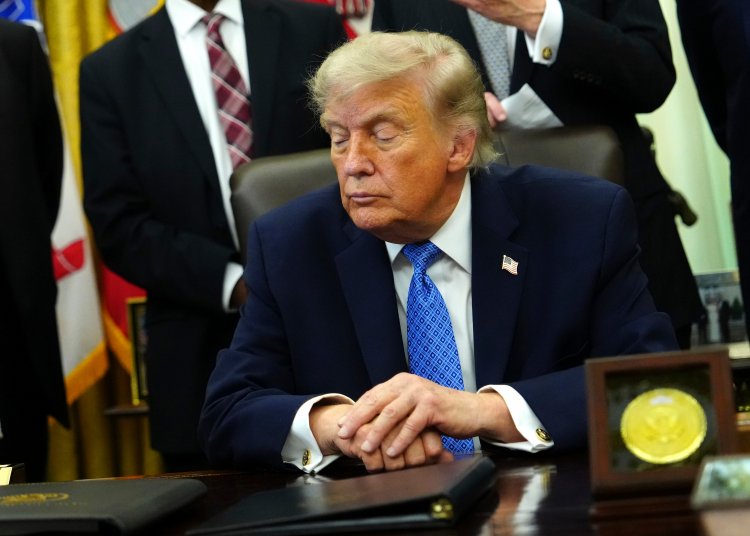
This is the context in which Donald Trump’s critique lands. Stripped of rhetoric, its core insight is straightforward: there is no “view from nowhere” in international economics. There is no disembodied global interest that overrides national priorities. Rules are not sacred; they are instruments. If they cease to serve national security, prosperity, and cohesion, they will—and should—be rewritten.
This is less a break with American tradition than a return to it. Hamilton, Henry Clay, and Andrew Jackson all understood that economic policy must serve national development. Institutions and standards were tools to build productive capacity, not ends in themselves. The postwar era, by contrast, gradually elevated process over outcome—treating adherence to global frameworks as a virtue even when the domestic consequences became increasingly difficult to justify.
The emerging shift is not toward isolationism, but toward explicitness. Every order has a sovereign. Every rulebook produces winners and losers. The pretense that globalization could be governed by neutral technocracy is giving way to a more candid recognition of power, interest, and trade-offs.
As Treasury Secretary Scott Bessent has put it, “standards are strategy.” If the United States does not write the rules, it will live under those written by others. The question is no longer whether the old order can be restored—it cannot—but what replaces it.
On its 250th anniversary, the United States faces a distinctly Hamiltonian task: to design an economic and institutional framework that aligns with its own productive capacity, security needs, and social stability. That means acknowledging that openness without reciprocity is unsustainable, that persistent imbalances are political choices rather than natural outcomes, and that legitimacy ultimately rests not in abstract global approval, but in the consent of the governed.
The rules-based order is not collapsing because rules no longer matter. It is being renegotiated because they always did.
[ad_2]
Source link
