
[ad_1]
Joshua Scheer
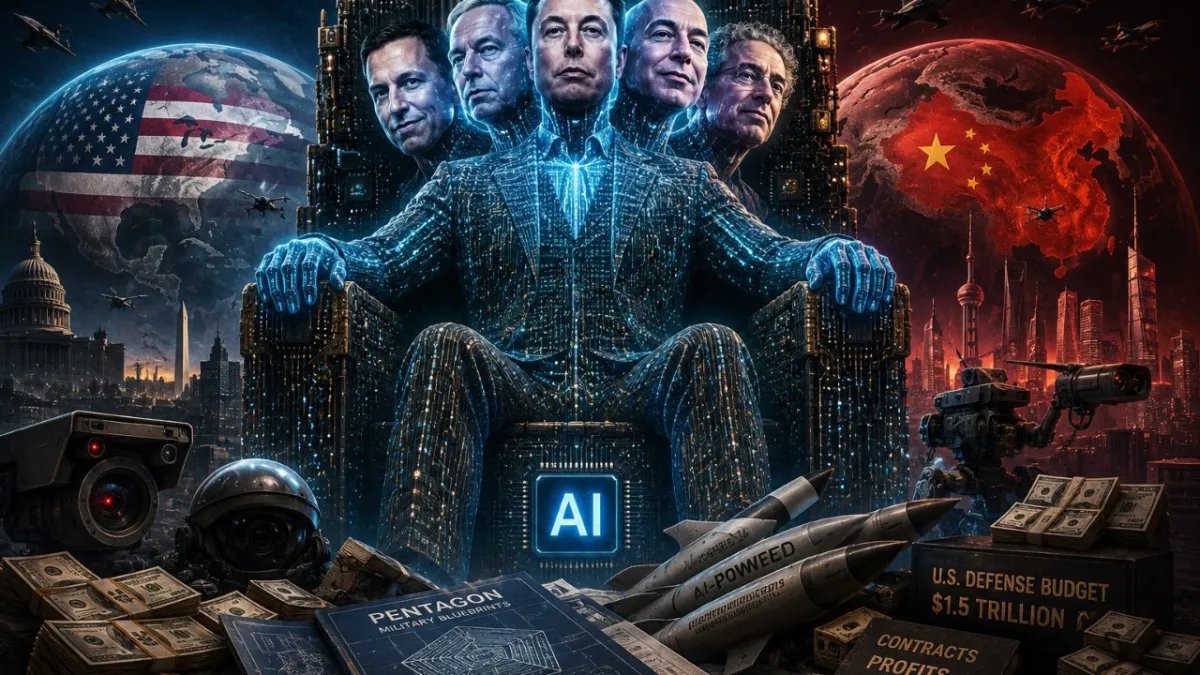
Is the race for artificial intelligence really about national security—or about preserving corporate power? In this wide-ranging analysis, journalist Ben Norton argues that America’s biggest technology companies are working hand in glove with Washington to frame China as an existential threat while securing billions in government contracts, subsidies and military partnerships. From paid social media influencers and Pentagon AI programs to surveillance technology and the growing influence of Silicon Valley billionaires over U.S. policy, Norton contends that the new Cold War is being driven as much by the pursuit of monopoly and geopolitical dominance as by concerns over innovation. Whether readers agree with his conclusions or not, the discussion raises urgent questions about who controls the future of AI—and who ultimately benefits from the fear surrounding it.
Artificial intelligence is increasingly being presented as the defining geopolitical contest of the 21st century. But according to journalist Ben Norton, the race is about far more than technological innovation. In his latest analysis, Norton argues that America’s largest technology companies and the U.S. government have become deeply intertwined in an effort to preserve Silicon Valley’s dominance while portraying China as an existential threat.
The discussion begins with reports that AI companies and affiliated organizations have funded campaigns encouraging social media influencers to promote pro-American AI messaging and anti-China narratives. Norton contends that these efforts are designed to build public support for policies that benefit major technology firms, framing competition with China as a matter of national security rather than corporate interest.
From there, Norton examines the increasingly close relationship between Silicon Valley and the Pentagon. He argues that artificial intelligence is no longer simply a commercial technology but has become central to military planning, surveillance and future warfare. As defense agencies invest billions into AI development and autonomous systems, he warns that the line separating private technology companies from the national security state continues to blur.
A central theme of the analysis is that the battle over AI is fundamentally a struggle over economic power. Norton points to statements from prominent technology executives who have argued for maintaining U.S. leadership in artificial intelligence, suggesting that protecting monopoly positions—not simply encouraging innovation—has become a driving force behind government policy. He contrasts America’s largely proprietary AI industry with China’s expanding open-source AI ecosystem, arguing that competing visions of technological development are emerging on the global stage.
The report also explores the implications of rapidly expanding surveillance technologies. Norton raises concerns that artificial intelligence is enabling unprecedented levels of data collection, predictive policing and government monitoring while strengthening the influence of a handful of powerful corporations over public life. He argues that these developments represent a broader shift toward centralized technological control that extends well beyond the AI marketplace itself.
Ultimately, Norton concludes that the debate over artificial intelligence cannot be separated from larger questions about democracy, military power and global economic competition. Whether one accepts his conclusions or not, the discussion highlights the growing role of AI in shaping international politics, public discourse and the balance of power between governments, corporations and citizens. As the United States and China continue to compete for technological leadership, the choices made today may determine not only who leads the AI revolution, but how that technology will be governed for decades to come.
Norton’s analysis builds on themes explored earlier this year on the Scheer Intelligence podcast with investigative journalist Peter Byrne. Byrne argued that artificial intelligence has become deeply embedded in what he described as a self-perpetuating “war machine,” in which Silicon Valley, the Pentagon, Wall Street and corporate media increasingly operate as parts of the same system. Norton’s examination of Big Tech’s influence campaigns, military partnerships and anti-China messaging extends that conversation, suggesting that the race for AI is no longer simply about technological innovation, but about preserving geopolitical dominance, expanding surveillance capabilities and securing the economic interests of an increasingly powerful alliance between government and the technology industry.
Norton’s analysis also echoes concerns raised earlier this year by investigative journalist Peter Byrne, whose reporting traced the deepening alliance between Silicon Valley, the Pentagon and the corporate media. Byrne sharply criticized The New York Times editorial board’s six-part “Overmatched” series, arguing that it framed a massive $1.5 trillion Pentagon buildup and the militarization of artificial intelligence as unavoidable responses to the rise of China.
“It was one of the scariest things I’ve read,” Byrne said. “They were channeling Karp, Schmidt, Musk, Andreessen—just parroting Silicon Valley’s war propaganda.”
Byrne argued that the narrative of an aggressive, expansionist China is contradicted by Pentagon and RAND assessments, which describe China’s military as largely defensive, technologically behind in key areas and focused primarily on deterring foreign intervention rather than projecting global force. He notes that China has not fought a major war since 1979, while the United States has remained engaged in continuous military conflicts for decades. Although Byrne acknowledges that China’s Belt and Road Initiative advances Beijing’s economic interests, he distinguishes it from military expansion, arguing that the United States—not China—has relied on repeated overseas interventions and the threat of force to maintain global influence.
For Byrne, and increasingly for Norton, portraying China as an existential military threat serves a broader political purpose: it justifies enormous defense spending, strengthens the ties between Silicon Valley and the Pentagon, and creates public support for an AI arms race that ultimately benefits some of the world’s largest technology companies and defense contractors.
Editor’s Note: At a moment when the once vaunted model of responsible journalism is overwhelmingly the play thing of self-serving billionaires and their corporate scribes, alternatives of integrity are desperately needed, and ScheerPost is one of them. Please support our independent journalism by contributing to our online donation platform, Network for Good, or send a check to our new PO Box. We can’t thank you enough, and promise to keep bringing you this kind of vital news.
You can also make a donation to our PayPal or subscribe to our Patreon.
Please share this story and help us grow our network!
[ad_2]
Source link
