
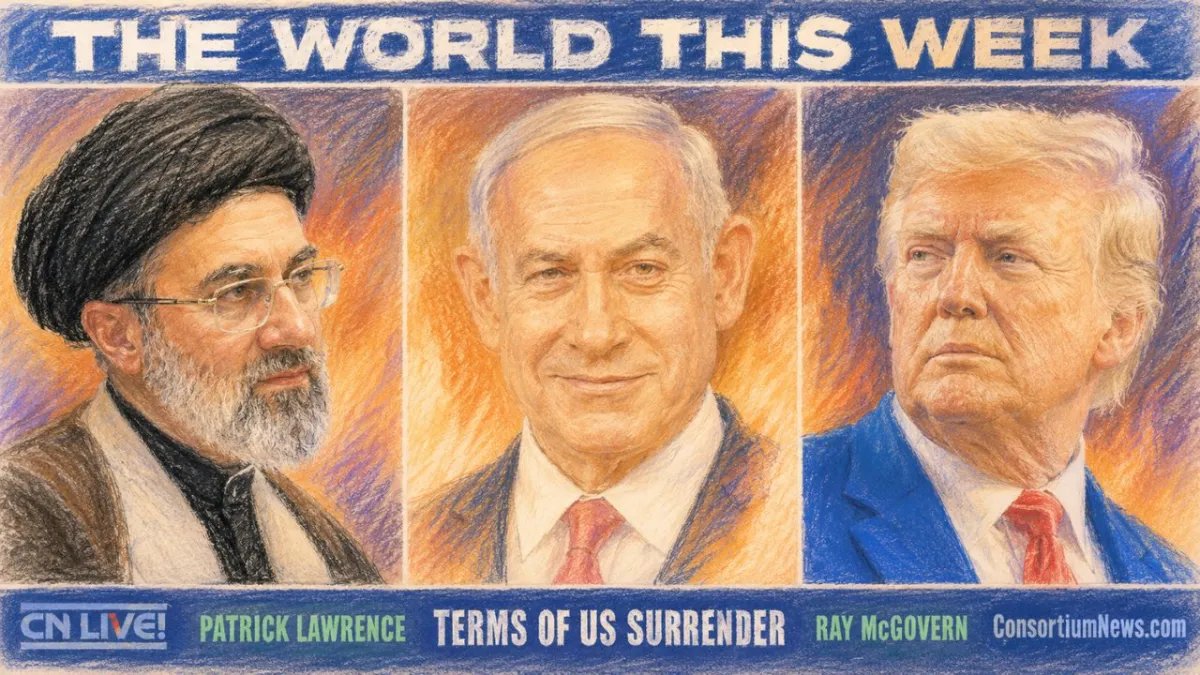
In the latest edition of The World This Week, host Joe Lauria is joined by former CIA analyst Ray McGovern and journalist Patrick Lawrence for a wide-ranging discussion on what they describe as a dramatic shift in the balance of power in the Middle East. Their central argument is stark: after months of conflict, economic turmoil, and mounting international pressure, Washington was forced to accept terms largely dictated by Tehran in order to avoid a wider regional war and a potential global economic crisis.
The conversation explores the fragile U.S.-Iran memorandum of understanding, the growing public rift between Washington and Tel Aviv, and the increasingly sharp criticism of Israeli Prime Minister Benjamin Netanyahu coming from figures who until recently would have been considered staunch allies. McGovern and Lawrence examine whether these unprecedented tensions represent a temporary dispute or the beginning of a historic realignment in U.S.-Israeli relations.
At the heart of the discussion is Lebanon, which both guests argue remains the key obstacle to any lasting settlement. They assess the political calculations facing Donald Trump, the pressures on Netanyahu at home, the role of public opinion in reshaping U.S. policy, and the possibility that the current cease-fire could unravel at any moment.
The program also turns to the war in Ukraine, growing tensions between NATO and Russia, and what both guests see as a dangerous escalation in Europe’s military posture.
McGovern and Lawrence offer a provocative analysis of a moment that could reshape the Middle East, U.S. foreign policy, and the global balance of power for years to come.
Ray McGovern and Patrick Lawrence on a Growing U.S.-Israel Rift
In the latest edition of The World This Week, host Joe Lauria was joined by former CIA analyst Ray McGovern and journalist Patrick Lawrence to examine what they described as a remarkable and potentially historic moment in U.S.-Israeli relations. Their discussion centered on the emerging U.S.-Iran memorandum of understanding, Israel’s continued military operations in Lebanon, and whether Washington is finally reaching the limits of its support for Benjamin Netanyahu.
The program opened with Lauria arguing that the United States effectively accepted terms largely shaped by Tehran after a costly war that failed to achieve its major objectives. According to Lauria, President Donald Trump ultimately moved toward an agreement not out of principle but because of growing economic and political pressures, including fears of a global economic crisis tied to instability around the Strait of Hormuz.
One of the most striking themes of the discussion was the unusually sharp criticism of Israel now emerging from senior U.S. officials. Lauria highlighted public comments from Trump, Vice President J.D. Vance, and even Hillary Clinton criticizing Netanyahu’s conduct and questioning Israel’s strategy. For all three panelists, such rhetoric would have been almost unimaginable in Washington only a few years ago.
Yet both McGovern and Lawrence cautioned against assuming that harsh words necessarily signal a lasting policy shift. Lawrence noted that while Trump’s attacks on Netanyahu are extraordinary, it remains unclear whether they represent a genuine strategic break or simply frustration over Israel’s actions at a moment when Washington desperately wants stability. He argued that the true test will come if Israel continues military operations in Lebanon and Iran responds. Only then will it become clear whether the United States is willing to place limits on its support for Israel.
Lebanon emerged as the central issue throughout the conversation. McGovern argued that Iran views Israeli withdrawal from Lebanon as a non-negotiable condition for any lasting agreement. While many regional actors may be willing to overlook Lebanon’s situation, he suggested that Tehran sees it as a fundamental matter of regional security and legitimacy. According to McGovern, that reality gives Iran significant leverage in the negotiations.
The guests repeatedly returned to the question of leverage. McGovern argued that Iran’s ability to disrupt maritime trade routes gives it powerful negotiating tools, while Lawrence suggested that Washington’s need for economic stability may be stronger than its willingness to continue military confrontation. Both viewed the current moment as one in which traditional assumptions about power in the region are being tested.
Another major theme was the changing mood of the American public. Lawrence argued that public opinion on Israel has shifted dramatically over the last several years, particularly among younger Americans. He suggested that growing public discomfort with the war in Gaza and broader regional conflicts may be contributing to the willingness of politicians to criticize Israeli policies more openly than in the past. McGovern agreed that attitudes are changing, though he questioned how much influence public opinion ultimately has on U.S. foreign policy.
The discussion also explored the broader implications of a potential rupture between Washington and Tel Aviv. Lawrence noted that tensions between the United States and Israel are not unprecedented and pointed to earlier periods when American officials openly challenged Israeli actions. Whether the current moment becomes another temporary disagreement or the beginning of a deeper realignment remains uncertain.
Turning briefly to Ukraine and Europe, both guests warned about growing military tensions between NATO countries and Russia. They argued that political leaders across Europe are increasingly preparing their populations for long-term confrontation with Moscow, even as economic pressures mount at home. McGovern maintained that Russia’s leadership remains focused on avoiding a direct NATO conflict, while Lawrence warned that continued escalation carries significant risks.
By the end of the conversation, the central question remained unresolved: Is Washington merely venting frustration at Netanyahu, or are the first cracks appearing in one of the most durable alliances in modern geopolitics?
For McGovern and Lawrence, the answer may come sooner rather than later. If Israel continues military operations in Lebanon and Iran responds, the United States could soon face a decision it has long avoided—whether to continue backing Israel unconditionally or begin redefining the relationship altogether.
Editor’s Note: At a moment when the once vaunted model of responsible journalism is overwhelmingly the play thing of self-serving billionaires and their corporate scribes, alternatives of integrity are desperately needed, and ScheerPost is one of them. Please support our independent journalism by contributing to our online donation platform, Network for Good, or send a check to our new PO Box. We can’t thank you enough, and promise to keep bringing you this kind of vital news.
You can also make a donation to our PayPal or subscribe to our Patreon.
Please share this story and help us grow our network!
