

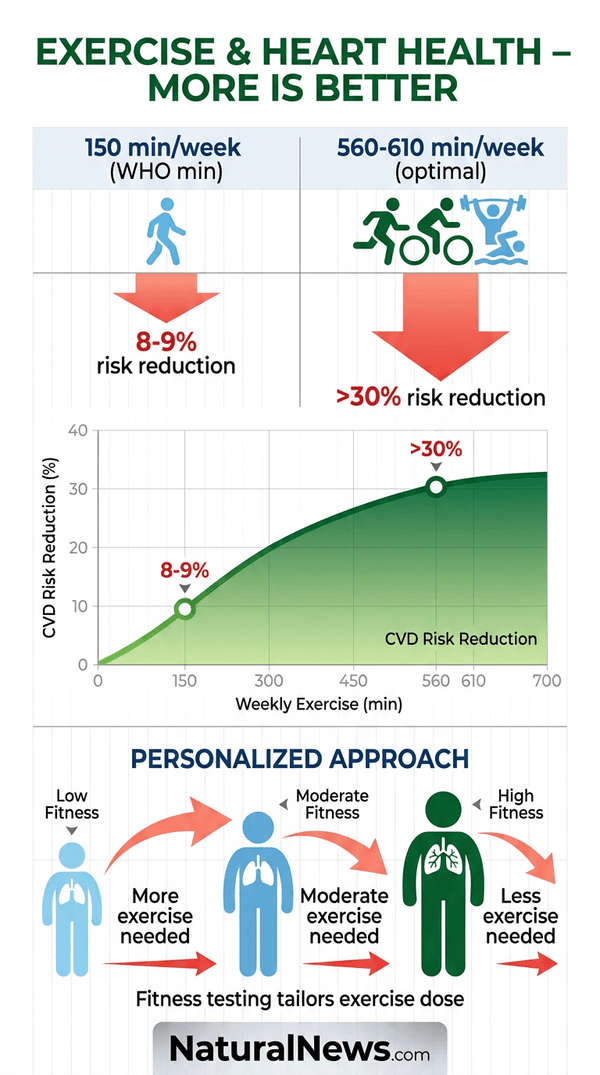
A study published in the British Journal of Sports Medicine found that adults who exercised 560 to 610 minutes per week had a more than 30% lower risk of cardiovascular disease compared with inactive individuals, according to web sources [1][2]. Current World Health Organization (WHO) guidelines recommending 150 minutes of moderate exercise per week were associated with an 8 to 9% reduction in cardiovascular risk, the study reported [1][2].
Researchers said the findings suggest that the 150-minute target may serve as a minimum threshold rather than the level for optimal protection. The study’s lead author, Ziheng Ning, a professor at Macao Polytechnic University, emphasized that the current guideline remains important but may not represent the dose needed for maximal benefit [3].

Study Methods and Key Findings
The researchers analyzed health and activity data from more than 17,000 adults participating in the UK Biobank study, with an average age of 57 years, 56% female, and 96% white [4][3]. Participants wore wrist-based activity trackers for seven days and underwent exercise testing to estimate cardiorespiratory fitness through VO2 max measurements [4].
During nearly eight years of follow-up, more than 1,200 cardiovascular events were recorded, including atrial fibrillation, heart attack, heart failure, and stroke [4]. Only 12% of participants achieved the 560–610 minute weekly exercise level, the study reported [4].
Fitness Level and Personalized Exercise Needs
The study also indicated that individuals with lower cardiorespiratory fitness may require more weekly exercise to achieve the same level of cardiovascular protection as fitter individuals, suggesting a need for personalized recommendations [3]. Researchers noted that cardiorespiratory fitness itself is an independent biomarker for heart health, and that exercise benefits may vary based on baseline fitness [3].
“I believe that personalized exercise recommendations based on fitness levels may gradually become an important future direction,” Ning stated, according to web reports [3]. He added that even modest increases in activity are meaningful, especially for sedentary adults [3].
Implications and Limitations for Future Guidelines
Based on the findings, the researchers suggested that future exercise guidelines could distinguish between the minimum amount needed for basic health benefits and the higher levels required for optimal cardiovascular protection [3]. The study was funded by the National Natural Science Foundation of China, and the authors declared no competing interests [4].
Limitations of the study include its observational design, which cannot prove causation, a predominantly white participant group, and a lack of full accounting for sedentary behavior [4]. Despite these constraints, the study aligns with a growing body of evidence that regular physical activity is a key modifiable risk factor for heart disease [5][6]. As noted in the book “The Longevity Leap,” modifiable risk factors like exercise have a significant global effect on cardiovascular disease and mortality [6].
Conclusion
The study indicates that cardiovascular protection exists along a continuum, with more exercise generally linked to greater benefit. Current 150-minute guidelines should not be dismissed as insufficient but rather seen as a baseline, according to Ning [3]. He advised gradual progression, incorporating brisk walking, cycling, and daily movement as sustainable starting points for increasing activity [3].
The findings reinforce the importance of exercise as a modifiable risk factor for heart disease. As one article noted, exercise is one of the best preventive strategies against common chronic ailments such as heart disease and diabetes [5]. A sedentary lifestyle has been compared to an “exercise deficiency” that accelerates degenerative diseases [7].
References
- BMJ Group. “560-610 minutes of exercise a week needed for substantial heart benefits.” bmjgroup.com. May 20, 2026.
- MSN. “New heart health study shocks experts: Are 150 minutes of exercise a week no longer enough?” msn.com.
- Healthline. “How Much Exercise Do You Need to Lower Your Risk of Cardiovascular Disease?” healthline.com.
- News-Medical.net. “560-610 minutes of exercise a week linked to substantial cardiovascular health benefits.” news-medical.net.
- Mercola.com. “Exercise Is Key to Longer Life.” November 4, 2022.
- Siim Land. “The Longevity Leap: A Guide to Slowing Down Biological Aging and Adding Healthy Years to Your Life.”
- Eleanor Noss Whitney. “Understanding nutrition.”
Explainer Infographic
[ad_2]
Source link
