
[ad_1]
Reprinted from The Realist Review.
There are certain episodes in Cold War history that modern conservatives are expected to treat as either sinister fantasy or liberal delusion. The McCloy–Zorin Accords of 1961 occupy a curious place. Explain the concept today and half of the audience assumes you are describing a proto-globalist fever dream hatched in Manhattan conference rooms full of Scandinavian furniture and earnest men in rimless spectacles.
Yet for a brief moment — and this is the part that ought to unsettle both the utopians and the cynics — the United States and the Soviet Union formally agreed that the ultimate goal of international politics should be the abolition of war itself.
Not metaphorically. Literally.
The “Joint Statement of Agreed Principles for Disarmament Negotiations,” better known as the McCloy–Zorin Accords, was negotiated between American statesman John J. McCloy and Soviet diplomat Valerian Zorin in September 1961 and endorsed unanimously by the United Nations General Assembly in December 1961. It envisioned phased and verified general disarmament under international control, including the eventual elimination of national military establishments and the creation of a United Nations peace force.
This was not drafted by Woodstock pacifists smoking hashish in Vermont. McCloy was the very model of the American establishment insider: Wall Street lawyer, banker, Assistant Secretary of War, and one of the founding grandees of the postwar Atlantic order. Zorin, meanwhile, was a hard Soviet apparatchik who had spent decades navigating the darker corridors of Kremlin diplomacy.
And yet there they were, at the height of the Berlin Crisis and only a year before the Cuban Missile Crisis, jointly sketching a roadmap toward “general and complete disarmament.”
The irony is that the men closest to this project were not starry-eyed internationalists in the modern sense. They were realists in the older and more serious tradition. They had lived through industrial slaughter on a civilizational scale. Twenty-seven million Russians had died in World War Two. They understood that thermonuclear war was not a talking point but an extinction event. The generation that built the United Nations had watched Europe commit suicide twice in thirty years and concluded, however imperfectly, that sovereign states armed to the teeth and gripped by ideological hysteria might not indefinitely coexist.
Dag Hammarskjöld, the Swedish Secretary-General of the UN, became the moral and administrative face of this ambition. Today he is remembered, if at all, as the Nordic bureaucrat whose name adorns the plaza outside the UN building by the East River in New York and the library inside that skyscraper. In his own time he was treated almost as a secular pope. The press followed him obsessively. In the newsreels, he emerged from turboprop airliners with a mysterious Swedish smile. A new conflict, a new day for Dag. For a few years from the mid-fifties to very early sixties, the UN became a repository for a tired planet’s hopes. Diplomats regarded him with awe, irritation, or both. He believed the UN could become not merely a debating chamber but an actual mechanism for preventing great-power war.
This is the part modern conservatives are supposed to laugh at.
And yet before laughing too hard, it is worth observing that Hammarskjöld’s world, unlike ours, still possessed statesmen capable of fearing war more than they feared bad headlines.
The McCloy–Zorin framework emerged at the same time as the Berlin confrontation of 1961. Nikita Khrushchev wanted NATO forces out of West Berlin. Washington refused. Khrushchev declared they would be forced out, and brandished nuclear threats. In public, Kennedy responded by talking tough: Berlin would be defended militarily. The city was framed as a great testing place of Western courage. “Any dangerous spot is tenable if men—brave men—will make it so. We do not want to fight—but we have fought before,” he told American prime-time TV audiences from a sweltering Oval Office on 25 July 1961.
Behind the scenes, however, Kennedy was far more open to compromise, leading top secret discussions with his cabinet about transforming Berlin into a kind of internationally supervised city under UN protection — blue helmets replacing the tripwire forces of the Cold War blocs, perhaps even moving UN headquarters from New York to that city. According to a memo from 5 September 1961 in the diplomatic archives of the State Department (FRUS): “The President asked the State Department to consider the following elements of an eventual negotiation on Berlin… a move of some UN functions, or the whole Headquarters of the UN, to West Berlin, with appropriate guarantees to make West Berlin really a Free City.”
When one of his officials, Adlai Stevenson, objected to moving the United Nations out of New York City, Kennedy snapped, “I don’t think enough of the UN not to be able to trade it for a nuclear war.”
The concept sounds fantastical now because contemporary diplomacy imagines nothing except its own next communiqué.
The broader principle was simple enough: if neutral international supervision could defuse Berlin, perhaps similar arrangements could reduce tensions elsewhere. If the blue helmets could make Soviet-American conflict moot in its most neuralgic area of tension, Berlin and central Europe, maybe it could work in many other places, and the superpowers could eventually stand down their forces. From there would emerge the wider concept of phased disarmament backed by international verification and collective security mechanisms. Eventually, only the UN would have an army. No nation state would have an army, only police forces. The extraordinary UN document, A/4879, agreed by the USSR and USA on 20 September 1961, signed by Messrs McCloy and Zorin, lays out the long term goal in black and white:
“The program for general and complete disarmament shall ensure that States will have at their disposal only those non-nuclear armaments, forces, facilities, and establishments as are agreed to be necessary to maintain internal order and protect the personal security of citizens; and that States shall support and provide agreed manpower for a United Nations peace force.”
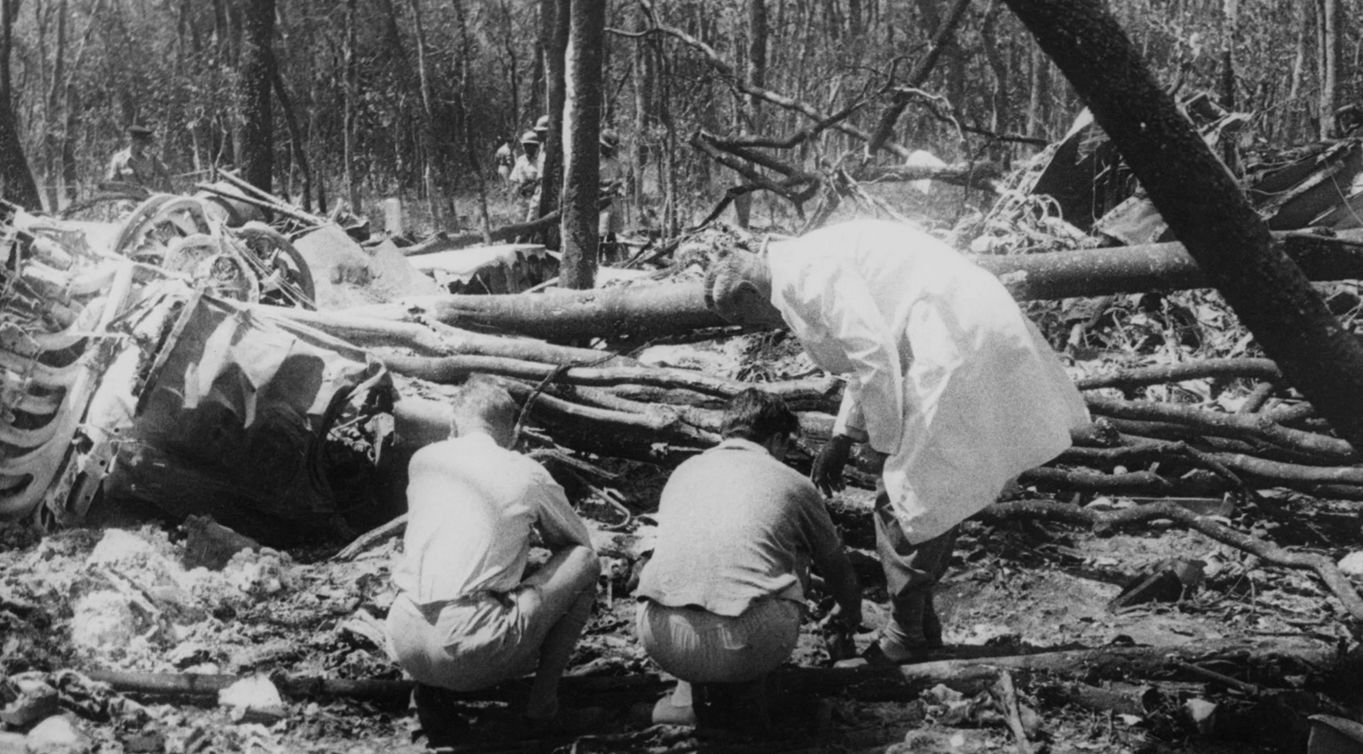
Of course, almost none of this happened. Hammarskjöld died in a plane crash in the small hours of 18 September 1961 while attempting to negotiate peace in the Congo, two days before McCloy and Zorin set their names to the text — so that the man most identified with the dream of a UN that could hold the peace never read the document that assumed one.
His death remains controversial, with continuing allegations of foul play and longstanding suspicions involving mercenaries, mining interests, Western intelligence, and colonial networks. Various UN inquiries have examined unresolved evidence and incomplete archival disclosures, particularly from British and American sources.
Then, two years later, Kennedy was murdered in Dallas. A notorious handbill circulating in the city, published by right wing groups, accused Kennedy of selling out the sovereignty of the United States to the “communist-controlled United Nations.”
Yet the grand design did not vanish entirely. Even as “general and complete disarmament” passed beyond reach, fragments of it survived. Kennedy had been genuinely taken with Hammarskjöld and his vision of a world at peace, and he was not about to let so convenient a martyrdom go unused. On 25 September 1961 — a week after the crash, and five days after McCloy had signed the Joint Statement — the President rose before the General Assembly and bound the dead Secretary-General to his own disarmament programme: “So let us here resolve that Dag Hammarskjold did not live, or die, in vain…as we build an international capacity to keep peace, let us join in dismantling the national capacity to wage war.”
He continued to pursue arms control after Hammarskjöld’s death, and something of the original ambition survived in the doing. The 1963 Partial Nuclear Test Ban Treaty grew out of the same atmosphere of post-Cuban terror and reluctant cooperation; the Non-Proliferation Treaty and the long architecture of strategic arms control followed. But the dream had been quietly redefined. The goal was no longer to abolish war, only to manage the apocalypse — to make the destruction survivable, or at least postponable.
That, in the end, is what became of McCloy–Zorin. It did not fail so much as shrink. The universal ambition collapsed into technocratic containment, as such ambitions usually do. We did not transcend power politics; instead we installed hotlines and verification protocols so that Washington and Moscow could threaten one another more responsibly. Perhaps that was the only realistic outcome.
And it is surely right to be wary of the alternative. The twentieth century offered evidence enough that universal ideologies, administered by self-anointed experts, tend to end in coercion, bureaucracy, and eventually blood. No sane person wants a superstate policing the planet from a tower on the East River.
But realism cuts both ways, and this is the part the cynics miss. The accords were not the fever-dream of pacifists. They were the last serious attempt by rival empires to imagine a totally new security order beyond permanent confrontation — and even at their most utopian they rested on a hard premise: that modern war had simply become too destructive to remain an ordinary instrument of policy. The men who drafted them feared annihilation more than they feared looking naive.
Set that against what followed. The post-Cold War triumphalists promised that liberal hegemony, NATO expansion, financial globalization, and humanitarian intervention would deliver permanent peace. What they delivered was forever wars, color revolutions, mass migration, collapsing social trust — and, once again, a nuclear confrontation in Eastern Europe. Today Western elites discuss war between nuclear powers in the bored tones of men who have never seen one, while proving unable to close a border to asylum seekers, or balance a budget. One suspects McCloy and Zorin, those hard old operators from Washington and Moscow, would have found our governing class not reckless so much as unserious — which, in the nuclear age, is the more frightening condition.
For the great irony is that the “New World Order” so feared by conspiracy-minded conservatives never arrived at all. No world government was ever built. What came instead was something far smaller and far shabbier: not a superstate but a drifting western order — managerial, directionless, conducted under ever-thinner moral slogans, with the occasional proxy war or managed student revolution to lend it the appearance of purpose.
And so the thing worth mourning is not the universal peace that was never going to come. It is the seriousness that died with the men who briefly believed in it: the capacity, now almost wholly lost, to look at a century of industrial slaughter and conclude that history itself had become too lethal to be left to run its course.
Pelle Neroth Taylor is a British-Swedish journalist and historian based in Sweden. He is writing a book on the death of Dag Hammarskjöld at Ndola in 1961.
[ad_2]
Source link
