
[ad_1]
ScheerPost Staff
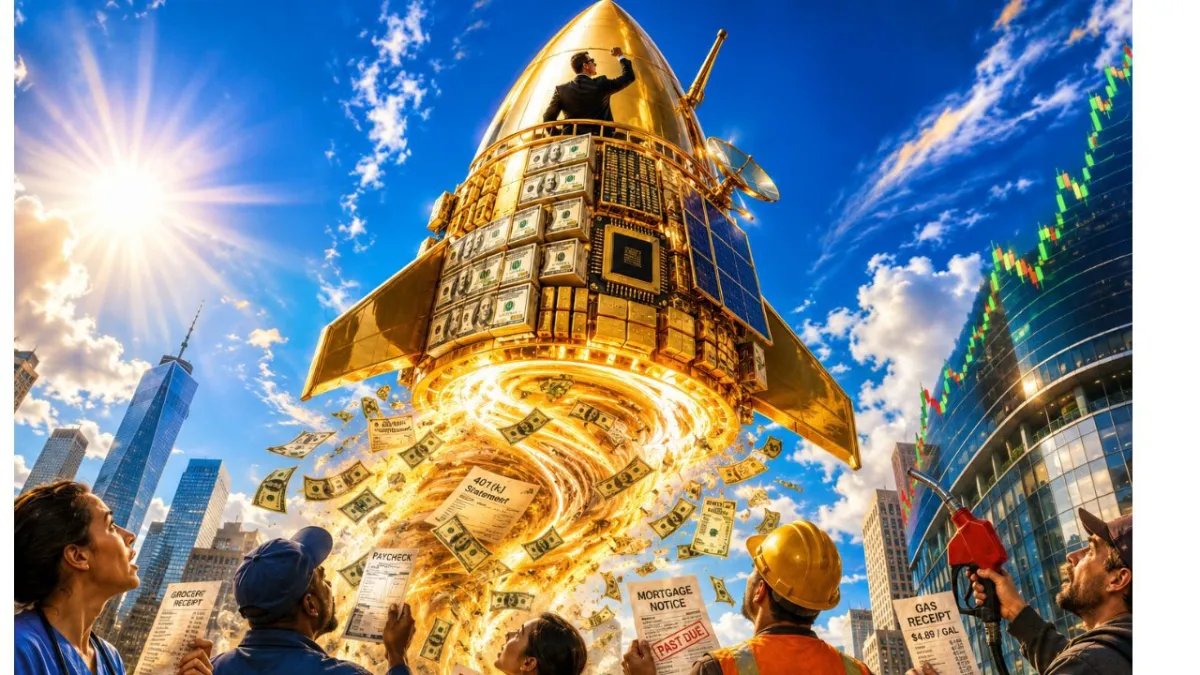
As Elon Musk crossed the trillion-dollar threshold following SpaceX’s historic public offering, millions of Americans received a very different economic message: their paychecks are buying less.
The juxtaposition could hardly be more stark.
On the same week that Musk became the first person in history to accumulate a trillion-dollar fortune, new economic data showed inflation-adjusted wages declining and many workers losing ground to rising energy costs and persistent inflation. While Wall Street celebrated a new age of technological wealth, ordinary Americans continued to struggle with housing costs, healthcare expenses, retirement insecurity, and fears that artificial intelligence may soon eliminate entire categories of jobs.
The story is larger than Elon Musk.
His trillion-dollar milestone is merely the most visible symbol of an economic system increasingly defined by extraordinary concentrations of wealth and power. According to economists cited in The New York Times report, the richest Americans now control a share of national wealth that would have been almost unimaginable even during the Gilded Age. The fortunes of a tiny handful of billionaires have grown faster than wages, productivity, and in many cases entire sectors of the economy.
The question confronting Americans is not whether Musk deserves his fortune. The deeper question is what happens to a democracy when wealth becomes so concentrated that individual fortunes rival the economic output of nations.
Extreme wealth inevitably translates into political influence. Billionaires can shape public policy, fund political movements, influence media ecosystems, purchase competitors, and increasingly determine the direction of technological development itself. As economist Gabriel Zucman argues, concentrated wealth does not merely distort markets—it can distort democracy.
This concern has become particularly acute in the age of artificial intelligence.
The same technologies creating vast new fortunes are also generating widespread anxiety among workers. Tech executives routinely warn that AI could eliminate millions of jobs while simultaneously assuring investors that productivity and profits will soar. Workers are effectively being told that their economic future may depend on technologies designed to replace them.
That contradiction helps explain the growing public unease.
For decades Americans were promised that economic growth would lift all boats. Yet many families increasingly experience an economy where stock market records coexist with unaffordable housing, rising healthcare costs, stagnant purchasing power, and declining economic security. Wealth exists in abundance, but access to it grows ever more unequal.
The SpaceX IPO may be remembered as a historic financial event. But it may also serve as a symbol of a deeper crisis: an economy capable of creating trillionaires while leaving millions uncertain about their future.
Whether that future produces broader prosperity or even greater inequality may prove to be one of the defining political questions of the coming decade.
Editor’s Note: At a moment when the once vaunted model of responsible journalism is overwhelmingly the play thing of self-serving billionaires and their corporate scribes, alternatives of integrity are desperately needed, and ScheerPost is one of them. Please support our independent journalism by contributing to our online donation platform, Network for Good, or send a check to our new PO Box. We can’t thank you enough, and promise to keep bringing you this kind of vital news.
You can also make a donation to our PayPal or subscribe to our Patreon.
Please share this story and help us grow our network!
[ad_2]
Source link
