
[ad_1]
The 1970s were heady times for high strangeness, the New Age, and myriad “unexplained” topics. Ancient aliens, UFOs, suspect archaeology, conspiracy theories, past lives, Bigfoot, life after death, voodoo, possession, the occult, Uri Geller, crop circles, and so on all went mainstream. Long before YouTube democratized mystery mongering and allowed anyone with an internet connection to pontificate about half-baked ideas—much of which is, as physicist Wolfgang Pauli noted, is “Not even wrong”—there were television shows and films.
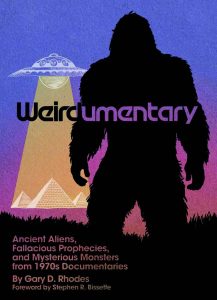
In his book Weirdumentary: Ancient Aliens, Fallacious Prophecies, and Mysterious Monsters from 1970s Documentaries, film historian Gary D. Rhodes examines the flood of television and film “documentaries” that hosted a parade of pseudoscience promoters, such as Ehrich Von Daniken. These programs successfully (and very profitably) blurred the lines between science, fiction, and science fiction. These programs were hugely influential, not only among the general public—who saw them as the credible, authoritative science-based programs they purported to be—but also among paranormal proponents, such as John Keel and Ivan Sanderson. Recall that the famous footage of Bigfoot (or, more probably, a guy in a costume) filmed by Roger Patterson and Bob Gimlin in October 1967 premiered not on the nightly news but instead in a television documentary titled Bigfoot: America’s Abominable Snowman.
As comics writer Stephen R. Bissette notes in his foreword, “What had been relatively obscure niche cult interests and obsessions indulged by the likes of Fate magazine had exploded into mainstream populist Americana and G-rated family entertainments.”
Once production companies saw how profitable these programs were, they cranked them out at a furious pace, each competing to be more sensational and lurid than the other. Though the number of actual scientists who endorsed these wild claims was vanishingly small, there were plenty of working actors who were happy to put on a lab coat and pretend to be baffled by whatever was put in front of them, from a blurry Bigfoot photo to a “prophetic” Nostradamus quatrain.
Weirdumentary is divided into eight sections, among them ancient aliens, mysterious monsters, speculative history, the Bermuda Triangle, UFOs, and paranormal powers. A few pages of analysis are provided on each film or TV series. Because Rhodes is a film historian, the entries delve into details of production companies, producers, stars, and the like. William Shatner, Leonard Nimoy, Isaac Asimov, Carl Sagan, and Arthur C. Clarke all make appearances, along with a who’s who of 1970s hosts, including Raymond Burr, Orson Welles, and Peter Graves. Though the 1970s are mentioned in the title, that was simply the peak of a long tradition. Rhodes begins with the section “The Proto-Weird” with the curious 1923 film titled Is Conan Doyle Right? (Doyle was, of course, a fervent believer in the existence of fairies, psychic powers, and ghosts, so the answer to the title question is arguably No.)
It’s no exaggeration to say that the Committee for the Scientific Investigation of Claims of the Paranormal (now CSI) was formed as a direct response to just these sorts of programs. Paul Kurtz and others recognized that no rational, evidence-based skeptical perspective or antidote was available to the public, and they decided to do something about it. As the cliché goes, the rest is CSI history, as revealed in Craig Foster’s “Time Warp” column in Skeptical Inquirer. Though films such as The Exorcist, The Entity, and The Amityville Horror were not promoted as documentary films, they were promoted as “based on a true story,” which fueled interest.
The book has an index but would have been more useful as a research tool with a bibliography or further reading section. Rhodes is clearly very knowledgeable and would be a delight to have a few drinks with, but showing some of his homework would have benefited readers. That being said, this book is especially useful for skeptics researching the nature of popular culture influences on beliefs and paranormal reports. There is a well-documented pattern of media depictions, such as documentaries inspiring interest and belief in their subjects, which in turn led to further (real or imagined) sightings, and the cycle begins anew. The book is lavishly illustrated with period posters and set photos. Often funny (and occasionally snarky), Weirdumentary is a well-written and researched love letter to the genre of grindhouse pseudodocumentary schlock.
[ad_2]
Source link
