
[ad_1]
Joshua Scheer
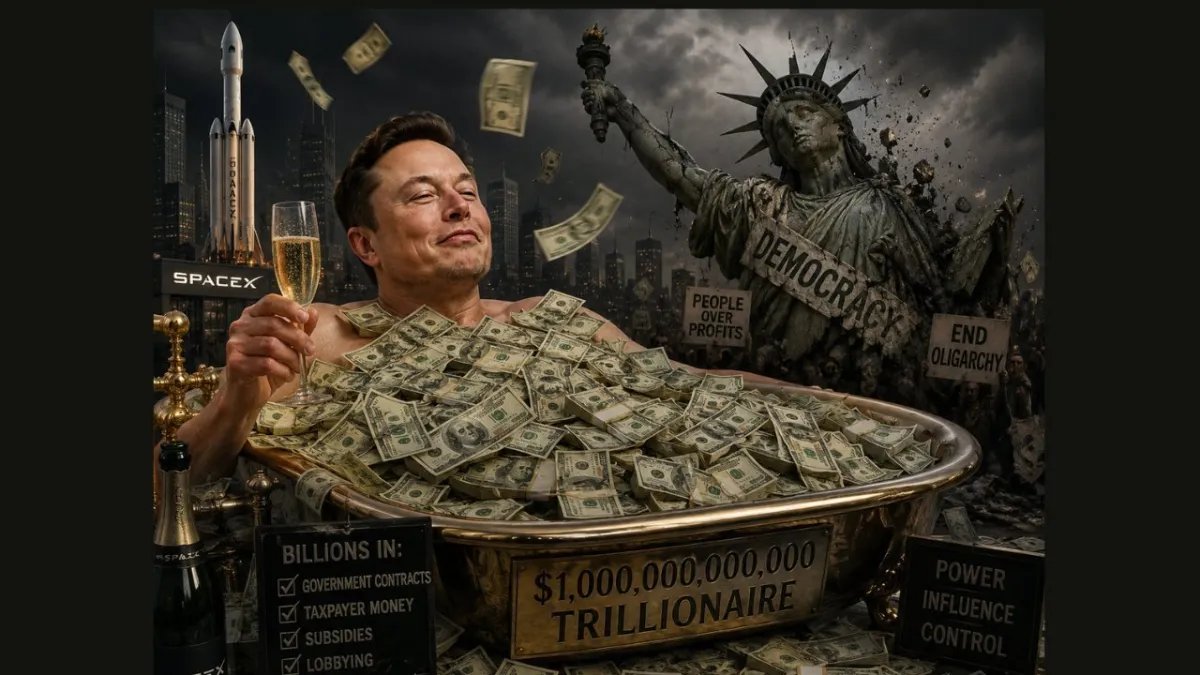
With the public debut of SpaceX, Elon Musk has officially become the first trillionaire in human history—a milestone celebrated by financial media as a triumph of innovation and entrepreneurship. But beneath the headlines lies a far more troubling story.
In this analysis, journalist Ben Norton argues that Musk’s trillion-dollar fortune is not merely a personal achievement but a symbol of a political and economic system increasingly dominated by oligarchic power. From government contracts and Wall Street speculation to billionaire-funded elections and media consolidation, Norton contends that the rise of the world’s first trillionaire exposes the widening gulf between democratic ideals and economic reality.
Tracing the arc from the Gilded Age robber barons to today’s tech monopolies, Norton examines how wealth concentration has reached levels unseen in modern American history, allowing a small class of billionaires to exert extraordinary influence over politics, public discourse, and economic policy. The result, he argues, is a society in which elections are increasingly shaped by money, public institutions serve private interests, and vast fortunes continue to grow while millions struggle with poverty, debt, and insecurity.
The emergence of the world’s first trillionaire raises profound questions about power, democracy, and the future of an economic system that continues to concentrate unprecedented wealth in the hands of a select few.
Democracy Is Dead: Elon Musk’s Trillion-Dollar Fortune and the Rise of America’s Oligarchy
Elon Musk has officially become the first trillionaire in human history.
Following the public offering of SpaceX, Musk’s wealth crossed the trillion-dollar threshold, marking a milestone unprecedented in modern economic history. For supporters, it is a testament to innovation, entrepreneurship, and technological ambition. For critics, it is something else entirely: evidence that extreme wealth concentration has reached levels incompatible with any meaningful concept of democracy.
In a recent analysis, journalist Ben Norton argued that Musk’s ascent is not merely the story of one billionaire becoming richer. Instead, he contends it is a symbol of a broader transformation in American society—one in which political power, economic influence, and media control are increasingly concentrated in the hands of a tiny elite.
The First Trillionaire
To grasp the scale of Musk’s fortune requires almost abandoning ordinary notions of wealth.
A trillion dollars is greater than the annual economic output of many nations. According to Norton, the emergence of a single individual possessing wealth on that scale should force a public reckoning with the nature of political and economic power in the United States.
“It is impossible for a society to actually be a democracy,” Norton argues, “when you have a small handful of oligarchs who are this wealthy.”
The question raised throughout the analysis is not simply whether Musk deserves his wealth, but whether any democratic system can function when so much power is concentrated in so few hands.
SpaceX and the Financial House of Cards
Norton also challenges the financial narrative surrounding SpaceX’s IPO.
While investors rushed to buy shares, he notes that much of the company’s valuation rests on expectations rather than profitability. According to the analysis, SpaceX’s Starlink satellite division remains profitable, but other parts of the company continue to consume billions of dollars annually.
At the same time, SpaceX has benefited enormously from federal contracts and subsidies. Public reporting has estimated that Musk’s business empire has received tens of billions of dollars in government support over the years.
For Norton, this illustrates a recurring feature of modern capitalism: public resources helping generate private fortunes on a historic scale.
Money and Political Power
The analysis goes further, arguing that wealth concentration inevitably translates into political influence.
Norton points to research showing that candidates who spend more money overwhelmingly win U.S. elections. Senate candidates with greater funding prevail roughly 80 percent of the time, while House candidates win at rates approaching 90 percent.
He also highlights Musk’s reported spending during the 2024 election cycle, where the billionaire contributed hundreds of millions of dollars to support preferred candidates and causes.
The result, Norton argues, is a political system increasingly responsive to wealthy donors and corporate interests rather than ordinary voters.
Beyond the Gilded Age
Many observers compare today’s billionaire class to the robber barons of the late nineteenth century.
Norton argues that comparison understates the problem.
Drawing on the work of economist Gabriel Zucman, he notes that today’s ultra-rich control a larger share of national wealth than the Rockefellers, Carnegies, and Vanderbilts ever did during the original Gilded Age.
In other words, the concentration of wealth now exceeds even the era historically synonymous with monopoly power and oligarchic influence.
The Return of Oligarchy
The analysis traces the growth of inequality through the neoliberal era beginning in the 1980s.
Tax rates on the wealthy declined. Financial markets expanded. Corporate consolidation accelerated. Meanwhile, labor’s bargaining power weakened and wealth increasingly flowed upward.
The result has been an explosion in asset values that disproportionately benefits those who already own stocks, real estate, and large corporations.
According to Norton, the beneficiaries of this system have become so wealthy that they now exert influence not only over markets, but also over media institutions, public discourse, and government policy itself.
The Debate Over the Future
Norton concludes that the rise of trillionaires is not a bug in the system but a consequence of how the system currently operates.
Whether one accepts his proposed solutions—including stronger public ownership of key technologies and greater restrictions on concentrated wealth—the underlying question remains difficult to ignore:
What happens to democracy when a single individual possesses more wealth than most countries?
The emergence of the world’s first trillionaire is more than a personal milestone. It is a signpost pointing toward a future defined by unprecedented concentrations of economic power—and a growing debate over whether democratic institutions can survive them.
[ad_2]
Source link
