
[ad_1]
Black Alliance for Peace Renews Call for Boycott of 2026 World Cup Hosted by the United States
Joshua Scheer
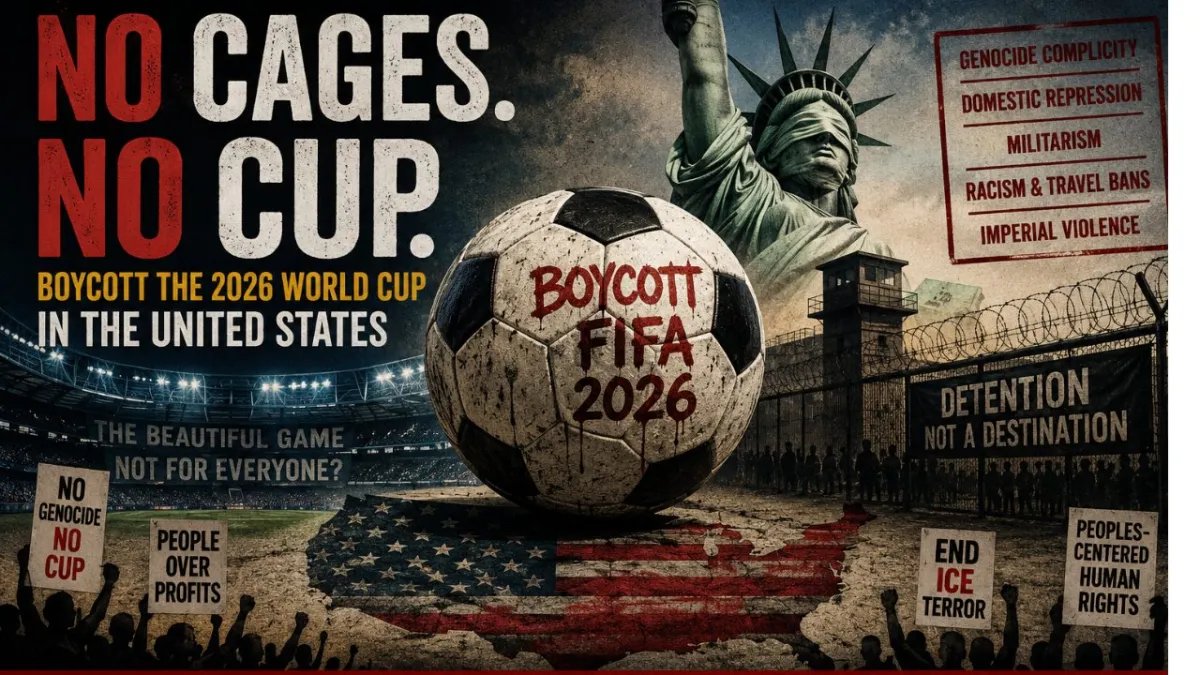
As the opening matches of the 2026 FIFA World Cup begin, the Black Alliance for Peace (BAP) is renewing a demand that many dismissed when it was first issued on May 28: the international community should boycott the tournament being hosted by the United States.
At the time, BAP’s North-South Project for People(s)-Centered Human Rights argued that the United States was fundamentally unfit to host the world’s largest sporting event, citing Washington’s support for Israel’s war on Gaza, escalating military interventions abroad, domestic immigration crackdowns, and what the organization described as growing assaults on civil liberties.
Weeks later, many of the concerns raised in that statement appear less hypothetical and more immediate.
The opening of the tournament comes amid growing controversy over Trump administration policies that have already impacted participation in the games. Reports of visa restrictions, travel barriers, and diplomatic disputes surrounding qualified teams and officials have fueled criticism that politics is increasingly shaping who can participate in what FIFA calls “the beautiful game.”
Among the most controversial cases were restrictions affecting Iranian participation and the denial of entry to Somali football officials, developments critics argue expose the contradiction between FIFA’s claims of global inclusion and the realities of hosting the tournament under an increasingly restrictive U.S. immigration regime.
For BAP, those incidents are not anomalies. They are evidence supporting a warning the organization issued months ago.
“The United States has rendered itself ineligible to host the games,” BAP argued in its May statement, pointing to what it described as U.S. complicity in genocide abroad and repression at home.
The organization’s criticism extends beyond immigration policy. BAP argues that FIFA’s decision effectively normalizes a political environment marked by militarism, mass detention, and international lawlessness.
“It is outrageous and obscene that FIFA would allow the United States—a nation operating completely outside the bounds of international law—to host the World Cup while providing material support for genocide, unleashing ICE goons who disappear people into detention gulags, and invading a sitting president,” said Ajamu Baraka, director of BAP’s North-South Project for People(s)-Centered Human Rights.
The group’s National Coordinator, Erica Caines, acknowledged that the boycott demand would be controversial, particularly among football supporters eager to celebrate a global event.
“We understand the excitement and pride of the nations that qualified and will compete in the World Cup,” Caines said. “However, participation in the games while they are hosted in the United States does not uphold the Beautiful Game. Instead, it risks normalizing genocide, domestic repression, militarism, and death.”
The timing of the statement highlights a broader question that FIFA has increasingly faced in recent years: can international sporting events ever be separated from the political realities of their hosts?
That debate has intensified as FIFA and other major international sporting bodies have taken strong positions against some governments while remaining largely silent regarding others. Critics point to what they see as inconsistent standards regarding human rights, military conflicts, and international law.
For BAP, the answer is clear.
The organization argues that the World Cup should not serve as a public-relations shield for governments accused of human rights abuses or military aggression. Instead, it says, the tournament’s global visibility should prompt scrutiny of the conditions under which it is being held.
Whether the boycott call gains significant traction remains to be seen. But as millions tune in to watch the world’s biggest sporting event, the controversy surrounding the tournament’s host nation has become impossible to ignore.
BAP’s Warning Looks Less Theoretical by the Day
When the Black Alliance for Peace first called for the tournament to be moved out of the United States on May 28, critics dismissed the demand as unrealistic. Two weeks later, however, the opening of the World Cup has been overshadowed by exactly the kinds of controversies BAP warned about.
What was once framed as a debate over principle has become a debate over reality.
The Iranian national team has reportedly faced extraordinary restrictions, including relocating its training base from the United States to Mexico and dealing with visa complications affecting support personnel. Somali referee Omar Abdulkadir Artan, selected by FIFA as one of the tournament’s officials after a distinguished career in African football, was denied entry into the United States and ultimately barred from participating in the competition.
The incidents have sparked international criticism and renewed questions about whether a host nation can simultaneously celebrate global unity while imposing restrictions that disproportionately affect participants from specific countries.
Even mainstream football journalists have described the situation as unprecedented. Speaking to Channel 4 News, Independent chief football writer Miguel Delaney argued that nothing comparable had occurred at previous World Cups, noting that even hosts frequently criticized for authoritarian governance had not barred FIFA-accredited officials from entering the country. Delaney further questioned FIFA’s willingness to challenge host-country immigration policies despite longstanding commitments to facilitate access for players, officials, and supporters.
The controversy has fueled a growing perception that the 2026 tournament is becoming defined as much by politics as football. Visa restrictions, heightened security procedures targeting some delegations, soaring costs, fan travel concerns, and geopolitical tensions have all contributed to what critics increasingly describe as a World Cup in crisis before a single champion has been crowned.
That context helps explain why BAP’s boycott call has gained renewed attention. The organization argues that the issue is no longer simply whether the United States should have hosted the tournament, but whether FIFA has allowed the World Cup to become a vehicle for normalizing policies that contradict the tournament’s stated values of international inclusion and global solidarity.
[ad_2]
Source link
