
[ad_1]
“The victim of Monday’s knife attack… remains in a serious condition in hospital receiving treatment for serious eye, face and back wounds… Detectives have said there is no indication Monday’s knife attack was terror-related” [emphasis added].
There, in a single paragraph in the Irish Times, the Republic of Ireland’s paper of record—describing an attempted beheading by a “Sudanese asylum-seeker” of a local man, Stephen Ogilvie, in Belfast, Northern Ireland, as not being “terrorist-related”—is proof that the Emerald Isle has emerged as the chief promulgator of the approved multicultural rulebook.
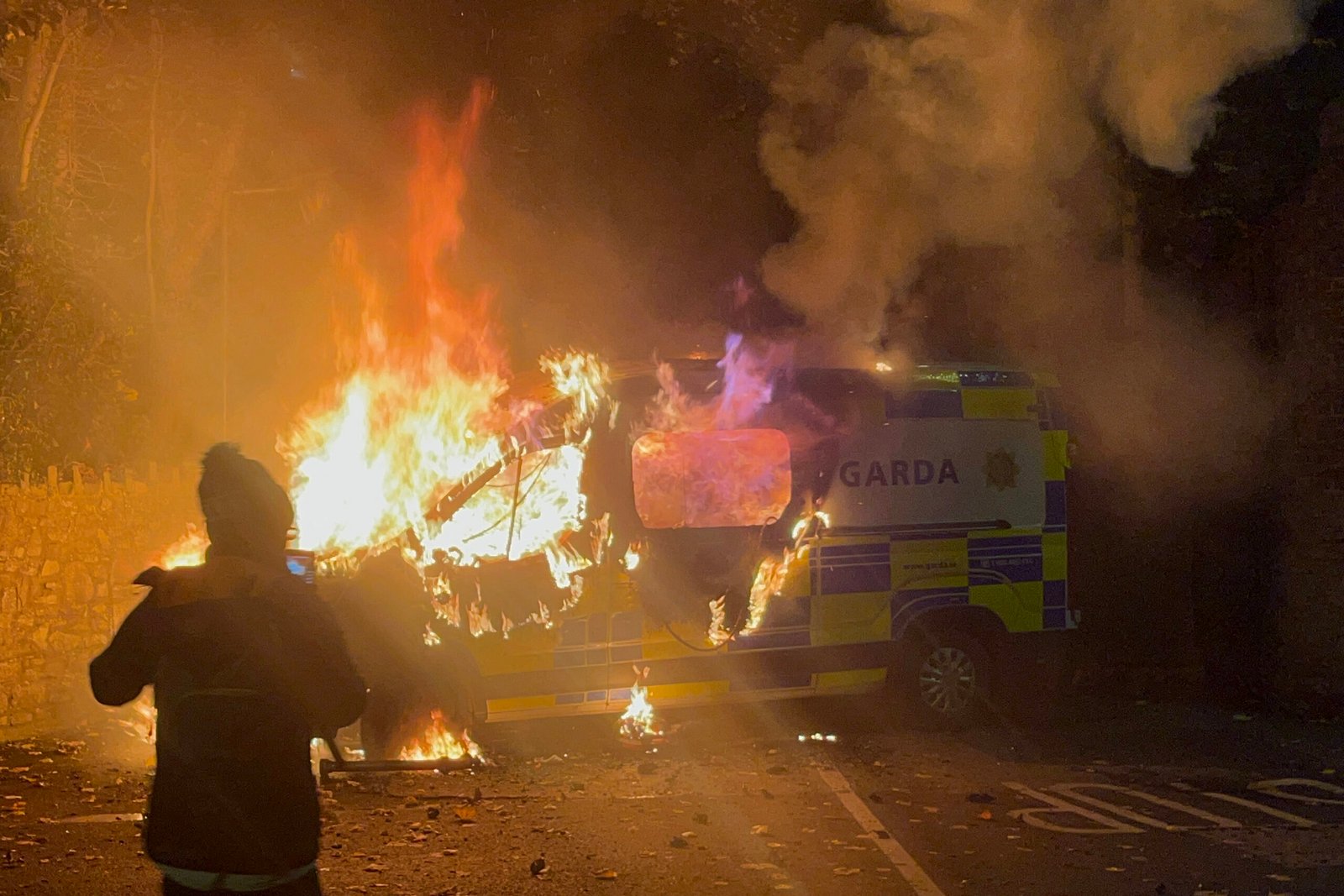
That rulebook compels politicians to intone that Islam is a religion of peace, and that the greatest threat to European values is Islamophobia. So, this near-beheading—though admittedly, not quite an act of love—was not an act of terror, according to the rules. Which means that the violence that subsequently convulsed Belfast—burning buses, cars, and even houses—was terroristic, but the event that triggered it all was not.
What a relief.
Like the hula hoop and miniskirt of yesteryear, this rulebook arrived rather late in Ireland, around the same time that other nations, though not their governments, were throwing it out the window. Most of Europe long ago woke up to the threats of Islamic fundamentalism and mass immigration, because unlike Europe’s smug political elites, its people came to understand that the real threat to European values is not native but imported: Immigrant communities tend to retain and transmit the habits and values that they arrived with, and those habits and values don’t always enrich life in European countries, to put it mildly.
Ireland, having not encountered the threat until relatively recently, has not yet fully learned that central truth, though it is now one near-beheading closer to grasping it. Future social scientists might one day create a universal model that mathematically assesses the relationship between “random atrocities” and the subsequent refusal to admit that they might share a common cause. That model is probably, at the very least, the square of the distance between the observer and the atrocity, meaning that there are probably far fewer people today in Belfast who would argue that there is no connection between the attempted beheading and the attacker’s religion. Others will continue to repeat the pious mantra that Islam is a “religion of peace.”
They will have learned that phrase from Europe’s political classes over the past several decades, including from Britain’s former Prime Minister Tony Blair, though he’s at least added some nuance: “There is also a clear move across the world to assert strongly the moderate and true authority of Islam.” Citing Afghanistan, Blair continued:
The Afghan Women’s Hour is a programme that would have been inconceivable not long ago. It offers girls, their mothers and their grandmothers a place to speak and to listen to one another. The full gamut of issues has been aired: standing for Parliament, learning to read, starting a business, the prevention of maternal mortality.
Since then, the Taliban has militarily trounced the USA, reconquered Afghanistan, and dispatched its female population into a darker hell than existed before the 9/11 New York atrocities. Islamist terrorist groups have captured large swathes of West Africa and have committed atrocities in virtually every single Western European country. Meanwhile, two of the Western world’s cultural capitals, New York and London, have elected Muslim mayors. Not a single word of this paragraph was remotely possible when Blair made his direly fatuous forecasts.
No state in Europe has been as slow as Ireland to realize the immensity of the challenges facing Europe’s cultural inheritance, including its Christian heritage. This seems extraordinary, for Ireland was the last country in Europe to enforce religious proscriptions within its criminal law. As recently as 1992, condoms could only be bought on a doctor’s prescription, and undercover police officers even launched a sting operation against a chain store that was freely selling them.
However, Ireland now enforces the new secular orthodoxies through state agencies, namely by means of “quangos”: quasi-autonomous non-governmental organizations, the terminological equivalent of “not terrorist-related.” Despite the name, quangos are staffed and funded by the government. Their authority over so-called “hate speech” is religious in its autonomy. The once all-powerful prelates of Irish Catholicism and their priestly apparatchiks have been replaced by administrators of hyper-liberalism, generally drawn from a caste of political clones who obediently parrot the same secularist and multiculturalist banalities.
Northern Ireland, with its sizable population of Protestants, is different, but hardly better. Its political discourse is largely governed by the hypocritical pieties of the Belfast Agreement of 1998 that supposedly brought peace to the province. It will probably come as a surprise to most readers, both inside and outside Ireland, to hear that this accord, also known as the Good Friday Agreement, was not signed by the Democratic Unionist Party, the largest pro-British party in Ireland, nor endorsed in full by Sinn Fein, the political wing of the IRA. Only myth declares that they did so, just as it proclaims that the agreement brought peace to Northern Ireland, which it did not. What the province now has is not “peace” but merely some conjoined ceasefires enriched by much intercommunal hatred and elaborate displays of simpering hypocrisy.
Northern Ireland’s politicians have accordingly been hosepiping vast quantities of humbug in their condemnations of masked loyalists—i.e., working-class Protestants—who orchestrated anti-immigrant violence following the near-beheading in Belfast. But both Sinn Fein and the DUP supporters once exulted in the activities of their own masked terrorists, and Sinn Fein still routinely hosts memorial events celebrating a few choice atrocities by the IRA during the Troubles.
Subscribe Today
Get daily emails in your inbox
That Sinn Fein can produce a theological justification for their own historical atrocities while condemning current acts of violence requires a casuistry that is usually beyond the modest intellectual means of today’s Protestant Loyalist thugs. The latter’s brutal appetites have been merely repressed within the taboo culture that the Belfast Agreement has now made politically mandatory. In fact, both sides covertly cherish the lore and the licentiousness of violence.
But what of the immigrants themselves? Both parts of Ireland have been transformed by mass immigration, but most especially the Republic, because of its booming economy and the priestly power of its ideological quangos. Up until recently, these loudly applauded the arrival of multiculturalism, even in the form of “asylum seekers.” This welcoming attitude has diminished now that it has become clear that many of these newcomers are simply illegal immigrants seeking access to European prosperity. Quite naturally, the hostels for these (mostly) bogus “asylum seekers” are usually sited in working-class areas, which are never near the homes of the white-collar quangoistas.
But even allowing for the bizarre latitude that Ireland has shown towards illegals, the authorities at Dublin Airport were quite criminally lax in allowing Monday’s assailant into the country. Once safely in the Republic, he was able to cross the border into Northern Ireland and then exhibit his cultural eccentricities on the streets of Belfast. Does his attack mark a turning point in the Republic?
[ad_2]
Source link
