
In Isaac Asimov’s The Caves of Steel he imagines a future in which most of humanity lives in gigantic cities, extending many levels underground. This leaves the majority of the Earth’s surface for industrial farming, necessary to feed all those densely populated cities. If you take a similar strategy, however, and keep the population at sustainable numbers, this could maximize land for natural ecosystems and also minimize the environmental footprint of the average person. So if we are going to plan our civilization around environmental sustainability we would not necessarily need Asimovian megacities, but we could concentrate the population in cities and in densely developed areas around cities, and leave large stretches of land in between undeveloped. This is far better than endless suburban sprawl.
But of course, we are not starting from scratch, and our current layout was not planned by some central committee but evolved organically. Pragmatically, the question we need to ask is – where do we go from here. Cities are growing dynamic things, so we can use city development to move in a certain desirable direction, even if we can’t tear it all down and start anew. This means it is important to study what the best city planning and development would be going forward.
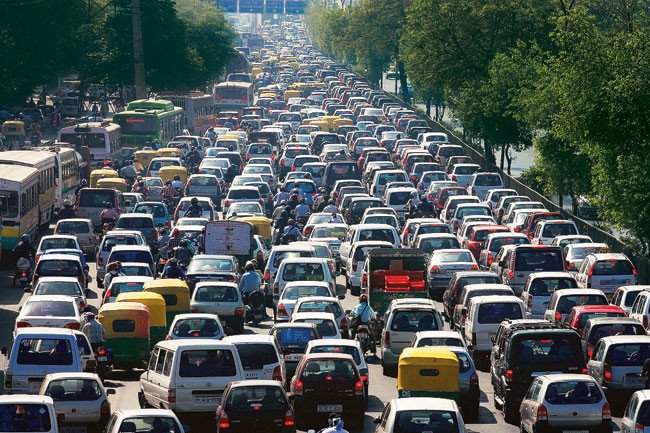
When most people think of city planning to reduce the carbon emissions of transportation, the first thing that comes to mind is planning city centers so that they are walkable/bikeable and to provide public transportation, in order to minimize reliance on fossil-fuel burning cars. This also has the advantage of reducing city traffic, which can be a nightmare. However, a recent study suggests that, while important, this may be of secondary concern with respect to impact on CO2 emissions. For many cities, especially those with a single concentrated hub (as opposed to multicentric cities, like LA), the most impactful strategy might be the densification of a ring surrounding the city center. The range of this ring depends on the city, but is something like 10-20 km for a typical large city, but can extend to 40 km. Increased density can be accomplished with infill development, as many such zones are only moderately developed leaving lots of room for densification.
The idea is that the workplaces will be concentrated in the city center, and the workers will live in the ring around the city center, minimizing their commute distance. This could have a significant impact on the average commute distance that people have and therefore their transportation carbon footprint. This approach would work better for some cities than others, depending on geography. This plan could also maximize the impact of public transport, like buses and trains, dedicated to bringing people back and forth from this densified ring to the city center.
One of the major findings of the study, which used gps data to track 10 million “mobility data points”, is that there are many interdependent variables at work. It is not as simple as just densifying a certain distance from a city center. Road planning, public transportation, carpooling, and working from home are also important variables that affect each other. Essentially, what this study does is provide additional information to city planners, using an AI model to help individual planning to each city in order to minimize average commute distance.
The authors acknowledge that there is still a lot of research to do in this area. The one variable that is always the most difficult to predict is human behavior. For example, we cannot simply build more roads to accommodate increased traffic, because more roads creates “induced demand” and may actually worsen traffic. In this case we need to deal with the fact that many people move out into the suburbs, increasing their commute, because they want to. It’s nice there. At the same time there is a “build it and they will come” phenomenon – people will buy or rent houses that exist. Since we are having a housing shortage, we have an opportunity to decide where to build the millions of homes we need to meet demands.
Generally speaking, however, it is a good idea not to assume that people will do what you want them to do, and to provide multiple options for different people with different desires and in different situations. At the same time, when dealing with these big environmental issues, it is not necessary for every single person to do the same thing. We just need to move some people toward behavior associated with lower emissions, by making certain choices more desirable or easier. The effects of behavior and infrastructure on CO2 emissions are cumulative – in both directions, good and bad.
I also think generally we should not expect most people to make big sacrifices to achieve our collective goals, not for moral reasons but for practical reasons. But I also think we should not always put the burden on the individual to make the sacrifice. It’s better to look for the win-wins, to make the system work for people rather than making people work for the system, and to provide the infrastructure and opportunity for people to make choices that are good for them and good collectively, in this case for the environment.
With all that in mind, what would I like to see in terms of minimizing the carbon footprint of transportation? First, I would love more walkable cities with less traffic, and with convenient low-cost transportation options. More convenient and cost effect transportation options into city centers would also be nice. Where I live the best option I have is to drive to the nearest train station and then pay ridiculous prices for a train ticket. If the family is taking a day-trip to the city, it could literally cost hundreds of dollars.
Also, as this study indicates, careful city planning to minimize commute distance could have a significant impact. There is a confluence of issues here. In the US we lack overall housing, we also lack mid-level housing in terms of costs. We need more condos, row houses, and multi-family units – something between an apartment and a large house sitting on a half-acre. These are exactly the kinds of homes that could be built to densify key regions around city centers. We could essentially address three problems at once.
Meanwhile, we need to continue to convert from fossil fuel burning to electric vehicles. These are more energy efficient and have a much lower carbon footprint over their lifetime. They are also now cheaper to own and have much less maintenance. Having shorter average commute distances would also make EVs, even those with modest ranges, more convenient. We are already past the technological tipping point in terms of the features of EVs themselves. The big issue is that we need to continue to build out the EV public charging infrastructure. They need to be ubiquitous.
I also think that we need to make a big push for working from home. This happened during COVID and I was hoping that everyone would realize the benefits and the trend would continue. However, once the pandemic was over some businesses snapped back to their old policies, and mostly with no good reason. We did make good progress, but not as much as we should have. We should be doing everything we can to maximize working from home. If the average worker worked from home 2 days a week, that would reduce commuting by 40%. This massively reduces traffic and CO2 emissions. Increasingly many people’s jobs involve lots of time sitting in from of a computer. There is no reason for them to commute to an office to do that. Schedule meetings on one or two days a week. In fact, in my experience, many work places have too many meetings. Most of what needs to be accomplished can happen in virtual time, then you can have one meeting to review everything. Obviously this has to be individualized to the workplace, but there are many businesses where there are lots of opportunities to reorganize workflow so that many people can work from home much of the time. Further – working from home increases productivity.
The same is true of the 4 day work week – it maintains or increases productivity. This is because of the same principle I discussed above – people are not machines that will just do what you tell them (short of oppressive environments). People work more efficiently when they are in a better mood, and have a better work-life balance. ]
Most of these things are win-wins. People do not want to spend large amounts of their life stuck in traffic, sitting in a car that is spewing out pollution. So give them other options, make commutes shorter, let people work fewer days and many days (or all days) from home. And when they do have to drive, EVs are a superior option for many people, and we should do what we can to make it the best option for as many people as possible.
