
[ad_1]
ScheerPost Staff
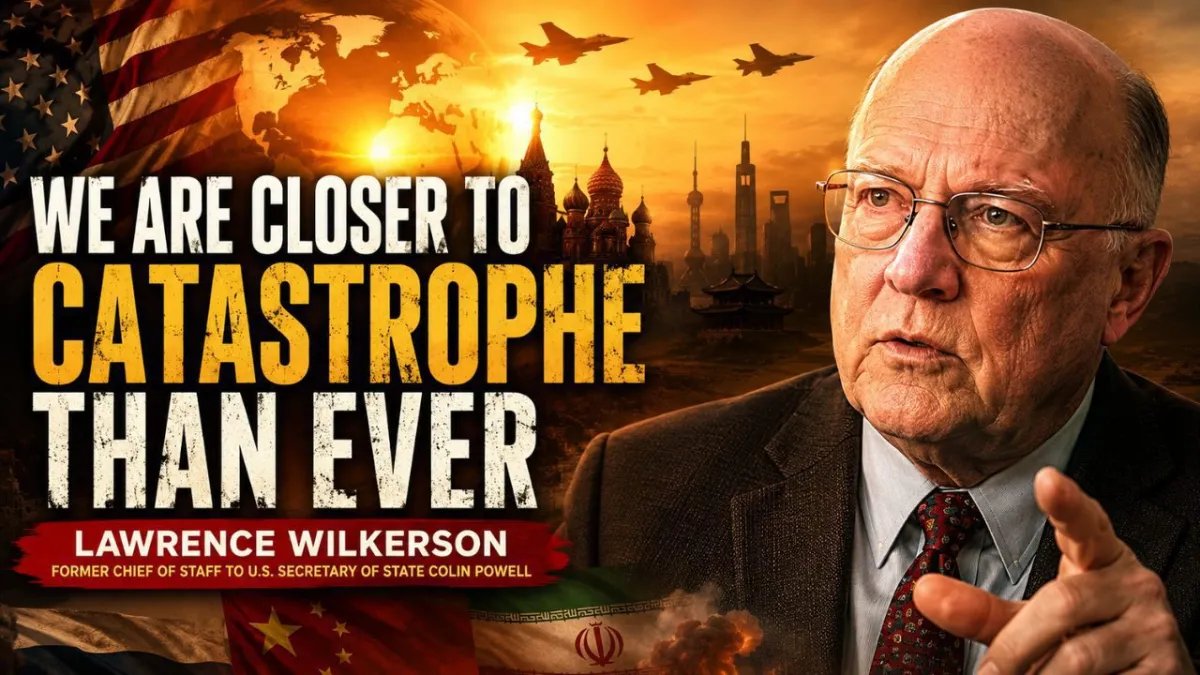
Retired Colonel Lawrence Wilkerson delivers a stark warning about a world he believes is rapidly slipping beyond Washington’s control. In a sweeping conversation with Glenn Diesen, Wilkerson argues that the United States is failing to adapt to the rise of a multipolar order—one increasingly shaped by China’s strategic patience, Russia’s military escalation, and the collapse of diplomatic norms that once restrained global conflict.
From NATO expansion and the war in Ukraine to tensions with Iran and the erosion of trust between nuclear powers, Wilkerson paints a picture of leaders trapped in outdated imperial thinking while the geopolitical ground beneath them shifts dramatically. The result, he warns, is a dangerous mix of technological upheaval, declining U.S. influence, and political desperation that could push the world toward catastrophic confrontation.
Wilkerson paints a picture of leaders sleepwalking toward catastrophe while convincing themselves they are preserving peace. And as the former insider surveys the accelerating breakdown of global stability, he leaves viewers with a chilling admission: “I hope I’m wrong more than anyone.”
Retired Colonel Lawrence Wilkerson does not sound like a man who believes the world is stabilizing. In a sweeping and deeply unsettling conversation with Glenn Diesen, Wilkerson paints a portrait of a global order entering a dangerous transition — one in which the United States remains trapped in the mindset of unipolar dominance even as the foundations of that dominance visibly erode.
For Wilkerson, the central reality shaping the 21st century is simple: power is moving eastward, and Washington either cannot or will not accept it.
“China is winning and doesn’t want to do anything to interrupt that victory.”
That observation becomes the organizing principle of the interview. While China, in Wilkerson’s view, pursues long-term strategic patience, the United States appears increasingly reactive, erratic and unable to adapt to a multipolar world it no longer fully controls.
Diplomacy Without Diplomacy
One of the most striking parts of the discussion centers on the collapse of diplomacy itself.
Wilkerson repeatedly emphasizes that genuine negotiations between Washington and Tehran barely exist. According to him, there have been no meaningful face-to-face talks between senior American and Iranian officials, only intermediaries passing messages between hostile states.
For Wilkerson, this is not merely incompetence — it is historically dangerous.
“The first ingredient in diplomacy is trust.”
Without direct dialogue, he warns, every “peace process” becomes theater. Every ceasefire becomes temporary. Every negotiation risks becoming little more than cover for the next escalation.
He predicts that the United States could once again drift toward military confrontation with Iran after another failed diplomatic spectacle — a cycle he believes has already repeated itself multiple times.
Ukraine as a Laboratory of War
Wilkerson’s analysis of Ukraine is equally bleak.
Rather than viewing the conflict strictly through the lens of democracy versus authoritarianism, he argues that powerful Western states increasingly see Ukraine as a battlefield laboratory — a place to experiment with advanced military technologies, drone warfare, electronic warfare systems and new methods of combat.
The comparison he reaches for is chilling:
“We’re like Hitler in 1936 in Spain watching those Stukas dive and amending their performance accordingly.”
The implication is clear: major powers are learning from Ukraine in preparation for future wars, not necessarily trying to end the current one.
At the same time, Wilkerson warns that Russia appears to be preparing psychologically and strategically for a direct confrontation with NATO itself. He points to Moscow’s recent nuclear exercises and escalating rhetoric as evidence that the Kremlin increasingly sees conflict with the alliance as inevitable.
The Collapse of Strategic Thinking
Throughout the interview, Wilkerson repeatedly returns to one idea: America no longer appears capable of coherent grand strategy.
Donald Trump, in Wilkerson’s telling, governs impulsively, driven more by personal instinct and political survival than any consistent geopolitical doctrine. Yet Wilkerson reserves criticism not just for Trump, but for the broader American foreign policy establishment — intelligence agencies, defense contractors, ideologues and political elites who continue acting as though the United States still exists in the uncontested post-Cold War moment of the 1990s.
The result is a dangerous contradiction:
- Washington continues expanding military pressure abroad.
- NATO continues moving toward Russia’s borders.
- The United States escalates confrontations with Iran and China.
- Yet diplomacy steadily disappears.
For Wilkerson, this is not deterrence. It is provocation masquerading as stability.
“What provides deterrence… is diplomacy.”
That line cuts directly against the dominant assumptions now driving much of Western foreign policy. Wilkerson argues that military buildups without trust merely intensify paranoia and insecurity on all sides.
Technology, Decline and Nuclear Danger
Perhaps the most haunting sections of the interview concern the speed of technological change and its implications for war.
Wilkerson argues that warfare is evolving faster than political institutions can comprehend. Drone swarms, electronic warfare systems, microwave defenses and AI-assisted battlefield technologies are reshaping military realities at extraordinary speed. Traditional concepts of deterrence, escalation and even victory may no longer apply.
At the same time, he believes the United States is confronting something it has not faced in generations: relative decline.
In Wilkerson’s framework, the world now contains:
- A rising power — China — that prefers patience and stability.
- A declining power — the United States — struggling to preserve global dominance.
- A rapidly destabilizing international system increasingly defined by insecurity and mistrust.
That combination, he warns, is historically combustible.
“There’s never been a time… that we were closer to the use of these weapons than now.”
Unlike many Cold War analysts who relied heavily on historical parallels, Wilkerson argues today’s environment may be even more dangerous precisely because it is unprecedented. Technology is changing too rapidly. Political leadership is weaker. Diplomacy is collapsing. And nuclear powers are communicating less, not more.
The Generational Shift
One of the more revealing sections of the discussion arrives near the end, when Wilkerson turns toward demographics and generational politics.
He argues that younger generations across Asia — and increasingly across the world — no longer see the United States as a stabilizing force. American military presence abroad, particularly after Gaza and years of endless wars, has deeply damaged Washington’s global legitimacy among younger populations.
He specifically points to South Korea, Japan and the Philippines as countries where younger generations are steadily becoming more skeptical of permanent alignment with the United States.
That generational divide, he suggests, may ultimately reshape global alliances more dramatically than any battlefield.
A System Unable to Adjust
What makes Wilkerson’s warnings so unsettling is not simply his fear of war. It is his suggestion that the political class driving the current order may be psychologically incapable of adjusting to a world where the United States no longer dominates uncontested.
Again and again, the conversation returns to the same contradiction:
The global balance of power is changing, but Western institutions continue behaving as though nothing fundamental has changed at all.
The danger, Wilkerson implies, is not merely miscalculation. It is denial.
And denial inside nuclear-armed empires has historically ended catastrophically.
By the interview’s conclusion, even Wilkerson appears exhausted by the scale of the crisis he is describing. Asked whether the world may be drifting toward a larger war, he does not offer reassurance.
Instead, he offers a grim acknowledgment that perhaps defines the entire discussion:
“I hope I’m wrong more than anyone.”
Editor’s Note: At a moment when the once vaunted model of responsible journalism is overwhelmingly the play thing of self-serving billionaires and their corporate scribes, alternatives of integrity are desperately needed, and ScheerPost is one of them. Please support our independent journalism by contributing to our online donation platform, Network for Good, or send a check to our new PO Box. We can’t thank you enough, and promise to keep bringing you this kind of vital news.
You can also make a donation to our PayPal or subscribe to our Patreon.
Please share this story and help us grow our network!
[ad_2]
Source link
