
[ad_1]
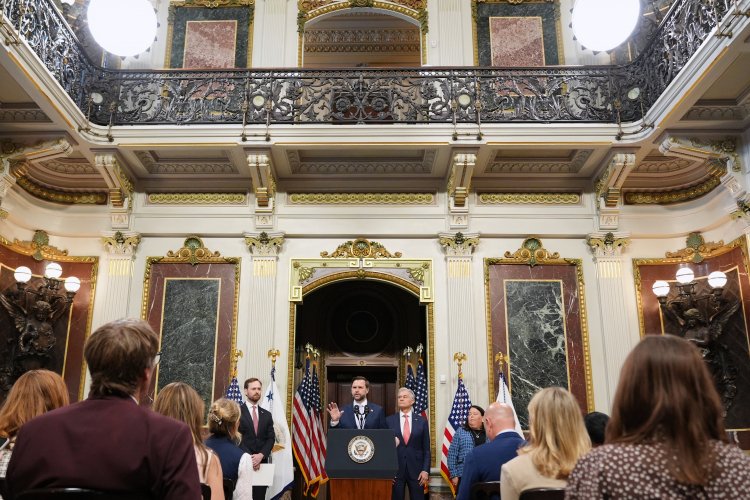
In the second major announcement from the White House anti-fraud task force, Vice President JD Vance revealed that the administration has forcibly closed roughly 800 hospice and home health care centers in California and is deferring $1.3 billion in Medicaid reimbursements to the state.
Additionally, the task force is sending a letter to all 50 statewide Medicaid and Medicare systems warning them to boost anti-fraud efforts or risk losing federal funding. The vice president said the deferrals are due in part to providers prescribing unnecessary medications to benefit from federal programs.
“We want to ensure that the American taxpayer isn’t getting fleeced,” Vance said from the Eisenhower Executive Office Building while patting himself and his team on the back. “And I’d say just a few months into it, gentlemen, we have done a very, very good job.”
Wednesday’s announcement marks the second major push the task force has made in the past year. In February, Vance announced the government would withhold Medicaid reimbursements from Minnesota until it proved it would tackle alleged fraud in daycare centers. In March, the task force sent letters to some 400 businesses receiving government money asking for proof of legitimacy. Medicare and Medicaid Services Administrator Mehmet Oz said at the event that the California deferral is the largest the federal government has ever made. He also said the government is cracking down on fraudulent hospice centers.
Even though the White House has shut down roughly 800 centers, Oz noted, only a handful have reached out to object to the closures.
“We have less than 20 who have complained, and we’re not even sure those are legitimate,” Oz said during the news conference. “It’s like crickets out there. So we believe we’re on the right path here.”
In addition to the closures, Oz announced that the Health and Human Services Department is imposing an immediate moratorium on licenses for any new home and hospice health care services nationwide. He did not provide an end date for the moratorium but said that the agency will ramp up investigating allegedly fraudulent providers.
Each state already has anti-fraud programs called Medicaid Fraud Control Units. But Vance claimed that many of these units are taking in billions of dollars in federal funds while not actually prosecuting fraud. He cited statistics that in the past year, New York has indicted nine providers for Medicaid fraud. Meanwhile, Indiana indicted roughly 36 cases.
“Does anybody here seriously think that the good people of Indiana are 12 times more likely to commit fraud than the people of New York?” Vance said. “What is happening is that the leadership in New York are just not taking the fraud issues seriously. They’re not using these anti-fraud control units to actually investigate and indict the fraud.”
The task force’s first step is sending letters requiring each state to provide proof that the MFCs are aggressively tackling fraud. Although Vance did not identify what specific measures he wanted to see, he said that if states do not comply, the government would turn off the tap to those anti-fraud units and possibly wider Medicaid payments as a way of sending a firm message.
President Trump established the White House task force to eliminate fraud and declared Vance its “czar.” In a Truth Social post, Trump said the focus would be on fraud “everywhere, but primarily in those blue states where crooked Democrat politicians … have had a ‘free-for-all’ in the unprecedented theft of American taxpayer money.”
During Wednesday’s event, Vance framed the issue in more bipartisan terms, urging all states to work with the federal government. He cited that both Ohio and Maryland have cooperated with the task force, but said states like New York, Hawaii, and California have not.
“We have red states and blue states that go after fraud aggressively,” Vance said. “But we also unfortunately have some states – mostly blue states, unfortunately – that do not take Medicaid fraud very seriously.”
At a White House dinner on Monday, Trump asked attendees to applaud for whether they would prefer Vance or Secretary of State Marco Rubio at the top of the Republican ticket in 2028. He then said that both would be a “dream ticket” but that he is not making an endorsement. Although the fraud czar position could ultimately boost the vice president’s profile for future elections, a much broader spotlight was on Rubio this week as he accompanied the president to China for high-level negotiations. Asked Wednesday about the potential rivalry, Vance demurred.
“Oh man, what I think is there are few topics that I want to talk about less than what office I’m going to run for years down the road when I’m having a good time and trying to do good work in the job that the American people already elected me to do,” Vance said in response to a reporter’s question, adding that he is close friends with Rubio and that the president has long been fascinated by politics.
“I think it’s natural for him to joke around with us a little bit, to play around with the idea,” Vance said, regarding a double ticket. “But I can tell you the president is as focused as any of us on making sure we do as good of a job now for the American people.”
Carolina Lumetta is White House correspondent for RealClearPolitics. Follow her on X @CarolinaLumetta.
[ad_2]
Source link
