
[ad_1]
If the U.S. government can’t leave free speech alone, then its oath to the Constitution and the Constitution’s stated guarantees are meaningless, writes Andrew P. Napolitano.

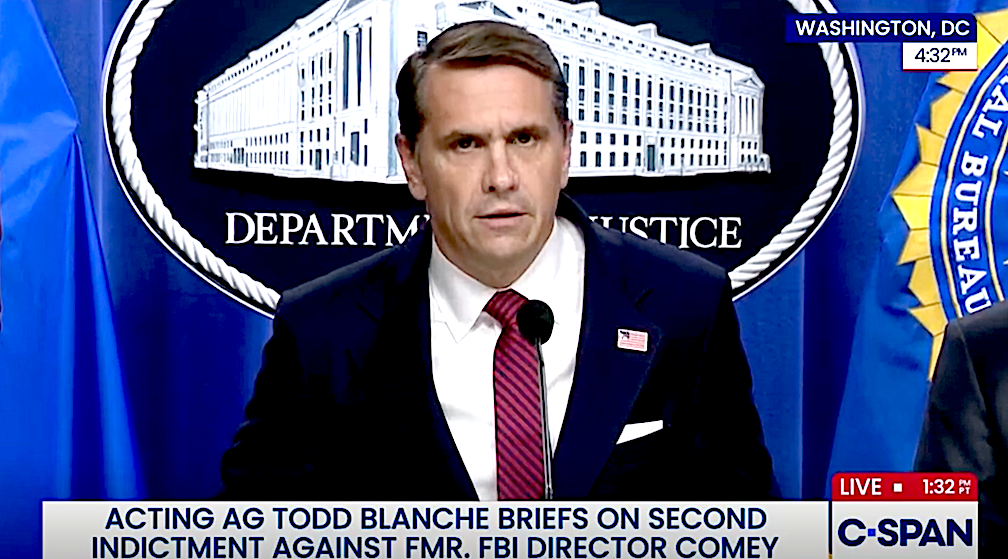
Acting Attorney General Todd Blanche announcing that a grand jury in North Carolina returned an indictment against former F.B.I. Director James Comey for allegedly threatening President Trump on April 28. (C-Span still)
By Andrew P. Napolitano
 In 200-plus years of interpreting the free speech clause of the First Amendment, the courts have narrowed and expanded its scope. The Supreme Court employed a particularly narrow approach during much of the last century, through two world wars and then the Red Scare in the 1950s.
Thankfully, in the 1960s, the Warren Court began a remarkable and thus far unimpeded march toward compelling the government to tolerate open, wide, caustic and even threatening speech.
When crafting the First Amendment with its iconic speech clause — “Congress shall make no law … abridging the freedom of speech” — James Madison insisted that the word “the” precede the word “freedom” so as to make clear the understanding of the drafters and ratifiers that the freedom of speech existed before the government did. This presumption — that speech is pre-political — has a theoretical and a practical application.
Madison’s theoretical application, shared by Thomas Jefferson and articulated by him in the Declaration of Independence — that our rights are endowed within us by our Creator — is that free speech is inherent in our human nature. Hence, it is a natural right that all persons have irrespective of the place or time of their births — or the government’s wishes.
The practical application is that free speech is vital to popular government. If people fear expressing opinions that might antagonize the government, they will hesitate to speak freely; and then debate over matters of public importance will be minimized rather than be a part of robust deliberative processes out of which many ideas are sifted and challenged.
When the government threatens to punish speech, the threat harms not only the person charged, but it also chills the expressive rights of others. It gives others pause before articulating an opinion that might offend those in power. In recent years, the federal courts have criticized chilling by the government, deferring instead to the open marketplace of ideas.
Speech should rise or fall — be influential or ignored — based on its ability to be accepted in the marketplace of ideas, not on whether it pleases the government.
Until now.
Comey’s Instagram Post
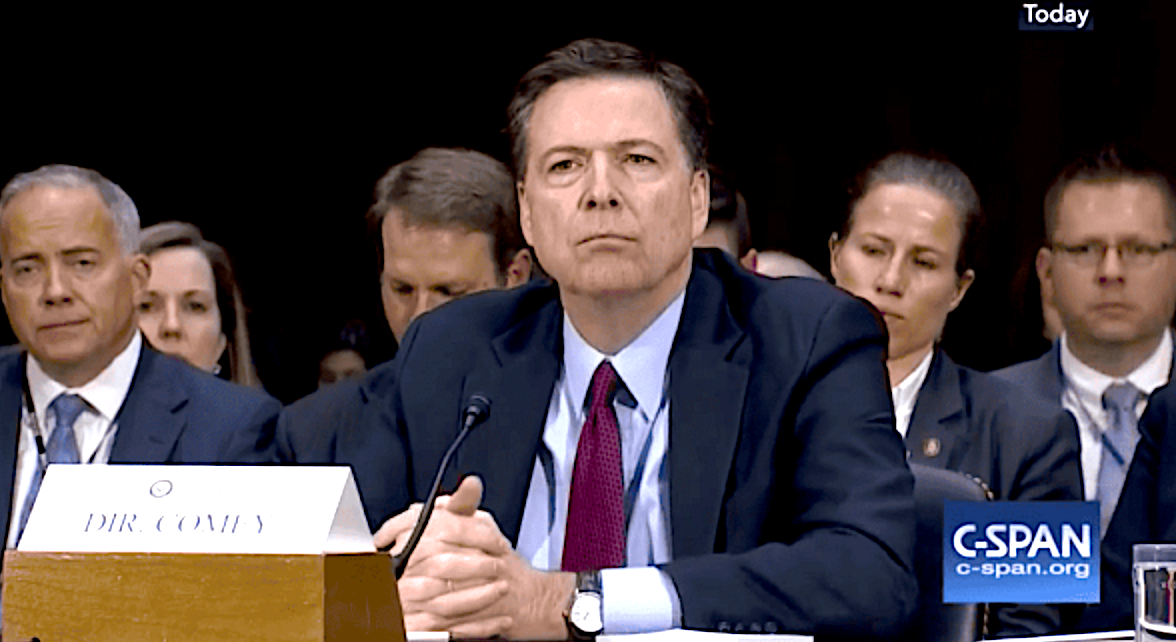
Then F.B.I. Director Comey testifying to Congress that the agency had been denied access to DNC servers, March 20, 2017. (C-Span still)
Now, the Trump Department of Justice has persuaded a grand jury in North Carolina to indict James Comey, the former federal prosecutor, DoJ official and F.B.I. director, for posting on Instagram a photo of a configuration of sea shells on a beach that someone else had crafted displaying the numbers 8647.
The government’s theory of its case is that the 47 refers to the 47th president of the United States, Donald Trump, and the 86 offers to kill him. Having worked in restaurants in my youth, I recall the use of 86 in restaurant jargon. There, it means that whatever item is articulated with the 86 is no longer available for offering to patrons. “Espresso is 86ed!”
The DoJ apparently persuaded the grand jurors that on a beach and coming from Comey, 86 expressed both a wish and an intent to kill Trump.
But the Comey posting was last year. That indicates that the DoJ itself did not take it as a serious threat. Secret Service agents — not the DoJ or F.B.I. — interviewed Comey via a phone call, and he satisfied them that he had no intent to harm anyone, least of all the president.
Then came the true threat to the president at the Washington, D.C., Hilton Hotel last month at which a dangerous and deranged man sought to kill him and others. Two days after that event, the DoJ presented its case against Comey to the grand jury.
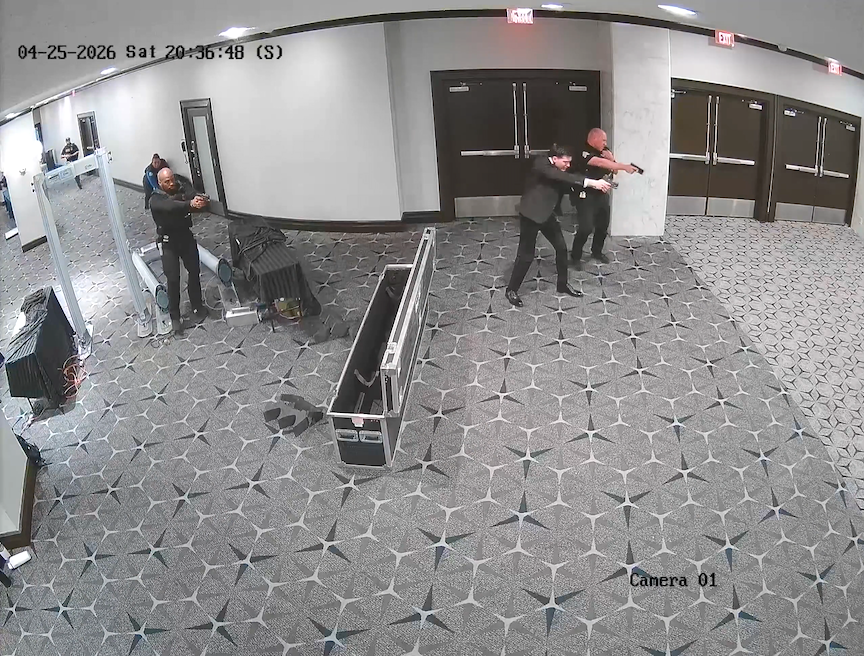
Law enforcement responds to a shooting at the White House Correspondants’ Dinner at the Washington Hilton Hotel on April 25. (CCTV/F.B.I./Wikimedia Commons/ Public Domain)
Is the benign posting of 8647 on Instagram protected speech? In a word: YES.
The Supreme Court has ruled consistently, as recently as 2023 in Counterman v. Colorado, that, if there are two or more interpretations of the behavior or speech which forms the basis of a criminal charge and at least one of them is not criminal, the non-criminal interpretation prevails over the criminal interpretation.
This derives from the presumption of innocence and is known as the rule of lenity. It commands courts to interpret ambiguous statutes, behavior and speech in a light favorable to a defendant. This is especially so in a case involving pure speech — that is, speech unaccompanied by any action taken to further the accomplishment of the words used by the defendant.
In a 1969 case, Watts v. United States, the court held that when a young man who was condemning the draft in the Vietnam era told a gathering that, if forced to carry a rifle for the government, the first person to be in his sights would be President Lyndon B. Johnson, he was not threatening the president as he had no immediate means to carry out his stated wish, nor was anyone in the crowd he addressed incited to make an attempt on LBJ’s life.
The Comey case is on all fours with the Counterman and Watts cases, as the government has not charged that Comey’s posting incited any of the attempts on Trump’s life of which we are all painfully aware.
This furthers the doctrine of constitutional avoidance by which courts are encouraged to terminate criminal cases based on reason, rather than equivocal constitutional jurisprudence.
But there is nothing equivocal in applying basic First Amendment principles here, and that can easily be done under the seminal and unanimous 1969 Supreme Court decision, Brandenburg v. Ohio.
There, a KKK leader in Ohio encouraged violence against Blacks and Jewish people in Washington, D.C., but no one in his audience reacted violently. In overturning his conviction in an Ohio state court, the Supreme Court ruled that all innocuous speech is absolutely protected and all speech is innocuous when there is time for more speech to rebut, neutralize or challenge it.
If the government can’t leave free speech alone, then its oath to the Constitution and the Constitution’s stated guarantees are meaningless.
Andrew P. Napolitano, a former judge of the Superior Court of New Jersey, was the senior judicial analyst at Fox News Channel and hosts the podcast Judging Freedom. Judge Napolitano has written seven books on the U.S. Constitution. The most recent is Suicide Pact: The Radical Expansion of Presidential Powers and the Lethal Threat to American Liberty. To learn more about Judge Andrew Napolitano, visit https://JudgeNap.com.
Published by permission of the author.
COPYRIGHT 2024 ANDREW P. NAPOLITANO
DISTRIBUTED BY CREATORS.COM
The views expressed are solely those of the author and may or may not reflect those of Consortium News.
[ad_2]
Source link
