
[ad_1]
As Washington retreats from multilateral institutions to instead opt for bilateral and transactional engagements, much of the world expects China to fill the gap, writes Damilola Banjo.
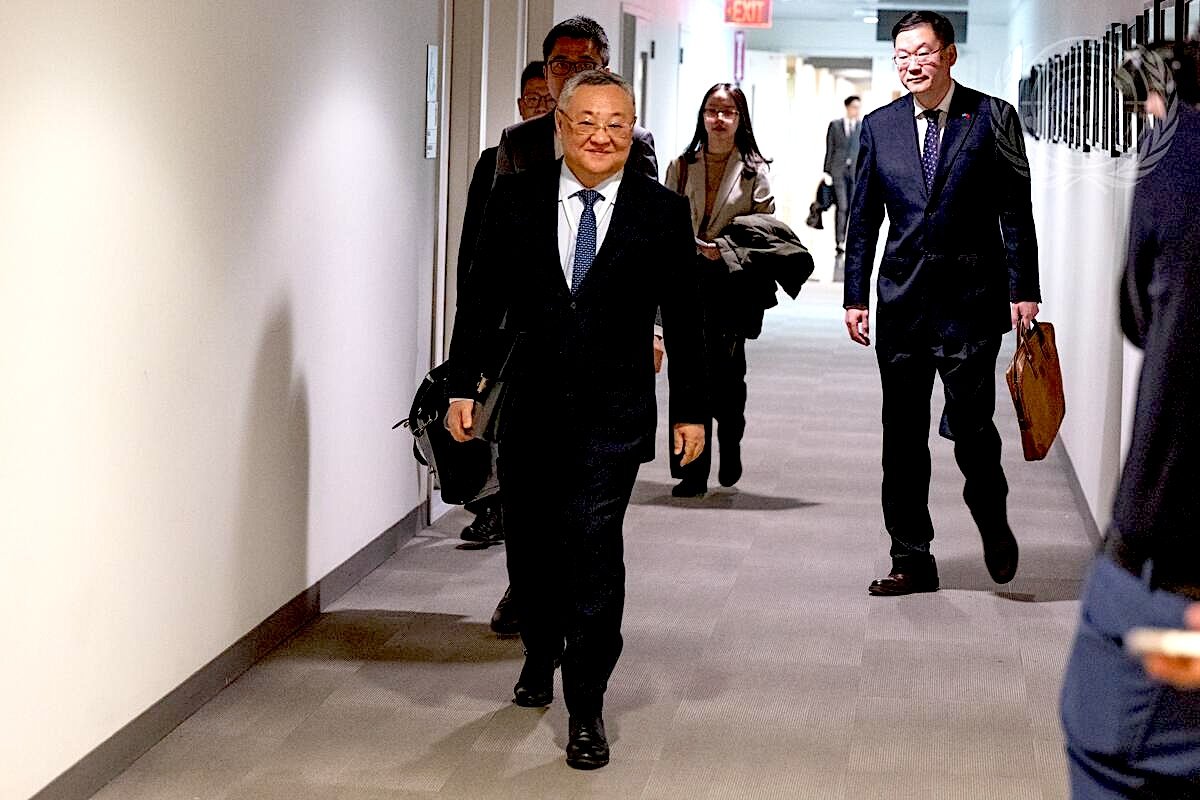
China’s U.N. Ambassador Fu Cong, president of the Security Council this month, arriving to brief reporters on May 1. (UN Photo/Eskinder Debebe)
 When Fu Cong, China’s ambassador to the United Nations, was asked whether Beijing intended to fill the financial and other voids left by Washington in the multilateral system, he said that China was already the “de facto” No. 1 contributor to the U.N. regular budget and had no interest in replacing the United States.
Over the last 15 months, the Trump administration has cut funding to several U.N. agencies, withdrawn from numerous international bodies and treaties, made token payments toward its mandated dues and pushed consistently for narrower, cheaper peacekeeping mandates.
The dismantling of USAID has removed what was once the single-largest development finance operation in the world. The U.S. has paid only about $160 million toward its nearly $4 billion debt to the U.N., accrued under the last two administrations.
But Beijing has not moved to claim the institutional space Washington is vacating. It has not pursued top leadership positions in the agencies the U.S. has abandoned. It has not deployed its financial weight to cushion an institution increasingly starved of American dollars. Indeed, China has continued to pay its own annual dues, albeit late, further compounding the U.N.’s liquidity crisis.
China, like many U.N. member states, pays its mandatory contribution late. In 2025, Beijing’s annual dues of $685.7 million were wired in late October, eight months after the February deadline. It has yet to pay its share for 2026.
“It’s not that the U.S. is withdrawing and China is filling the gap. That is not true,” Fu said on May 1 at U.N. headquarters as the country assumed the monthly rotating presidency of the Security Council in May.
“This is not a zero-sum game between China and the U.S.,” he said.
As Washington retreats from multilateral institutions to instead opt for bilateral and transactional engagements, much of the world’s expectation is that China, the second-largest economy in the world, will fill the gap and take more responsibilities.
Even within the U.S. government, the fear of China’s growing influence is palpable, but in rhetoric and actions, China seems wary of offering itself as the world leader in global governance. Rather, it is capitalizing on America’s retreat while avoiding the costs and responsibilities of full authority.
China benefits from a U.N. that continues to enjoy commitments from countries and major power blocs, but Beijing is not willing to pay for it, said Jeremy Chan, a senior analyst at the Eurasia Group think tank. Beijing does not want to manage global hotspots, he added, particularly problems that are far from its shores. It also does not have the ability to project influence in far-flung locations.
“Beijing lacks both the capability and the willingness to fill the vacuum left behind by the U.S. retreat from the U.N.,” Chan said. “This is due to both China’s longstanding foreign policy principles, most notably its unwillingness to interfere in the sovereignty of other nations and its respect for the veto rights of all permanent members of the U.N. Security Council, including the U.S.”
Championing the UN Charter

U.N. headquarters in New York in 2024. (LPulecio-WMF/ Wikimedia Commons/ CC BY 4.0)
As chair of the Council this month, China aims to highlight the virtues of multilateralism, as it did in February 2025, when it last held the rotating presidency. Fu said Beijing would convene a high-level open debate on revitalizing “authority of the U.N. Charter and the role of the United Nations.” (The Council’s provisional program of work.)
The meeting, he said, will allow Council members to describe how they will keep the 80-year-old organization on top of today’s global challenges and “reaffirm” their commitment to the U.N. Charter and the U.N.’s role in the international system.
A U.N.-led multilateral system suits China’s interests, Chan said, because Beijing could continue to wield its veto as one of the five permanent members of the Security Council (including Britain, France, Russia and the U.S.) over international action it disagrees with, while being insulated from direct exposure to messy global conflicts or spillover.
(Significantly related to multilateralism, Fu also told journalists on May 1 that China will “be happy to see” a female U.N. secretary-general and backs the turn of the Latin America/Caribbean region to claim the spot.)
On the development front, Washington, through USAID, donated specialized grants across a wide range of sectors in many African countries. It funded programs from malnutrition to HIV treatments, but Beijing has less interest in this type of development assistance, experts say.
In Zambia, where disruptions to U.S.-funded aid have strained healthcare services like HIV treatment, China’s engagement has centered on large infrastructure projects that support the transport of critical minerals.
Zambia and Tanzania have granted the China Civil Engineering Construction Corporation a roughly 30-year concession to rehabilitate the 1,860-kilometer Tazara railway. The line connects the resource-rich regions of landlocked Zambia to the Tanzanian port of Dar es Salaam on the Indian Ocean, providing a key export route for copper and other minerals.
China’s approach to economic engagement in developing countries has largely centered on state-backed loans and infrastructure construction, an approach that aligns with its commercial interests.
While Africa accounts for only a modest share of China’s global exports, shipment to Africa grew 56.4 percent in September 2025. In recent years, China has been projected to receive more in debt repayments from Africa than it disburses in new loans.
“In the end,” said Richard Gowan, the global issues and institutions program director at the International Crisis Group think tank:
“China does not have to do much to gain more influence around the U.N. when the U.S. is pulling back. Beijing gains credibility and influence by default. The Chinese strategy is to sit tight and point to their belief in the U.N. Charter, as they are doing through this month’s flagship event.”
Damilola Banjo is a reporter for PassBlue.
This article is from PassBlue.
Views expressed in this article may or may not reflect those of Consortium News.
[ad_2]
Source link
