
[ad_1]
In one of the scariest moments in modern history, we're doing our best at ScheerPost to pierce the fog of lies that conceal it but we need some help to pay our writers and staff. Please consider a tax-deductible donation.
Review of Truth and Consequence: Reflections on Catastrophe, Civil Resistance, and Hope, by Daniel Ellsberg, ed. Michael Ellsberg and Jan R. Thomas (New York: Bloomsbury, released 3/2/26)
Peter Dale Scott
Eager as I was to review this collection of Daniel Ellsberg’s unpublished writings, for days all my available time was spent in fascinated reading, as I learned more and more about this man I thought I knew so well. I came to visualize Dan’s mind as a vast cathedral, with myself gazing upwards from its Poet’s Corner. My mind kept hearing a line from Robert Oswald’s eloquent Foreword: “And there is so much more.”
This is a truly accomplished book, and its origins are astonishing. Dan’s longtime assistant, Jan Thomas, had returned to organize his papers scattered throughout 500+ long-buried boxes in his office basement. Fortuitously, she knew his work well, she happened to be an editor, and she could decipher his difficult handwriting as no one else could. Glimpsing the unusual and wide-ranging insights in his hundreds of notebooks, she set out to harvest and curate this material.
The result is a magnificently edited book that offers a window into Dan’s innermost thoughts over a 50-year period, starting with the year he released the Pentagon Papers. I knew him throughout this time, yet the depth and scope of his thoughts in Truth and Consequence were a revelation for me. His writing voice in the notebooks is entirely different from his other writing — simpler, sharper, and introspective. It gets right to the point.
Dan was a gifted prose writer. The book rightly opens with several chapters he wrote thirty years ago, taken from the introspective, personal autobiography that he began to write but soon abandoned when he decided instead to produce his politically urgent memoir, The Doomsday Machine: Confessions of a Nuclear War Planner.
Although he didn’t refer to it often through the years, I knew that the accident that killed his mother and sister, which he discussed at length in Part One, had weighed heavily on him. It seemed evident to me that this trauma contributed to his lifelong focus on preventing the massacre of innocent civilians. Here, he confirms this impression:
When an opportunity arises to protect women and children by “just sitting,” I feel a strong desire and obligation to do it. I feel similarly when it is time to “wake up the driver”—the Authority, the President. (1983). 1
The notebooks track his evolution from a critic of bureaucracy as a former insider –
Why did I never hear anyone raise the question “Is this right?” Why were ethical or moral principles never mentioned? The only questions raised were, “Will this work?” “Is it expedient?” “Is it worth the risk?” “Will we get away with it?” 2
to what in 1975 he called a
“different line of work” from the bureaucrats: telling the truth about the war, not “the” truth, but truths compared to the usual reporting. I was resisting Authority and the war, taking risks of my career and reputation – and later in my freedom. 3
Throughout, Truth and Consequence lifts up Dan’s preoccupation with questions of moral consequence. Although he never published his writing on morality per se, the topic was clearly at the center of his concerns through the years.
All mass harm or killing is done for reasons—usually not all bad, invalid, or selfish—that are not enough to justify it. (2020) 4 I want us to be more like who we think we are. (2019). 5
This book shows how deeply Dan understood and loved America in all its strengths and weaknesses. He saw its capacity for good and also for evil.
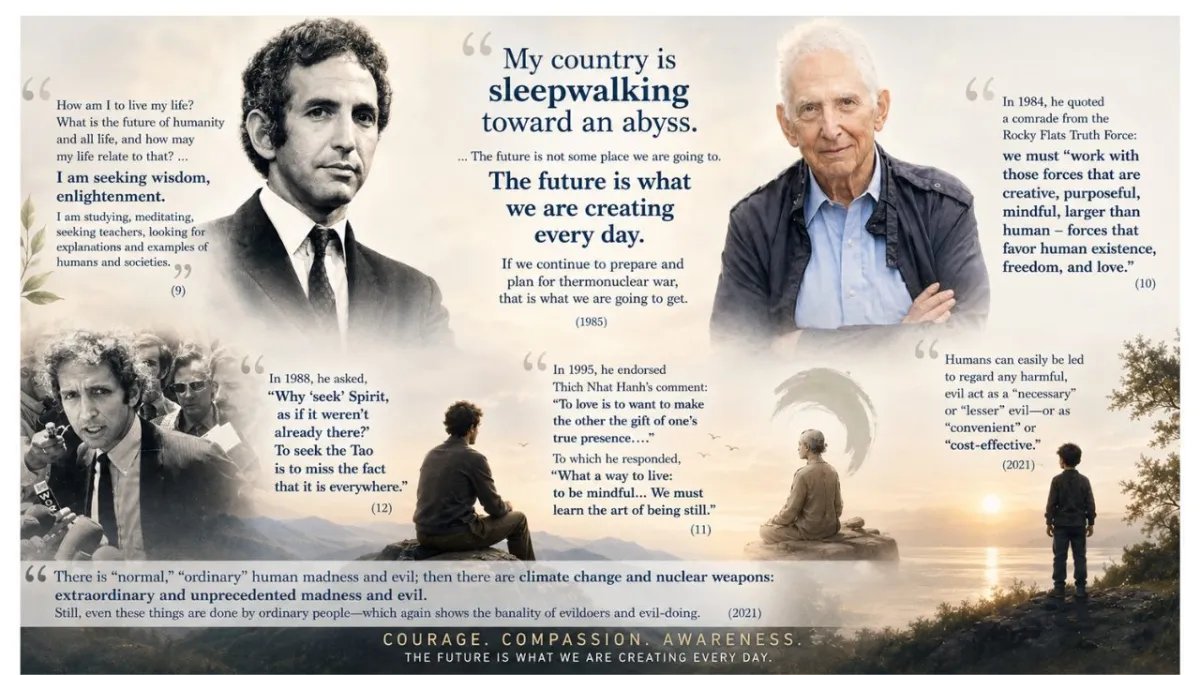
Humans can easily be led to regard any harmful, evil act as a “necessary” or “lesser” evil—or as “convenient” or “cost-effective.” (2021) 6 There is “normal,” “ordinary” human madness and evil; then there are climate change and nuclear weapons: extraordinary and unprecedented madness and evil. Still, even these things are done by ordinary people—which again shows the banality of evildoers and evil-doing. (2021) 7
Dan uncannily foresaw where the country might be headed. Nearly 40 years ago, he concurred with Nixon‘s comment about Alabama Governor George Wallace’s presidential candidacy in 1972:
“This country is going to go so far to the right that you won’t recognize it.” (1988) 8
As the book’s subtitle acknowledges, Dan said of himself, “I am a person of Hope.” However, he had been alienated by his parents’ strident teaching of Christian Science, and in our long telephone conversations he consistently denied my vigorous contention that he was also a man of faith. Thus, I was happily surprised to discover quite a few spiritual references in the notebooks:
In 1975, he wrote, “How am I to live my life? What is the future of humanity and all life, and how may my life relate to that? … I am seeking wisdom, enlightenment. I am studying, meditating, seeking teachers, looking for explanations and examples of humans and societies.” 9 In 1984, he quoted a comrade from the Rocky Flats Truth Force: we must “work with those forces that are creative, purposeful, mindful, larger than human – forces that favor human existence, freedom, and love.” 10 In 1988, he asked, “Why ‘seek’ Spirit, as if it weren’t already there? To seek the Tao is to miss the fact that it is everywhere.” 12 In 1995, he endorsed Thich Nhat Hanh’s comment: “To love is to want to make the other the gift of one’s true presence…. the gift of being truly there.” To which he responded, “What a way to live: to be mindful… We must learn the art of being still.” 11
Dan became a wager of peace, rooted in the philosophy and practice of Satyagraha — “truth force,” which he described as “clinging to the truth with one’s entire weight.” (2011) 13 He was one of the first to use truth — confronting lies — as a social change weapon. Although he was by no means alone in this, few matched him as an influencer.
He had many gifts and many obsessions. Among his greatest obsessions was his overwhelming commitment to reduce the risk of nuclear conflagration.
My country is sleepwalking toward an abyss. … The future is not some place we are going to. The future is what we are creating every day. If we continue to prepare and plan for thermonuclear war, that is what we are going to get. (1985) 14
Back in 1971 when the Pentagon Papers were released, I had a strong sense of who had leaked them, although I’d never met Dan. Earlier that year, he had published a well-written piece about Laos in the New York Review that caught my eye, which ended by his quoting extensively from T.S. Eliot. His writing suggested somebody who knew a great deal about Laos, yet the elegance of his writing was highly uncharacteristic of bureaucrats.
“This is a rare mix,” I thought at the time. “This is somebody I would like to get to know.” So I took note of the name “Daniel Ellsberg”. Then when the Pentagon Papers first surfaced, I said to myself, “This must be him.” A year later, we began what became a lifelong friendship.
I wonder what he would make of this chronicle of his inner world. It is certain that he never expected his notebooks writing to see the light of day. As he said to Jan, the notebooks were solely “to work out my own thoughts.” We can be grateful for the unlikely outcome: having his most deeply held values and beliefs represented in this extraordinary book. Otherwise, his notebooks and the rich material they contain might have been lost to history.
Dan lived his life governed by a passionate love of the world that asked everything of himself, a passion which has helped inspire many others. This year, amazingly, we have seen millions in the streets protesting for truth and justice. This book captures Dan’s passion for that truth movement, more clearly than anything he ever published in his lifetime.
Peter Dale Scott is a Canadian poet, scholar, and former diplomat whose work has shaped contemporary understanding of U.S. foreign policy, deep politics, and the hidden forces that drive modern state power. A professor emeritus of English at the University of California, Berkeley, he is the author of landmark studies including Cocaine Politics, Deep Politics and the Death of JFK, The Road to 9/11, American War Machine, and The American Deep State. His poetry—most notably the long political epics Coming to Jakarta and Minding the Darkness—bridges the personal and the geopolitical, exploring the moral and emotional costs of state violence. A longtime critic of U.S. militarism and covert operations, Scott has been translated into more than a dozen languages and remains one of the most influential voices examining the intersection of empire, secrecy, and democracy.
Editor’s Note: At a moment when the once vaunted model of responsible journalism is overwhelmingly the play thing of self-serving billionaires and their corporate scribes, alternatives of integrity are desperately needed, and ScheerPost is one of them. Please support our independent journalism by contributing to our online donation platform, Network for Good, or send a check to our new PO Box. We can’t thank you enough, and promise to keep bringing you this kind of vital news.
You can also make a donation to our PayPal or subscribe to our Patreon.
Please share this story and help us grow our network!
[ad_2]
Source link
