
[ad_1]
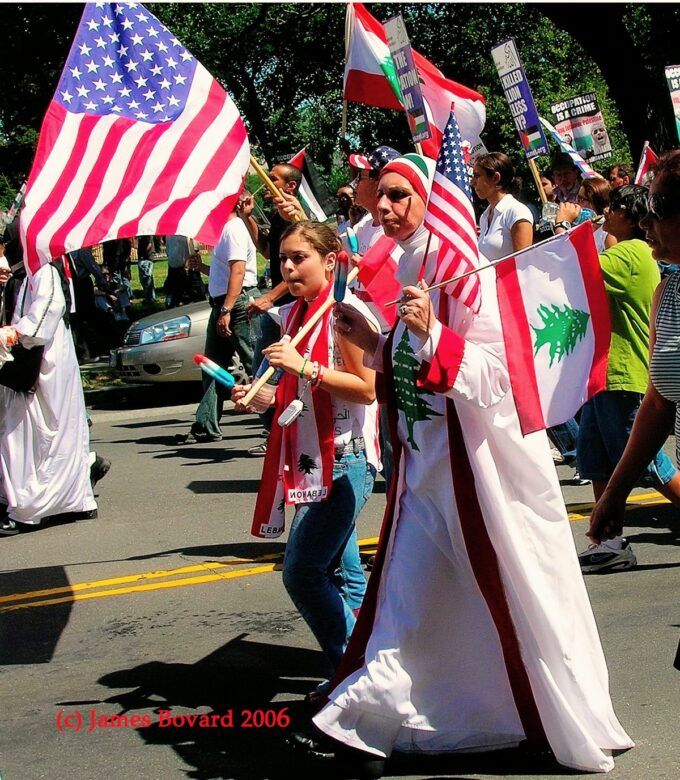
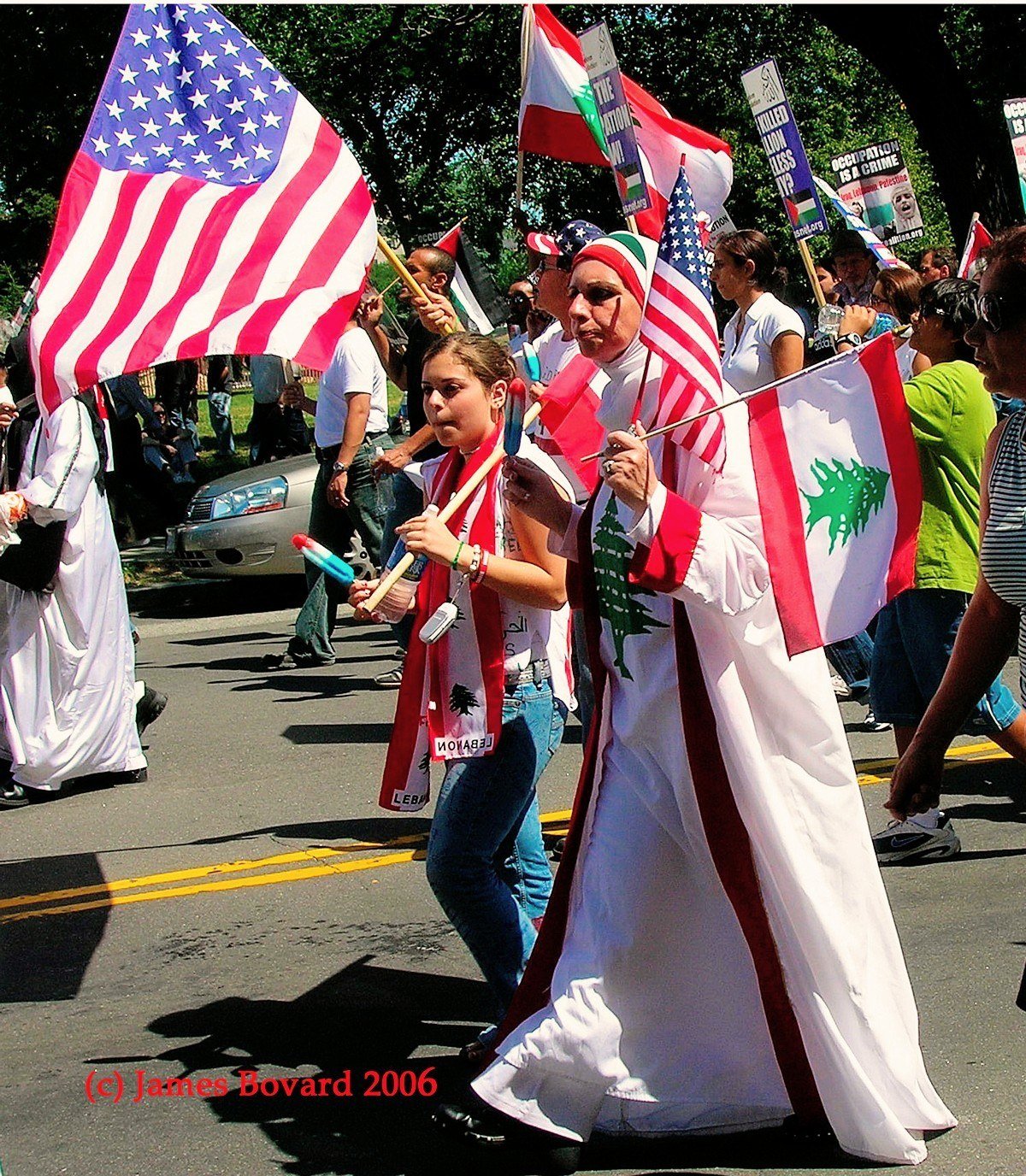
Mother and daughter at Lebanese-American protest in DC against bombing of Lebanon in 2006.
Israel’s bombing of Lebanon has reportedly killed more than a thousand civilians this year. Israel also drove out more than a half million civilians from southern Lebanon as part of an effort to confiscate or ravage that territory. The New York Times reports that Israel is “applying the Gaza model in Lebanon,” destroying entire towns and villages and leaving the rubble uninhabitable. Israel’s bombing has been so indiscriminate that even President Trump pretended to object. On Truth Social, Trump announced: “Israel will not be bombing Lebanon any longer. They are PROHIBITED from doing so by the U.S.A. Enough is enough!!!”
Trump’s assertion had as much effect as his boasts about how he already won the war against Iran. The Israeli military continues assailing Lebanon and Trump’s attention long since wandered back to his ballroom.
The latest attacks are reminiscent of Israel’s 2006 invasion of Lebanon, which also killed roughly a thousand civilians, as well as a few hundred Hezbollah fighters. With the Bush White House cheerleading all the way, Israel assailed Lebanon in response to Hezbollah’s seizure of two Israeli soldiers. Israel and Hezbollah had been exchanging bombs and missiles for years prior to Israel’s launching a bombing campaign that soon expanded to include much of Lebanon. The carnage was wildly popular on Capitol Hill, where the House of Representatives voted 410-8 in favor of a resolution endorsing Israeli military action. But the Israeli military didn’t do as well in south Lebanon as they did in the halls of Congress. Hezbollah thwarted the invasion in one of the biggest defeats for the Israeli military since the start of the Yom Kippur War in 1973.
On August 12, 2006, thousands of people gathered near the White House to protest U.S. support for the Israeli attacks on Lebanon. At that time, some American pundits were portraying Arabs as would-be terrorists waiting to wreak havoc on the United States.
But I saw plenty of demonstrators that day who looked more wholesome than your average political zealot of any persuasion. This photo I snapped of a mother and daughter marching along captured the all-American reality of many supporters of Lebanon. The mother is wearing traditional Lebanese garb and carrying both a U.S. flag and a Lebanese flag. The daughter is soaking up the scene while chomping on a popsicle. This is a pair that would have fit in with practically any American Fourth of July celebration. Perhaps they were typical of the nearly 700,000 Lebanese-Americans tabulated in the 2020 census.
There were plenty of Arab Americans at the protest who were confounded to see the U.S. government supporting the attacks on their kinfolks. One protestor held up a sign by the White House: “President Bush: You Can Stop Israeli Crimes in Gaza and Lebanon.” But it was impossible to exaggerate the president’s spinelessness. After an Israeli airstrike on an apartment building in Qana, Lebanon killed 28 civilians two weeks earlier, the New York Times reported: “Facing one of the most awkward moments in recent relations with Israel, Bush described the current Middle East crisis as part of a larger struggle between the forces of freedom and the forces of terror.” Bush refused to call for a ceasefire regardless of how many Lebanese children the Israelis killed in the name of anti-terrorism. And the U.S. government continued rushing more armaments to Israel to enable the carnage to continue.
The U.S. government has been perennially dragged into Lebanese quagmires since the Reagan era. In June 1982, a terrorist organization headed by Abu Nidal (the Osama bin Laden of the 1980s) attempted to assassinate the Israeli ambassador in London. Nidal’s forces had previously killed many Palestinian Liberation Organization (PLO) officials in numerous bomb and shooting attacks, since they considered Yasir Arafat a traitor for his stated willingness to negotiate with Israel. Prime Minister Menachem Begin of Israel exploited the shooting in London to send the Israeli Defense Forces (IDF) into Lebanon to crush the PLO. Yet, as Thomas Friedman noted in his book From Beirut to Jerusalem, “The number of Israeli casualties the PLO guerrillas in Lebanon actually inflicted [was] minuscule (one death in the 12 months before the invasion).”
Defense Minister Ariel Sharon told the Israeli cabinet that his 1982 “Operation Peace for Galilee” would extend only 40 kilometers into Lebanon. However, Sharon sent his tanks to Beirut, determined to destroy the PLO once and for all. As David Martin and John Walcott noted in their 1988 book, Best Laid Plans: The Inside Story of America’s War against Terrorism, the U.S. embassy in Beirut “sent cable after cable to Washington, warning that an Israeli invasion would provoke terrorism and undermine America’s standing in the Arab world, but not a word came back.”
The Palestinian Red Crescent estimated that 14,000 people, most of them civilians, were killed or wounded in the first month of the operation. When Palestinians fought back tenaciously, the IDF responded with indiscriminate bombing, killing hundreds of civilians. The Israelis cut off Beirut’s water and electricity supply and imposed a blockade. The IDF bombed the buildings housing the local bureaus of the Los Angeles Times, United Press International, and Newsweek. U.S. publications gave far more coverage to Israeli carnage against civilians back then than they have allotted in the current conflict.
U.S. troops were sent to Beirut to help buffer a cease-fire. After the U.S. military intervened against Muslims in the Lebanese Civil War, a Muslim truck bomber killed hundreds of U.S. Marines in October 1983. On the 20th anniversary of that attack in 2003, I wrote a Counterpunch article headlined, “The Reagan Roadmap for an Antiterrorism Disaster.” Reagan responded to the Marine barracks bombing by pulling U.S. troops out of Lebanon, one of the few bright spots in U.S. policy in that part of the world in the last half century.
It would be foolish to expect the Trump White House to show wisdom or courage in its Middle East policy. I have the same recommendation now that I had in a 1987 USA Today piece opposing deploying U.S. Navy to the Persian Gulf: “This is not our war, and there is no profit in U.S. intervention.” GTFO remains the best Middle East policy for America.
An earlier version of this piece was published by the Libertarian Institute.
[ad_2]
Source link
