
[ad_1]
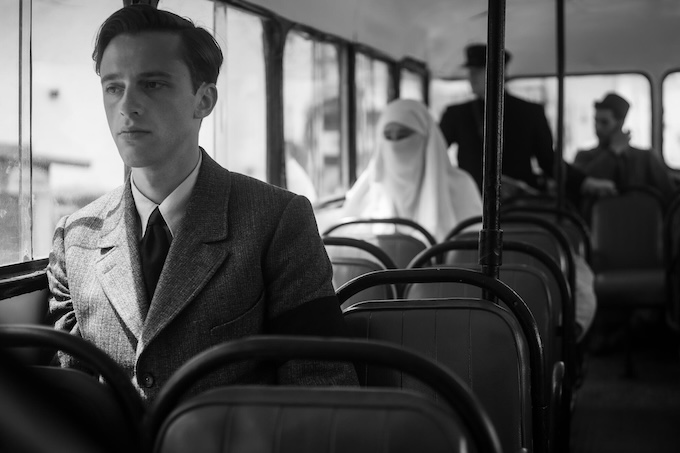
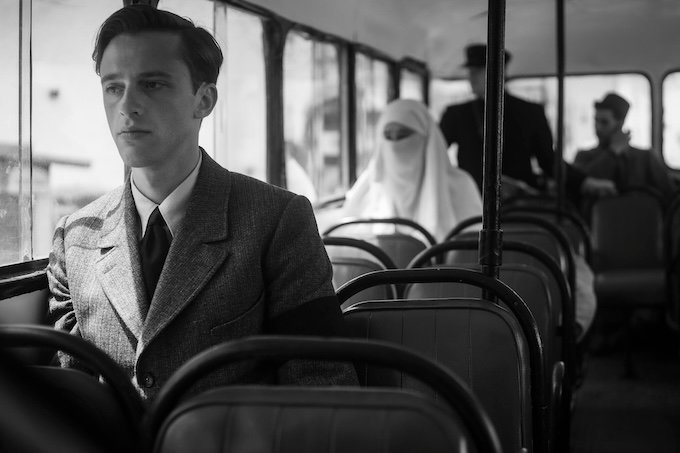
Still from Francois Ozon’s film of Camus’ “The Stranger.” (Music Box Films)
One of the few guarantees in life is loss. The unmerciful realities of temporal existence and entropy make the pain of separation a sole constancy. Over the course of an average life, a person will lose not only one person of emotional importance, but many. A few will take their last breath after an extended and humiliating period of decline, giving the bereaved an opportunity to prepare, which despite what logic would have us assume, doesn’t always make the blow any easier to absorb, while others will exit like captives making a jailbreak or party guests who neglect to say, “goodbye.” The surprise does seem to make the aftermath worse.
Grief is universal. The disorientation, burden, and sadness that it brings transgresses all racial, ethnic, and national differences. To wrap it up in simplest terms, grief is hard. It is especially hard in the United States of America. As if representatives of each sector met in a shadowy hideaway, the most powerful institutions of governance and finance, the most dominant social norms, and the most influential pop culture appear to conspire to coordinate a society that makes grief more confusing and alienating. Everyone from Sarah Winnemucca, a Native American leader in the nineteenth century who authored the first autobiography of an indigenous woman, to patrician man of letters, Gore Vidal, questioned if the US even has a culture, but there is little doubt that the most triumphant strain of the society is its consumer culture. “The chief business of the American people is business,” President Calvin Coolidge famously said. Its people, as he went on to say, are “profoundly concerned with producing, buying, selling, investing and prospering.”
Grief doesn’t sell. More important, the dead don’t make good consumers. A corpse cannot produce, buy, sell, or invest. Their erasure, along with the eradication of anything that might provoke sustained reflection and appreciation in regard to the lives they led – to the past – becomes an important business practice. Life, especially as it becomes inseparable from the market, is for the living.
Of course, the people whose business is business are nothing if not clever, always able to brandish their latest “innovations” and “disruptions.” So, grief doesn’t sell, except when it does. There are countless grief manuals that line the shelves of the remaining bookstores. One forthcoming release promises the bereaved, “40 grief-centered meditational practices.” Grief podcasts can fill the earbuds of listeners with endless chatter, and then, of course, the self-help racket offers high priced seminars to those who miss their deceased loved ones. Meanwhile, psychotherapy has become big business with an entire generation of Z’s operating according to the belief that sorrow, disappointment, worry, sadness, and even the slightest pang of unpleasantness, are not inevitable and unavoidable aspects of the human experience, but problems to troubleshoot with professional intervention. The amateur therapist and the professional podcaster are in agreement that grief should lead to an epiphany, conversion, or transformation. It is a lesson, perhaps even for which the bereaved will eventually feel grateful. But those who live with their grief with honesty realize that grief doesn’t teach as much as it hurts. Sure, it might affirm the power of love or the value of counting blessings, but that is similar to someone saying, “Getting hit on the head with a hammer reminded me of the importance of cognitive health.”
I recently lost two of my closest friends. They were both dedicated to movements that sought to make America a more humanistic, humanitarian, and ultimately, human society. Working for civil rights and social justice consumed them. To mourn my friends demands that I survey the disparity between the country in which they hoped, labored, and fought to live, and the one that they left behind. It is an unsettling and bizarre experience.
Grief is a sustained examination of the value of life. Because the lives of my friends ended, I am dealing with their eternal and irreplaceable value. There is only one of each person. So, when that person dies, we feel what they meant. We feel how much they mattered. The intensity of that feeling is painful. It is also strange in a society that consistently diminishes and devalues, often to the extent of denial, the value of human life.

Burial vaults at Mt. View Cemetery in Oregon City, during height of Covid pandemic. Photo: Jeffrey St. Clair.
To grieve people who committed themselves to civil rights and social justice is also to grieve a society currently swinging a wrecking ball at those pillars of a just world. It is to measure the distance between the friends that I admired and a large percentage of the American people who treat civil rights and social justice with indifference or even contempt. Finally, it is to live in a strange inversion of the Albert Camus novella, The Stranger.
In Camus’s first published work of fiction, the protagonist, Meursault, learns of the death of his mother. In French Algeria, he goes through the motions of requesting time off work, attending the funeral arranged by the director of the nursing home where she resided, and seeing to her burial, but he seems to feel nothing. His emotional detachment is not only odd. It is borderline psychopathic. One of the most unforgettable passages involves the memorial service. Meursault obsesses over his body temperature, the physical appearance of his mother’s mourners, and his own fatigue. It disturbs him that a nurse from the nursing home is wearing a bandage over his nose, and he finds the sobbing of one of his mother’s friends annoying. When she stops crying, while thinking of his back pain, he then thinks that the silence irksome: “Now it was all these people not making a sound that was getting on my nerves. Except that every now and then I’d hear a strange noise and I couldn’t figure out what it was. Finally I realized that some of the old people were sucking at the insides of their cheeks and making these weird smacking noises. They were so lost in their thoughts that they weren’t even aware of it.”
Later in the novel, Meursault murders an Arab without a clear motive, provoking the reader to consider the effects of colonialism and Meursault’s own refusal to engage with the stakes of life and death. Apathy is his defining characteristic until his bitter end. When in a jail cell, awaiting his execution, he comes to embrace the “benign indifference of the universe.” Camus said that The Stranger was about “man faced with the nakedness of the absurd.” Meursault fails to see any meaning in the world beyond his immediate physical sensations, whims, and fluctuations of temperament.
The focus of Camus’s intellectual life and work was not domestic. It went beyond France and Algeria to touch upon the most fundamental questions of philosophy, politics, and psychology. Those questions are not unique to the United States, as Camus’s own background demonstrates, but they are, perhaps, sharper in the United States. The blade of absurdity cuts everywhere. In the US, it lacerates.
Imagine wrestling with the grief of losing a loved one in a mass shooting, only to watch your country move on as if it didn’t happen. Even worse, the ruling political party and its tens of millions of voters celebrate and fetishize the lethal weapon that your child, spouse, parent, sibling, or friend’s killer used to commit the crime. Meanwhile, the opposition party never even speaks of the issue.
Imagine wrestling with the grief of losing a loved one to a treatable disease, knowing that your child, spouse, parent, sibling, or friend did not acquire adequate care, because their insurance policy forbid it or they could not otherwise afford it. Then, you watch an insurance industry profit in the billions from denying other people’s loved ones medical care, while the political system has arguments about stripping millions of people of health care coverage.
Imagine wrestling with the grief of losing a loved one in the Covid-19 pandemic, learning that the US did relatively little as compared to the rest of the developed world to prevent Covid deaths, and then listening to the most powerful forces in media and politics discuss how the main lessons of the pandemic are that governing authorities kept schools and business shut too long, and that the vaccine didn’t do all that epidemiologists initially promised.
Imagine caring for a disabled child or close family member, only to have to go through the annual irritation and indignity of having to prove that said relative is sufficiently disabled to qualify for the miserly aid that the state government is able to provide. Meanwhile, perhaps as you help your loved one to bathroom, wipe his chin, or remind him to take his medication, you hear the news that the federal government intends to further cut assistance programs for families caring for disabled children.
Imagine wrestling with the grief of losing a loved one to an act of police brutality, only to see both political parties and innumerable programs on television treat agents of law enforcement as knights on horses galloping into the village to slay dragons and save princesses. If you live in a major city, the police union is the most powerful political force in your community.
It is difficult to contemplate anything more nakedly absurd than the above scenarios, and yet they transpire nearly every day in the land of the free. They don’t happen anywhere else in the developed world. The political systems of other wealthy, democratic societies, and the voters that they represent, long ago determined that mass shootings, medical bankruptcies, and police killings are not tolerable within a civilization. Far from utopian and full of their own respective histories of injustice against indigenous people, countries like Canada and Australia have, at least, met a bare minimum standard of community, safety, and solidarity.
It is hard to grieve in a country where the opposite is true; where the reality is best captured by Asha Bandele, who wrote in her novel, Daughter, “The United States likes to act as if it honors its dead. But if it did, there’d be a whole lot more people alive.”
The United States is a country of strangers.
[ad_2]
Source link
