
[ad_1]
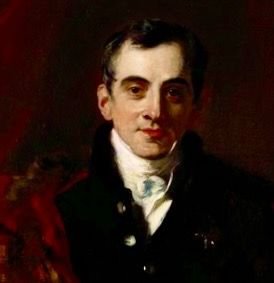
Detail of a portrait of Ioannes Kapodistrias, Minister of Foreign Affairs of Russia. By Thomas Lawrence, 1818-1819. Public Domain.
Political history explains the steady decline of the 200-year old modern Greek state. In the 4th century, the Roman emperor Constantine ditched Greek and Roman civilization in favor of the Jewish heresy of Christianity. The Christianization of Hellas / Greece was catastrophic. In 1204, Western Christian crusaders occupied Constantinople, capital of medieval Greece. The crusaders slaughtered many inhabitants of Constantinople and destroyed valuable institutions of that giant metropolis. They burned its libraries. They inflicted long-lasting damage to the security of medieval Greece. They dismembered the country, thus weakening it, and opening the highways for later invaders. Moslems took advantage of this ferocious Western onslaught on medieval Greece. In 1453, Mongol Turks, armed with the war technology of Europe, occupied Greece.
Centuries of resistance, rebellions, unbroken ties with ancient Greek civilization and indirect diplomatic and military Russian support finally exploded in the Greek Revolution of 1821. Like the ancient Greeks, the revolutionaries of 1821 fought for freedom or death. The European powers (England, France, Russia, and Austria) had taken a holy oath against rebellious people. The French Revolution and Napoleon had embittered the monarchies of Europe. Yet they could not ignore the Greek Revolution of 1821. Nothing could stop it. The Greeks joined forces and fought a heroic, determined, and largely successful war of liberation against the abominable tyranny of the Turks.
Greek intellectuals kept reminding their fellow brothers and sisters they were the descendants of the ancient Greeks whose science and civilization made possible the Renaissance and the Enlightenment in Western Europe. This heroic struggle paid off. Greece became independent in late 1820s.
The Turkish evil
The ferocity and success of the Greek Revolution explain the Turkish evil in Greece. It is more than a huge embarrassment, that the most civilized, heroic, intelligent and philosophical people in Europe, the Greeks, were enslaved by the barbarian Mongol Turks. It is a psychological trauma etched on the Greek soul. Which is why it is taking a long time to heal. One can’t think of a greater tragedy than the Turkish factor overlaying so much of post-medieval Greek history.
And much more: Adamantios Koraes, 1748-1833, born in Turkish occupied Smyrna but educated in France, became the intellectual father of the Revolution. He said that you could not enter a Greek town / village without feeling a coldness in the heart. You would hear cries of desperation. You would sense immense sorrow, hopelessness, and fear of the inhabitants for their very lives. You would see the tears, dreadful poverty, and destitution of the inhabitants (Ελληνική Νομαρχία (Greek Rule of Law) 3.31-32). And the Greek novelist Andreas Karkavitsas, writing in the early twentieth century about the life of the Greek peasants in the prosperous land of Thessaly when Thessaly was under Turkish colonialism, says that the terror of the Greek peasants for their Turkish landlords was so pervasive, so ingrained, that, like robots, they continued to do obeisance to the Turks even after Thessaly was Greek (Ο Ζητιάνος (The Beggar, 1920, 14-15).
When, therefore, the Greek Revolution broke out, centuries of hatred and fear and loathing and hope and courage rushed to the field of battle for a final settlement. The trouble was that the Greek peasants, who did the fighting for a free Greece, had three enemies: the Turks, the Greek landed and ecclesiastical oligarchy that served the Turks, and the Phanariots, Greeks living in Constantinople / Istanbul who also served the Sultan.
But in the revolutionary chaos, civil wars started by the Phanariots and local pro-Turkish landlords, and foreign interventions, the social origins of the Greek Revolution were completely and deliberately erased from the revolutionary agenda of the managers of the emerging Greek state.
Kapodistrias and independent Greece
In 1827, the national assembly of the Greek revolutionaries elected Ioannes Kapodistrias President / Governor of Greece.
Ioannes Kapodistrias, 1776-1831, was a beneficiary of the spreading European Enlightenment, which continued the Hellenic work of the Renaissance. He became the first President of independent Greece. He was born in the Ionian island of Kerkyra, then under the rule of Venice. He studied medicine, law and philosophy at the University of Padua, Italy. He started his political career in the government of the Septinsular Republic, the first independent Greek state of the seven Ionian Islands. Tsar Alexander I of Russia was so impressed by the diplomatic genius of Kapodistrias, he sought his advice during the 1815 Congress of Vienna. In that capacity, Kapodistrias united Switzerland as a neutral state guaranteed by the great powers of Europe. He also prevented Austria from dismembering France.
Tsar Alexander I appointed him to head the Ministry of Foreign Affairs. He served in that top diplomatic post from 1816 to 1822. Kapodistrias tried to convince the Tsar to support the Greek Revolution, but the Russian ruler had other priorities. Kapodistrias took a leave of absence and “retired” in Geneva. He founded the Philomusse Society to spread the news about the Greek Revolution to Philhellenes, and, otherwise, influence powerful Europeans who appreciated freedom and Hellenic culture. His reputation among European leaders and Philhellenes sufficed to boost his promotion of Philhellenism. The money he raised from Philhellenes went for the needs of the Greek revolutionaries. He was a patriotic Greek with exceptional political talent, ethics and wisdom. He governed Greece from 1828 to 1831.
In 1828, Kapodistrias arrived in Nauplion, the capital of the Greek state in Peloponnesos. Warships of France, Russia, and England brought Kapodistrias home.
Kapodistrias defended his country against the Turks. He established its first borders. He organized the Greek army and navy. He advanced education, and the establishment of courts for the administration and benefits of justice for all. He issued the country’s currency and established a national bank, postal service, and statistical service. He introduced the cultivation of the potato and supported farming and food self-sufficiency as the pillars of economy and society. He taxed the rich and earned the trust of the vast majority of the Greeks. He used his own funds (and donations from European Philhellenes) to pay the salaries of the army, navy, and government employees.
However, his efforts to end the arbitrariness of large landowners and political parties, designed to support the interests of France, Britain and Russia, sparked resistance and hostility against him. Mafia-like groups of politicians were waiting for Kapodistrias in order to extract from him as much as they could for their contribution to the common struggle against the Turks.
The resistance to Kapodistrias became small-scale rebellions in the island of Hydra and Mani in southern Peloponnesos. Kapodistrias asked the Russian admiral Ricord to suppress the rebellions. This action raised the suspicion of France and England that Kapodistrias had become a Russian agent.
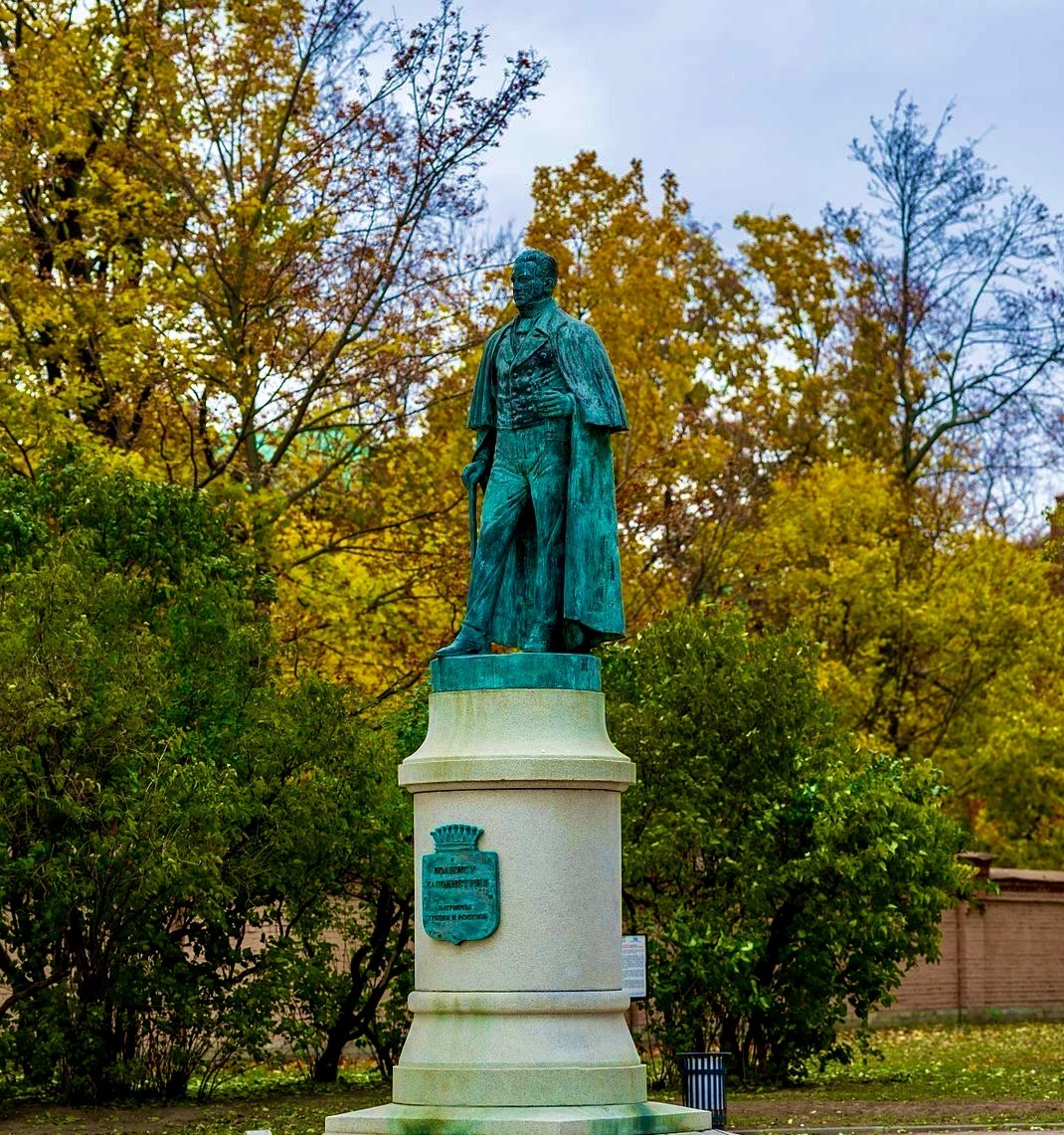
Statue of Ioannes Kapodistrias, St. Petersburg, Russia. Photo: Eugene Egorov. Wikipedia.
The internal opposition to the Kapodistrias administration was a godsent to the British and the French who undermined him and Greece. They resented Kapodistrias because he refused to play their colonial games. Kapodistrias was building an independent country, not exactly in the agenda of England, France, and Russia, much less Turkey.
Kapodistrias’ ambition was to expel the remaining Egyptian troops of the Sultan from Peloponnesos, and to expand the frontiers of the Greek state to include central and northern Greece, and the British-occupied Ionian Islands. English and Austrian policy toward Kapodistrias was mean-spirited, bordering on outright hostility. English and Austrian spies and the domestic political opposition to Kapodistrias added fuel to the horrendous problems of warfare against the Turks, disease, poverty, and anarchy that dominated the Greek state when Kapodistrias appeared on the scene like a savior. No sooner had he arrived in Peloponnesos, that he was already a “Russian regent,” “agent,” and “tyrant.”
Only the peasants gave Kapodistrias their unqualified and genuine support. They hoped he would beat the Turks and humble their Greek oppressors, the large landowners, the monks and priests and bishops. And the peasants wanted Kapodistrias to punish those people immediately.
Kapodistrias, however, was neither a Messiah nor a social revolutionary. He restricted the arbitrariness and insolence of the great men of wealth, but he never took advantage of his immense popularity with the peasants to turn the Greek social order upside down. His European “protectors” were also not known for kindness towards their own peasants. Kapodistrias tried to build a modern nation state with his own devices. He organized a bureaucracy and appointed his trusted followers to run that state machinery. He made all important state decisions. He was well aware of the precarious position he and the young Greek state occupied in the hegemonic and antagonistic policies of France, Austria, Russia, and England. He concluded he alone had the ways and means to guide Greece to an independent national existence. However, Kapodistrias could not often pay his troops because the “great European protecting powers,” France, Russia, and England, played dirty games with him.
The assassination of Kapodistrias
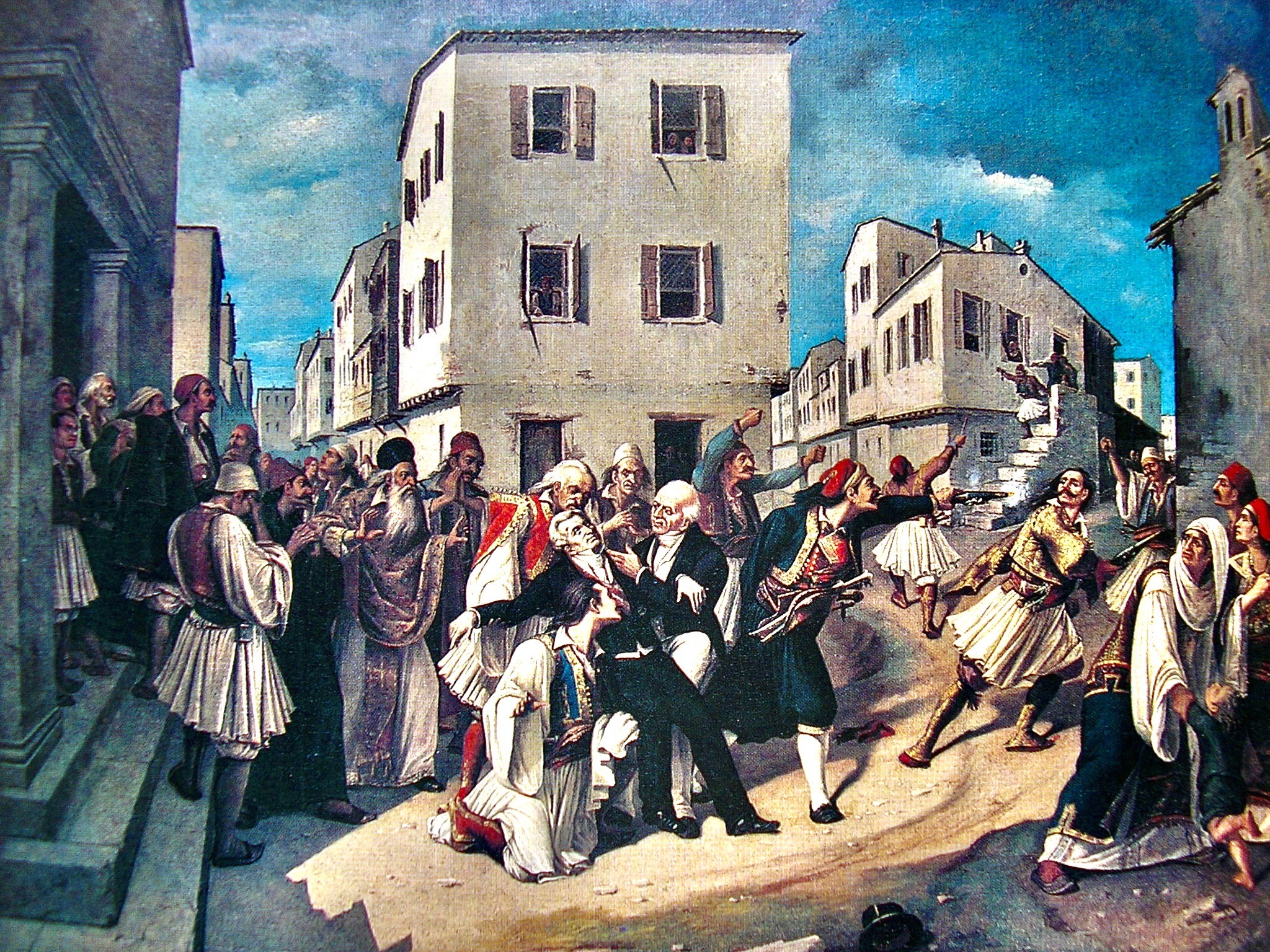
Assassination of Ioannes Kapodistrias by Charalambos Pachis, 1831. Public Domain.
There was no way Kapodistrias could convince England or the Greek political cliques of England and France that he was not doing the bidding of Russia. And while Russia helped Kapodistrias and the Greek state without any reservations, the Tsar, Nicholas I, was not about to challenge England over Kapodistrias.
The usual and accepted theory for the murder of Kapodistrias suggests that disgruntled landlords and politicians from Mani, southern Peloponnesos, assassinated him the moment he tried to enter the Church of St. Spyridon in Nauplion. This happened on September 27, 1831. The killers included father and son Konstantinos and Georgios Mavromichalis, from Mani. killed Kapodistrias. It’s also very likely that these killers were influenced and funded by England, which never supported a free and independent Greek state. Needless to say, the assassination of Kapodistrias was a colossal tragedy. The Greeks lamented the loss of such a great and talented patriot who had given them hopes that better days lie ahead.
Kapodistrias’ dream of Sacred Hellas
European leaders were suspicious of Kapodistrias. Here was a Greek politician of the highest standing and reputation in Europe. He dreamed of a united Europe. But, above all, he dreamed of a Greek nation state that resembled the ancient and fabled Hellas. To accomplish that he wanted a Renaissance in Greece.
Kapodistrias’ ideas and dreams disturbed the European diplomats, especially the Chancellor of Austria, Klemens von Metternich. Since Kapodistrias’ days and trips to Vienna (from 1811 to 1816) when he founded the Philomusse Society, Metternich ordered Austrian diplomats, police agents, and military officers to keep a close watch of the sayings and doings of the Greek diplomat, politician and philosopher Kapodistrias. One of the senior military officers named Joseph Chervenka, interviewed people who knew Kapodistrias. Chervenka summarized the impressions of those who spoke to him about Kapodistrias. On February 13, 1816, he wrote a report and sent it to Metternich. Chervenka said to Metternich that Kapodistrias had quite an agenda for making modern Greece into Hellas. He said to Metternich:
“Kapodistrias expected all powers unanimously to agree in establishing an independent Hellas with inviolable borders. Hellas would be neutral, not allowing any foreign intervention or influence in the country. Hellas sole purpose would be to cultivate the sciences and enlightenment for humanity. Hellas would send teachers, artists, and laws to all countries. The rulers of those countries would be educated in Hellas. And in concert with their Greek teachers, they would be able to rule their people with fairness and justice in the spirit of Hellenic civilization. The geographical position of Hellas between East and West would help her to maintain a balance of security and peace. Kapodistrias also insisted that humanity would declare Hellas a sacred country.” (For documentation, see my Freedom, 2025).
I suspect Kapodistrias had in mind Alexander the Great and his ecumenical vision. Alexander dreaming to create a united humanity, an ecumene, in effect a world society and government under the rule of reason. This interpretation of Alexander comes from a Greek living in the Roman Empire. Rome abolished Greek freedom in 146 BCE. Ploutarchos / Plutarch was that voice. He was a Greek philosopher, prolific writer, and a priest of Apollo. He lived from about the second half of the first century to the first twenty of so years of the second century of our times. He served Rome but remained Greek. He said that Plato, Aristotle, and other thinkers like the Stoic Zeno wrote and taught how to live in ideal cities but never translated their ideas into political reality. Alexander did. He conquered Asia, but his purpose was more than warfare. He dressed like the Asians, and he tried convincing his officers to marry Persian women. Alexander married a princess from Afghanistan. He also established dozens of cities in Asia, all of them governed by justice and the rule of law, thus eliminating injustice in large regions of his empire. Plutarch argues correctly that the conquest of Alexander brought peace, justice, and civilization to Asia. “[Without Alexander,] Says Plutarch, “Egypt would not have Alexandria, Mesopotamia would be without Seleucia, Sogdiana would not have Prophthasia, India would be without Bucephalia, and the Caucasus would be without Alexandria in the Caucasus. It was by living as citizens of these cities that the bad and unacceptable were extinguished. The lives of the citizens improved by familiarity with better ways of living…. Alexander is a great philosopher…. Alexander believed that the gods sent him to unite the world and create one commonwealth of equality and justice and civilization” (Plutarch, On the Fortune of Alexander, Discourse 1. 5-8).
Alexander was a revolutionary. Kapodistrias was no less a revolutionary than Alexander the Great. He was the best of Europeans, but once he “retired” from his serving the Tsar, he was powerless. His only powers were reason and his knowledge of Greek and European philosophical and political ideas. He proposed a resurrected Hellas as a model for peace and culture. Yes, such a new Hellas had to be a sacred country, the Pharos of light and civilization.
Kapodistrias had the knowledge of both ancient Greek science and civilization. He loved freedom. In addition, he was master of Western diplomatic and monarchical politics. He had earned great diplomatic reputation and exercised state power in Russia, the largest country in Europe and Asia. He directed the foreign policy of Russia for six crucial years of reaction and revolution in Europe, 1816 to 1822. He was one of the three most powerful diplomats of Europe – the other two being Charles Maurice de Talleyrand of France and Klemens von Metternich of Austria-Hungary. Kapodistrias worked with them, though Metternich opposed him and independent Greece. Swiss friend and great Philhellene, the banker Jean-Gabriel Eynard, mourned the death of Kapodistrias as a calamity for the Greeks and a tremendous loss for Europe.
Kapodistrias on film: from a great diplomat and revolutionary to a saint?
This brief story of the heroic and controversial life of Ioannes Kapodistrias appeared in film – in late 2025 in Greece.
On April 22, 2026, in a movie theater in LaVerne, California, a Greek friend and I watched in amazement and pleasure the bringing to life of Kapodistrias – in film. My friend and I were the only people in the theater.
The producer of this extremely important film, Giannis Smaragdis, did his homework. In addition, he admitted he made the movie “not merely [as] an artistic creation but a profound spiritual obligation to Hellenism…. the film contains no fiction. I have not changed a single real event. But cinema is not a documentary. The work of art is to illuminate the soul behind the facts. I did not want a dry record but a transfer of the ‘aura’ of things, of the spiritual vibration. The events are accurate. But through them, the soul of Kapodistrias emerges.”
It turns out Smaragdis sees Christianity behind spirituality. This is no surprise as most Greeks are, theoretically at least, Christians. Yet Smaragdis is right. The film illuminates history and the virtuous life of Kapodistrias, entirely selfless and honorable and passionately in love with Hellenic civilization. He was without doubt “kalos k’ agathos,” a handsome man of virtue who knew himself.
Antonis Myriagos, the extremely talented actor portraying Kapodistrias, shines of virtue and even looks like Kapodistrias.
I liked the film because it treated Kapodistrias fairly. I have studied Kapodistrias extensively. I felt the film moved me to another, yet very familiar, society of early nineteenth century monarchical Europe. Greece did not exist as a nation state. Greece was a conquered country, a province of the Ottoman empire: in upheaval and revolt.
I recognized the corrupt and ruthless European politicians like the Chancellor of Austria Hungary, Metternich. I also felt angry looking at the lawless Greek traitors who served the Turks. The film, like a mighty mythical power, made that resurrection possible. However, it stayed clear of the horrific life of the Greeks under Turkish occupation, locally governed by the Orthodox clergy and other Greeks reporting to the Sultan. Yet the film captured the turbulent and dangerous times when Kapodistrias appeared on the political stage, first on his island, Kerkyra, and politically active in the Septinsular Republic, the first independent Greek state made up of the seven Ionian islands in early nineteenth century. A few years later, in 1815, in Western Europe at the Congress of Vienna, we see Kapodistrias disagreeing with Metternich. Tsar Alexander I of Russia was listening. He said to Metternich that Kapodistrias represented him. Metternich was so upset he set his spies after Kapodistrias.
The Congress of Vienna in 1815 was an exclusive club of the great powers of Europe, Russia, Austria and Britain. Their representatives at Vienna tried to return Europe to the pre-Napoleonic period. Revolution became an anathema. This high level discussion and negotiation took place among prime ministers and emperors.
Metternich, the old and possibly senile Austrian Chancellor, made no effort to hide his contempt and hatred of the Greeks and Kapodistrias in particular.
Kapodistrias becomes a Greek tragic hero. In 1828, the great European powers appoint him Governor / President of Greece. The country, basically Peloponnesos, was then moving rapidly to official independence. Russia had just defeated Turkey. The 1829 Treaty of Adrianople that brought the war between Russia and Turkey to an end forced the Turks to recognize Greece as an independent state.
The Smaragdis film highlights two things. One, the brilliance, integrity and patriotism of Kapodistrias. He was so immersed in nation building, he ignored the emerging fatal enclosure around him. Smaragdis has even a British agent talking to Kapodistrias about his forthcoming assassination. Kapodistrias retains his composure and does nothing to protect himself. We see him writing his last letter to his Greek lover in Russia, Roxandra Sturdza. In his loneliness and agony for Sacred Hellas, the nation state of modern Greece he had put together and personal survival, he failed to invite Roxandra to come to Nauplion, Greece and marry her.
In the early hours of September 27, 1831, he goes to the church accompanied only by a guard with one hand – not shown by the film. Instead, Smaragdis surrounds Kapodistrias with death. He invented several young women dressed in black walking after him. Kapodistrias sees the Maniot killers, Georgios Mavromichalis and his father, Constantine, waiting in front of the main door of the little church of St. Spyridon in Nauplion. He hesitates for a moment. And instead of making a U-turn for assistance, he proceeds straight to the assassins’ bullet and knife, his tragic death. He was like a manic follower of Dionysos, a hero who lived the life of freedom or death. He chose death to subjugation of any kind. Kapodistrias was a passionate lover of Hellas, a dreamer helplessly fighting domestic and foreign powers to the end.
The Smaragdis film also makes Kapodistrias a saint-like head of state. His presidential office was decorated with icons. He did go to the church. But Smaragdis goes much further. He hinted that Christian divine powers saved Kapodistrias from death when once he fell from the horse he was riding in Kerkyra. In addition, we see Kapodistrias walking among Greeks in Greece and receives the adoration of the crowd like another Jesus, an archbishop or a king. People competing for kissing his hands or touching him. And in several interviews, Smaragdis paints Kapodistrias like a super saint: a “bearer of light” and “executor of God’s plan…. the film aims to transcend conventional historical storytelling and function as a spiritual-national manifesto.”
Kapodistrias was no saint. Moreover, a saint in Christianity sometimes does good works, but, in general, preaches and fights for “life after death,” the opposite of the outstanding work of Kapodistrias who tirelessly labored for the freedom and wellbeing of living people, especially modern Greeks. Kapodistrias almost single-handedly set the foundation of the first modern Greek nation state. The film is unlikely to become a national manifesto. Kapodistrias was a well-educated patriotic Greek hero whose intelligence, virtues, daring and diplomatic excellence honor Hellas, ancient and modern. His footsteps in diplomacy and his courage and genius in establishing the foundations of the Greek nation state are paradigmatic and merit study and emulation.
After the assassination of Kapodistrias, the antidemocratic kingdoms of Europe saddled tiny Greece with a teenage German king and absolute monarchy. Kings guaranteed a free hand in corrupting Greek politicians to do the bidding of foreign interests. The Greek political parties became partisan lobbyists for France, Russia, and Britain. They even adopted their official names after the foreign country they represented: the French, British and Russian Party. Since Kapodistrias, there has not been a Greek political party representing and lobbying for Greece: political independence, knowing and loving the ancient ancestors of modern Greeks, and, following the mind of Kapodistrias, making Greece a Sacred Hellas.
Despite that political handicap, the Greeks spent the nineteenth century and the early part of the twentieth century in expanding the territory of independent Greece and giving the country its present twenty-first century borders and culture.
The Kapodistrias film’s greatest virtue is that, for the first time in about 200 years, made Kapodistrias known potentially to millions of Greeks and probably many non-Greeks. Kapodistrias’ association with Russia and his sincere patriotism and love for ancient Greece made him undesirable to the ruling class of Greece tied to foreign powers. In that sense, we should all be grateful to Smaragdis. Kapodistrias remains a great model of Hellenic virtues: freedom, independence, intelligence, justice, moderation, wisdom and patriotism.
Perhaps the Kapodistrias film will inspire similar movies on other great Greeks: Homer, Pythagoras, Hippocrates, Democritos, Aristarchos of Samos, the tragic poets, Plato, Aristotle, Euclid, Archimedes, Alexander the Great, Hipparchos, Ptolemaios, Galen and the great astronomical computer of the second century BCE, known as the Antikythera Mechanism.
This kind of history can be an introduction to the real transformation of modern Greece back to the Sacred Hellas of Alexander the Great and Kapodistrias.
[ad_2]
Source link
