
It is long past time the US eliminated gerrymandering, the drawing of district lines specifically for the purpose of favoring one political party, across the board. This requires either a 50 state agreement, or action at the federal level. This has been a problem since near the beginning of our democracy, and seems to be getting worse. We are now in the middle of a mid-decade tit-for-tat rash of gerrymandering that is extremely anti-democratic, so it’s a good time to raise this as an issue voters should definitely understand and prioritize.
As a quick aside – this is not a “political” blog, which does not mean that I never discuss political issues or topics with a political dimension. It partly means that I try my best to by non-partisan, and to avoid purely political value-judgements. I recognize this is an impossible ideal – we all have our biases and perspectives that color our thinking on topics in subtle ways. But we can try. Also, this is not a strictly science blog, it covers science, critical thinking, and media savvy, which are part of what we call scientific skepticism. Recently I started a video podcast, Political Reality, with co-host Andrea Jones Roy, who is a political scientist, for the purpose of applying scientific skepticism to political topics. This is also not a partisan show, and is mostly part civics lesson and part fact-checking. With that in mind, I thought I would write about what science and critical thinking have to say about gerrymandering, given that this is a topic in the news recently, although not as much as I think it should be. We also did cover this topic on Political Reality.
The term gerrymander dates back to 1812 when Massachusetts Governor Elbridge Gerry redistricted his state’s representative districts in order to favor his party, the Democratic Republicans. One of the districts looked like a salamander, leading the Boston Gazette to quip that it was really a “Gerry-mander”, and the name stuck. (Ironically, the two parts of that term, gerry and mander, both kinda sound like they mean “rig”, but the word has nothing to do with that.) Since then all political parties have used gerrymandering to gain unfair advantage. This stems from some features of US politics.
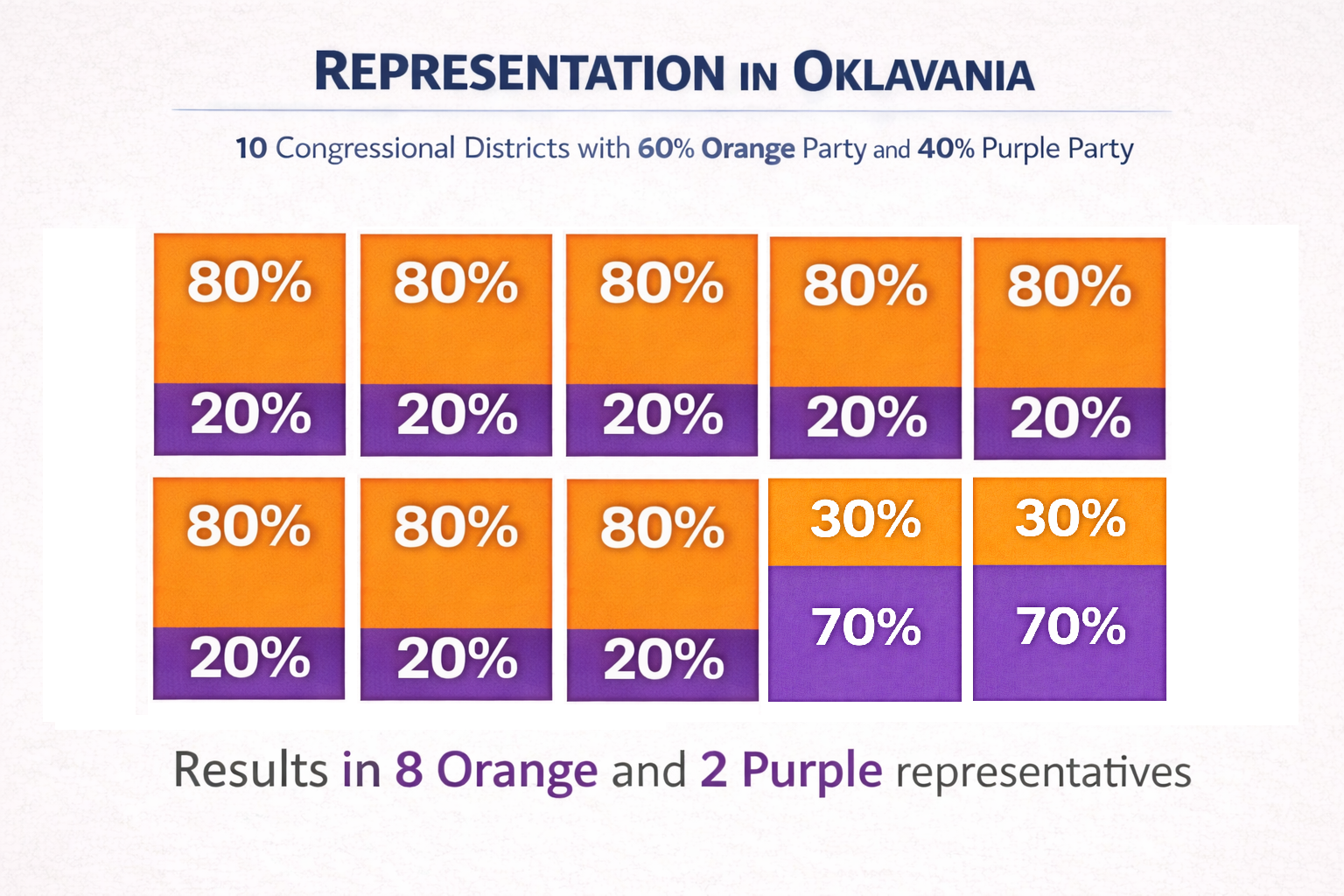
First, we have single representative districts, in a winner-take-all system. Senators are elected state-wide, and so gerrymandering is not an issue. Many countries have multi-representative districts, with representatives being apportioned to the votes – if your party wins 40% of the votes, you get 40% of the representatives. This also, by the way, is part of why we have such a dominantly two-party system – you need to earn a plurality of votes in order to have any representation. A party representing 10% of voters, without a local power base, would have zero representation. Districting, in a fair world, would be designed to share power roughly according to the population. In a state that is 60% party A and 40% party B it seems intuitively fair that party A, on average, should net about 60% of the representatives and party B 40%. Also, districts can be drawn to keep people with similar demographic interests together enough to have their interests represented. This would be partly geographic, but also partly urban vs rural, cultural, and racial.
Gerrymandering happens when one party controls the process of redistricting, usually because they control the state legislature. In our hypothetical 60/40 state, with let’s say 10 representatives, you could draw districts so that all 10 are 60/40, meaning party A would likely win all 10 representatives. You could also use redistricting to specifically disenfranchise specific demographics of voters. With modern data and computers you could theoretically do this with “surgical precision” (as one judge put it).
Partisan gerrymandering causes several problems for democracy. It is often referred to as politicians choosing their voters, rather than voters choosing their politicians, and this is apt. It makes districts less competitive, and often non-competitive, which reduces voter choice. This shifts the real election battle to the primary, which tends to favor more extreme partisan candidates. There is then no incentive to appeal to the middle in the general election because the outcome of that election is all but predetermined. So gerrymandering disenfranchises voters, reduces voter choice, and favors more extreme partisan politicians. This results in greater political polarization among our politicians, which causes dysfunction in Congress. How do we stop this?
The 2019 SCOTUS decision on Rucho vs Common Cause determined that federal courts have no roll to play in deciding questions of redistricting, which should be left entirely to the states. This is a deep issue unto itself – in our federalist system, what rights do congress and federal courts have in controlling how the states manage elections? Under Rucho vs Common Cause, however, Congress still has the right to pass laws to regulate redistricting. So it could be as simple as passing an anti-gerrymandering law. This would be ideal, rather than dealing with this state-by-state, which hasn’t worked. We are seeing what happens when this is left to the states. Some hold to principles, and leave redistricting in the hands of non-partisan committees, or some other reasonable fair process. But many states use their control to unfairly gerrymander their state, which then leads other states to do the same in retaliation. The best solution would therefore involve all 50 states at once.
Congress, however, has failed to pass anti-gerrymandering laws, most recently in 2025. This is typically blamed on political polarization, but also on the fact that many congressmen benefit from gerrymandering, on both sides, and would not want to see their favorable district suddenly become competitive. About 85% of House seats are not competitive (even lass after the recent round of gerrymandering), so that is most representatives. It is likely that only extreme pressure from voters will break this logjam and get us the anti-gerrymandering law we deserve. In fact, I would prefer a constitutional amendment. This is a higher bar to cross, but that’s the point – it would also be far more difficult to undue.
Gerrymandering makes America less democratic, it reduces voter choice, disenfranchises some voters, and increases political extremism and polarization. When asked, 70% of voters say that gerrymandering is bad and we should do something to eliminate it. However, those same voters seem to be OK with it when it is done to the advantage of their own party, justifying it by saying it is necessary because the other side does it. This is another reason why action at the federal level is needed, because that would affect everyone all at once. This is not going to happen, however, unless it comes from the bottom up. Voters need to take control of their own voting rights.
