
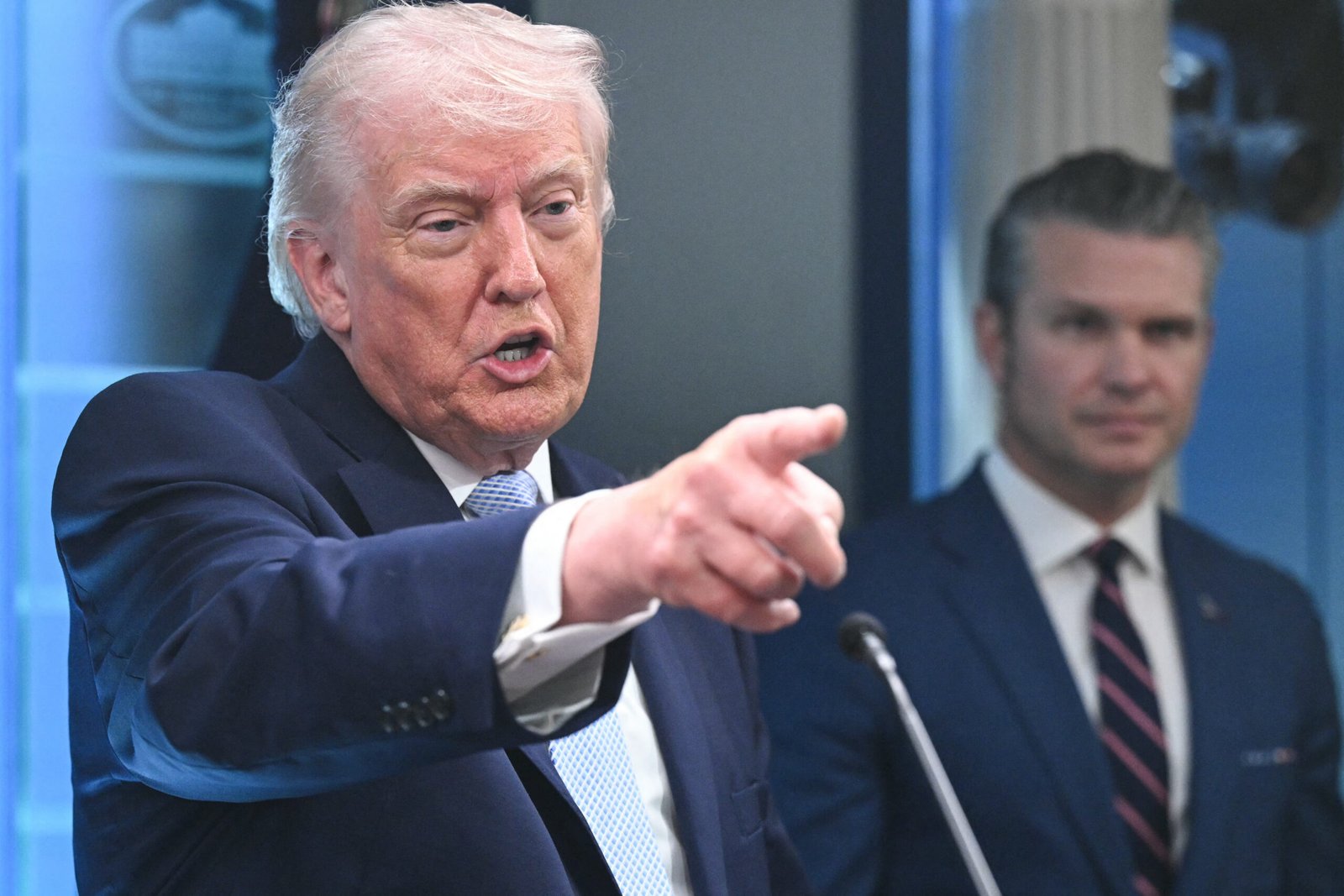
President Donald Trump was irritated when a reporter pointed out we have been at war with Iran for longer than the originally promised four to six weeks. He noted this was still a much briefer military adventure than various past wars and even accidentally invoked an enduring gag from the 1990s sitcom Friends.
“I took a break,” Trump said in the Oval Office, presumably referring to the ceasefire that remains in effect at this writing.
While Trump has never channeled Ross Geller before, he has previously mentioned America’s longer wars in comparison with what is transpiring in Iran. “And I just looked at a little chart, World War One, four years and three months. World War Two, six years. Korean War, three years. Vietnam, 19 years. Iraq, eight years,” Trump told CNBC. “I’m five months. Okay, five months.”
“I would have won Vietnam very quickly,” he added. “I would have, if I were president, I would have won Iraq in the same amount of time that we won, because essentially, we won here. Okay?”
That is precisely where things have gone off the rails in Iran. Trump became convinced that the difference between his past brief military interventions and no-win quagmires like Iraq and Vietnam was his superior management skills. He isn’t alone in this kind of thinking. That’s why Robert McNamara and Donald Rumsfeld (or Paul Bremer) became the scapegoats for Vietnam and Iraq, respectively.
The real difference is that Trump has previously stuck to things that were militarily achievable and ended the conflict as quickly as practically possible. Whatever your view on whether what Trump did in Venezuela was wise or just, it was short, and in the immediate term, at least, it worked out well enough.
It is the attempted political transformation of foreign countries, especially in the Middle East, that leads inevitably to American failure. George W. Bush wasn’t unsuccessful at overthrowing Saddam Hussein or the Taliban. He was unable to quickly replace them with anything better (or in the case of the Taliban, after 20 years in Afghanistan, really to replace them at all).
Trump of course doesn’t want to devote much time or resources to a political transformation of Iran, though he was likely convinced the regime was much closer to collapse when he decided to begin this war. He doesn’t want to do nation-building. He is perfectly happy to stroll into Pottery Barn, smash everything on the shelf, and then leave someone else with the bill.
The problem is that means you have to either leave behind a political vacuum or do business with the remnants of the regime you went to war with in the first place. In Venezuela, those remnants were willing to cooperate with Trump. In Iran, they aren’t yet and may even be further radicalized.
That’s why we usually end up nation-building, even though we aren’t very good at it. The alternatives seem equally unappealing in the immediate aftermath of the expenditure of blood and treasure. It is not until the conflict fully devolves into a forever war that it becomes apparent that a sunk-cost fallacy foreign policy isn’t actually a positive outcome.
Trump is probably readier for the war to be over than what’s left of the Iranian government is, despite the pounding Tehran has taken. That’s why he has largely stuck to the ceasefire even when Iran has arguably broken it, or at least given him plausible pretexts to abandon it himself. He has advertised this as a short war from the very beginning, keeping intact a domestic political coalition with a wide variety of perspectives on war and peace, even if at the cost of sowing confusion about the war’s aims among the broader electorate.
Subscribe Today
Get daily emails in your inbox
This remains the main area on which Trump is still preferable to Bush on foreign policy.
In peace talks, however, Trump continues to demand a face-saving way out for himself without offering one to the other side’s negotiators. This has so far been a nonstarter. Yet it is Trump’s party, and soon after his legacy, that most suffers the longer this goes on without any obvious benefit to America’s strategic position or the global economy.
The Iran War probably won’t drag on as long as Iraq, Vietnam, or Afghanistan precisely because Trump’s successor is unlikely to continue it. Whether the outcome is any better, or Trump is able to take the credit for its comparative brevity he clearly thinks he deserves, will depend on how quickly he can declare victory and come home.
