
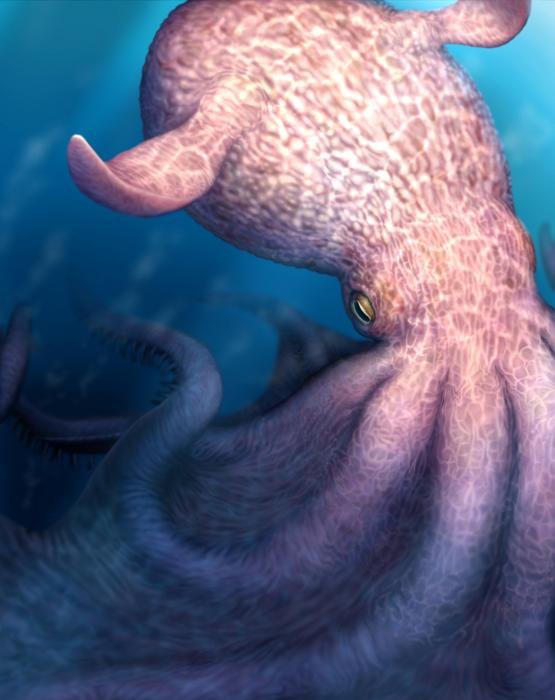
It’s an iconic image – a giant cephalopod with its tentacles wrapped around a sailing ship, tearing it apart as the crew panic. Eventually it drags the splintered remains down into the deep. Meanwhile, the largest living octopus is the Giant Pacific octopus (Enteroctopus dofleini), averaging about 16 feet long, however an exceptionally large specimen about 30 feet long weighing 600 pounds was found. The largest squid is the Colossal Squid (Mesonychoteuthis hamiltoni), reaching roughly 1,500 pounds (490–500 kg) and lengths up to 46 feet (14 m). That’s huge – but it’s no Kraken.
What about in the past? Everything was bigger in the past, right? That’s obviously a trope, but there is some truth to it, in that there have been ages of gigantism in the evolutionary past. In some periods and locations there are rich resources allowing for the evolution of larger body size, which comes with a number of survival advantages. This can set off an arms race of size, with prey becoming larger to avoid predation, and predators becoming larger to hunt bigger prey. The age of the dinosaurs is the most iconic example of this. But that, of course, does not mean that all lineages were necessarily larger in the past. Whales are a good example – the largest whales (and animals) to have ever lived are extant. So what about cephalopods? Are the largest ones living now, like with whales, or were there even larger ones in the past?
A new study examines the fossil remains of 12 giant octopuses that lived 100-72 million years ago. These were discovered and examined through grinding digital mining techniques at Hokkaido University in Japan. This method grinds very thin (25-50 micrometers) layers from a rock specimen, then takes a high resolution full color image of each layer. This method completely destroys the specimen, but results in a high resolution 3D image of any fossils within the rock. It uses AI models to reconstruct the fossils. The technique is used in cases where the fossils are too soft to X-ray (they are invisible to X-rays), cannot be chemically separated from the surrounding rock, and are too fragile for ordinary extraction. All of these are true for the soft beaks of octopuses.
Cephalopods are soft-bodied invertebrates, and so they rarely fossilize well. However, they do have chitinous jaws or beaks they use for eating. These are like the exoskeletons of insects or shell fish, but with some structural differences. Crustacean exoskeletons are mineralized to make them hard, so they serve well as armor. The octopus jaws are not mineralized but rather are reinforced with specialized proteins. The edges are hard to form a cutting edge, and become less hard but stronger as you move away from the edge. This way the jaws don’t crack under strain. These are evolved to be predatory crushing instruments. But they are also too soft for traditional fossil extraction methods, which is why the new technique was needed.
What did the paleontologists learn from examining these new specimens? They were able to infer the size of the creatures, which they estimate were up to 19 meters long – that is enormous. OK, it’s not quite Kraken size, but we are getting close. The wear patterns on the jaws also indicates that they were used to crush bones. What this could mean is that these cephalopods (Vampyronassa rhodanica) were definitely predators, and given their size they may have even been top predators. That is an incredible claim, given that they shared the Cretaceous oceans with plesiosaurs and mosasaurs. Mosasaurs were giant reptilian (but not dinosaurs) sea-dwelling predators up to 18 meters long. Could one of these invertebrate giants have taken on a mosasaur? Probably not, unless they were a baby.
As a point of clarification – the mosasaur was an apex predator, which means they they had no natural predators. The researchers are arguing that Vampyronassa rhodanica was a top predator, which means it occupied the top tier of the food chain, but could also have been prey itself. In a cage match between a mosasaur and a Vampyronassa rhodanica, my money is on the mosasaur.
But still, this means that there were cephalopods around 100 million years ago that were among the top predators of the ocean, competing with giant sharks and aquatic reptiles. This is the first invertebrate to join this group of top predators.
The researchers point out one more detail from the fossils – they had an asymmetric wear pattern, meaning that one side was significantly more worn than the other. This may not sound like much, but it suggests they had a preference for one side over the other. This likely reflects what is known as lateralization – that there were functional differences between the left and right side of their central nervous systems. This phenomenon tends to be seen only in species that have fairly complex central nervous systems, and the authors put this forward as evidence for this in this species. We know that modern cephalopods are highly intelligent, and this evidence suggests that these early cephalopods may have already evolved CNS sophistication. But this is, overall, a rather weak line of inference. Lateralization is not an iron-clad sign of intelligence, and is context dependent, but in this case it is a reasonable inference given that we know cephalopods eventually do evolve in this direction.
Overall this is a pretty interesting study, using a new technique to get a window into ancient cephalopods that was not previously possible. As a result we have gained new insight into this branch of the tree of life. I do have mixed feelings about the new technique, grinding digital mining, because it is completely destructive. It does seem like these fossils would otherwise not be usable, however. But – we do not know if we will eventually develop a non-destructive technique to examine such fossils, maybe even ones that can yield more or better information. The researchers and the field are aware of these tradeoffs. Destructive techniques are therefore used sparingly and only when the scientific information gained outweighs the loss of physical evidence, which they thought was justified in this case. Still, I hope this technique becomes obsolete quickly.
