
[ad_1]
In one of the scariest moments in modern history, we're doing our best at ScheerPost to pierce the fog of lies that conceal it but we need some help to pay our writers and staff. Please consider a tax-deductible donation.
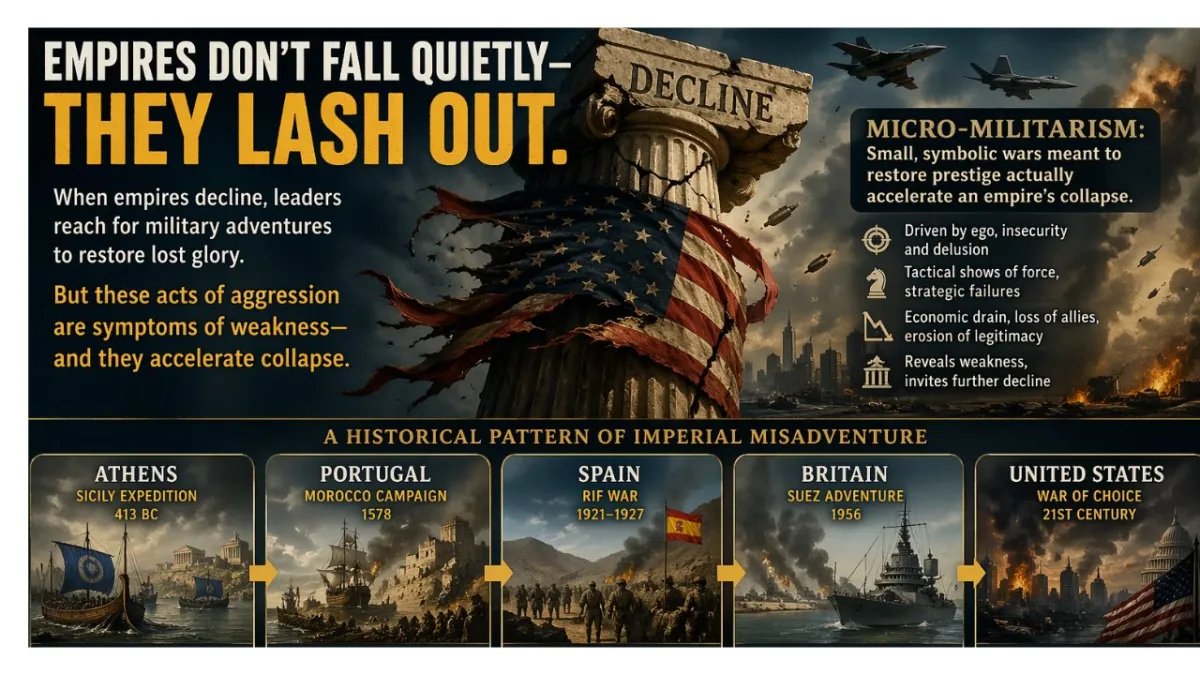
Writing more than 2,000 years ago, the Greek historian Plutarch gave us an eloquent description of what modern historians now call “micro-militarism.” When an imperial power like Athens then, or America now, is in decline, its leaders often react emotionally by mounting seemingly bold military strikes in hopes of regaining the imperial grandeur that’s slipping through their fingers. Instead of another of the great victories the empire won at its peak of power, however, such military misadventures only serve to accelerate the ongoing decline, erasing whatever aura of imperial majesty remains and revealing instead the moral rot deep inside the ruling elite.
There is mounting historical evidence that America is indeed an empire in steep decline, while President Donald Trump’s war of choice against Iran is becoming the sort of micro-military disaster that helped destroy successive empires over the past 2,500 years — from ancient Athens to medieval Portugal to modern Spain, Great Britain, and now the United States. And at the core of every such ill-fated war-making decision lay a problematic leader, often born into wealth and prestige, whose personal inadequacies reflected and ramified the many irrationalities that make imperial decline such a painful process.
During that demoralizing downward spiral, imperial armies, so lethal in an empire’s ascent, can err by plunging their countries into draining, even disastrous “micro-military” misadventures — psychologically compensatory efforts to salve the loss of imperial power by trying to occupy new territories or display awe-inspiring military might. Although such micro-militarism often chose targets that proved strategically unsustainable, the psychological pressures upon declining empires are so strong that they all too often gamble their prestige on just such misadventures. Not only did such disasters add financial pressures to a fading empire’s many troubles, but in a humiliating fashion, they also invariably exposed its eroding power while exacerbating the destabilizing impact of imperial decline in the capitals of empire (whether Athens, Lisbon, Madrid, London, or Washington, D.C.).
In our moment, when the bombs stop falling and the rubble is finally cleared from the streets of Tehran and Beirut, the impact on U.S. global power of such a de facto defeat will become all too clear — as alliances like NATO atrophy, American hegemony evaporates, legitimacy is lost, global disorder rises, and the world economy suffers.
Let me now turn from the disasters of the present imperial moment to the lessons of history to explore the sort of lasting damage that Donald Trump’s micro-military misadventure in the Middle East might be inflicting on this country’s declining imperium.
The Defeat of Athens in Sicily
The date was 413 BC. The place was ancient Athens, then the seat of a powerful empire, long dominant around the rim of the Aegean Sea but losing influence to a sustained military challenge by Sparta. At the port of Piraeus, a “certain stranger,” as the historian and philosopher Plutarch recalled, “took a seat in a barber’s shop, and began to discourse [on] what had happened as if the Athenians already knew all about it.” Stunned by this stranger’s report of a military debacle in far-off Sicily, the barber “ran at the top of his speed to the upper city” of Athens, where the news sparked “consternation and confusion.”
What that stranger described was the greatest military disaster in the history of the Athenian empire. Two years earlier, in the midst of the protracted Peloponnesian Wars, the aristocrat Nicias — an indifferent, indecisive leader who used his inherited wealth to court popularity with lavish spectacles — persuaded the citizens of Athens to deliver a theoretically bold blow against a rival imperial power, Sparta, by attacking its ally Syracuse in Sicily in hopes of crippling the enemy, capturing riches, and recovering Athens’ ebbing hegemony.
Instead of victory, however, Athens’ vast armada of 200 ships and some 12,000 soldiers suffered a devastating defeat. Not only was the fleet destroyed (largely because Nicias proved “an incompetent military commander”), but his surviving soldiers were captured, confined on a starvation diet in a stone quarry, and sold into slavery. Athens never recovered.
Within a decade, the city had been starved into submission by Sparta’s impenetrable blockade of a naval chokepoint in the Dardanelles Strait, stripped of its empire, and subjected to autocratic rule by a pro-Spartan oligarchy.
Portugal’s Debacle in Morocco
Our next date is 1578. The place is Portugal, the seat of a lucrative empire that had controlled commerce across the Indian Ocean for decades but now found its hegemony challenged by Muslim merchant princes allied with the Ottoman Empire.
In its capital, Lisbon, a headstrong young king, Sebastian, suffered from sexual impotence and a fiery temperament that made him a fanatical “captain of Christ.” With the idea of striking a lethal blow in his country’s global war against Islam, the young king persuaded the flower of his nation’s aristocracy to follow him on a latter-day crusade across the Mediterranean Sea to Morocco. There, at the fateful Battle of Alcácer Quibir, Portugal’s army was slaughtered by local Muslim forces. Some 8,000 Portuguese troops were killed, 15,000 captured, and only 100 escaped.

The defeat was so devastating that it not only destroyed the king and his court but also precipitated the country’s incorporation into the Spanish empire for the next 60 years. In the aftermath of such reverses, the Portuguese Estado da India (or state of India) at Goa was reduced to selling permits to any ship captain who could pay, whether Hindu, Muslim, or Christian. With Portuguese commercial dominance removed from the Indian Ocean, Muslim merchants and pilgrims could once again move across it unimpeded.
Though the Portuguese empire would survive for another three centuries, it would never recover the commercial hegemony that had once allowed it to dominate the world’s sea lanes from the Spice Islands of Indonesia, across the Indian Ocean and the South Atlantic to the coast of Brazil.
Spain’s Disaster in the Atlas Mountains
And now to jump several centuries, another significant date for imperial disasters is 1920. The place was Madrid, where Spain’s leaders were already reeling from the psychological stress of their country’s long imperial decline, culminating in the loss of its last colonies, Cuba, Puerto Rico, and the Philippines in the Spanish-American War of 1898 with the rising United States.
Seeking regeneration through further colonial conquest, Spain’s conservative leaders reacted to that demoralizing defeat against America by expanding their small coastal enclaves in northern Morocco to establish a protectorate over the whole region and its arid Atlas Mountains. Spain’s inept monarch Alfonso XIII, who liked to play soldier, cultivated a clique of military favorites who shared his passion for the recovery of lost imperial glory by pacifying that rugged terrain. As resistance to Spanish rule by Berber Muslims escalated into the bloody Rif War of 1920, one of the king’s favorite generals led his troops into the Battle of Annual, where Berber fighters slaughtered some 12,000 of them.
Nonetheless, through the influence of the king and his military cronies, Spain clung desperately to those profitless Moroccan mountains. The Spaniards would, in fact, dispatch 125,000 more troops there, including its Foreign Legion led by the man who, in the 1930s, would become the leader of a fascist Spain, Francisco Franco, for a protracted pacification campaign that featured both mass slaughter and military innovation. In a desperate quest for a victory that defied both economic and strategic rationality, Spain produced some 400 metric tons of lethal mustard gas to conduct history’s first aerial bombardment using poison gas, raining mass death down upon Berber villages. And in military history’s first successful amphibious operation, the Spanish navy also landed 18,000 troops and a squadron of light tanks at Al Hoceima Bay in September 1925 to flank and soon defeat the Berber guerrillas there.
Such micro-militarism, however, not only plunged Spain into a protracted pacification campaign with soaring costs, heavy casualties, and mass atrocities, but also unleashed political forces that would destroy its struggling democracy. As the masses protested that misbegotten war, King Alfonso backed a military favorite, General Primo de Rivera, in imposing a decade of dictatorship that finally gave way to a short-lived Second Republic. In 1936, however, only a decade after the Rif War ended, General Franco flew his Army of Africa back from Morocco over the Mediterranean Sea, launching a Spanish civil war that would defeat the Republic and establish a fascist dictatorship that would rule the country for nearly 40 dismal years of economic stagnation.
The End of the British Empire at Suez
Arguably, when it came to imperial decline, however, the most revealing date was 1956. The place was London, the seat of the once-proud British Empire, where the suffocating stress of a painful, protracted global imperial retreat had pushed British conservatives into a disastrous micro-military intervention at Egypt’s Suez Canal, leading to what one British diplomat would term the “dying convulsion of British imperialism.”
In July 1956 (as described in my recent book Cold War on Five Continents), Egypt’s charismatic president Gamal Abdel Nasser nationalized the Suez Canal, ending British colonial control there, electrifying the Arab world, and elevating himself to the first rank of world leaders. Although British ships could still pass freely through the canal, the country’s conservative prime minister, Anthony Eden, a vain aristocrat and determined defender of empire, would be deeply unsettled, if not unhinged, by Nasser’s assertive nationalism. Indeed, his leadership throughout the crisis would prove so unbalanced that senior Foreign Office officials would become convinced “Eden has gone off his head.”
In response to the news of the canal’s nationalization, an apoplectic Eden would immediately convene a council of war at 4:00 in the morning. Calling Nasser a “Muslim Mussolini,” a reference to the former fascist ruler of Italy, Eden ordered “him removed and I don’t give a damn if there’s anarchy and chaos in Egypt.” Making his meaning perfectly clear, Eden asked his foreign minister: “What’s all this nonsense about isolating Nasser or ‘neutralising’ him as you call it?” He then added pointedly: “I want him destroyed, can’t you understand? I want him murdered.” With the British secret service MI6 failing in multiple assassination attempts, however, Eden’s government began plotting with the French and Israelis to launch a secret, two-phase invasion of the Suez Canal Zone.
On October 29th, the Israeli army led by the dashing General Moshe Dayan swept across the Sinai Peninsula, destroying Egyptian tanks and bringing his troops within 10 miles of the canal. Using that fighting as a pretext for its own intervention (supposedly to restore peace), in just three days, an armada of six Anglo-French aircraft carriers smashed the Egyptian air force, destroying 104 of its new Soviet MIG jet fighters and 130 additional aircraft.
With Egypt’s strategic forces destroyed and its military virtually helpless before the might of that imperial juggernaut, Nasser deployed a geopolitical strategy brilliant in its simplicity. He had dozens of rusting cargo ships filled with rocks and then scuttled them at the canal’s northern entrance, quickly closing one of the world’s main maritime choke points and so cutting off Europe’s oil lifeline to the Persian Gulf. By the time 22,000 British and French forces began storming ashore at the canal’s north end on November 6th, their objective of securing the free movement of ships had already been snatched from their grasp.
By the end of that micro-military disaster, Britain would be reprimanded by the United Nations; its currency would require an International Monetary Fund bailout to save it from utter collapse; its aura of imperial majesty would have evaporated; and the once mighty British Empire would be on the road to extinction. In retrospect, the Suez Crisis would not only expose the full-scale decline of British power, but also show the world that the country’s ruling Conservative establishment, with its illusions of imperial and racial superiority, was no longer capable of global leadership.
America’s Defeat in the Strait of Hormuz
Another date likely to prove all too significant when it comes to the history of imperial decline is February 28, 2026. The place was Washington, D.C., home to what had been history’s most powerful imperial state that had dominated much of the globe for nearly 80 years through a mixture of military alliances, deft diplomacy, and economic leadership. By then, however, cracks had distinctly begun to appear in its edifice of power as U.S. global hegemony faced an increasingly strong economic challenge from China, its massive military suffered two searing defeats in Afghanistan and Iraq, and its economic globalization produced an angry populism at home.
After a populist campaign based on promises to restore both working-class prosperity and America’s global power, Donald Trump took office a second time in January 2025 promising a “golden age of America,” a “thrilling new era of national success” in which the country would “reclaim its rightful place as the greatest, most powerful, most respected nation on earth, inspiring the awe and admiration of the entire world.” Born to wealth and privilege himself, Trump returned to office convinced of his unique “genius” for leadership and believing that “I was saved by God to make America great again.”
Wielding raw economic and military might to compel obeisance from friend and foe alike, the president, inspired by a delusional sense of divine mission, began attempting to bend the world to his will. But during his first year in office, nothing seemed to work as planned. Indeed, most of his initiatives produced the sort of backlash that only served to show how far the United States had fallen from 1991, when the break-up of the Soviet Union made it the world’s sole superpower.
On April 2, 2025, on what he called “Liberation Day,” Trump announced a roster of punitive tariffs to protect domestic manufacturing largely from Chinese imports that faced an initial duty of 34% — later raised to a fully punitive 100%. But at their October 2025 meeting in South Korea, China’s leader Xi Jinping forced Trump to back down by cutting U.S. access to his country’s storehouse of strategic rare earth minerals.
In January, with his tariff initiative losing its luster, Trump plunged the NATO alliance into crisis by demanding that Denmark give him the island of Greenland, threatening to impose new tariffs on European allies unless they complied. Within a week, however, vociferous European resistance had led him to retract that threat at the Davos economic summit, claiming he was satisfied with NATO’s offer of a “framework of a future deal.”
On February 28th, 2026, with his tariff initiative failing and his Greenland gambit checkmated, Trump joined Israel in a seemingly bold strike on Iran that soon had the makings of the sort of fateful “micro-military” maneuver that appears to go with imperial powers in decline.
In the first few days of war, U.S. and Israeli bombing killed Iran’s leadership, destroyed its navy, and eliminated its air defenses, leaving the country seemingly prostrate before the might of America’s air-power juggernaut. After a week of devastating bombardment that seemed to stun the world with its lethality and precision, on March 6th Trump demanded that Iran offer an “unconditional surrender” and signal its capitulation by “the selection of a GREAT & ACCEPTABLE Leader.” In exchange, he promised that the U.S. would “work tirelessly to bring Iran back from the brink of destruction.”
But much as Nasser had done at Suez in 1956, Iran’s leadership reversed the war’s geostrategic balance by closing a critical maritime choke point in the Strait of Hormuz. By striking five freighters with drones in the first week of war, Iran’s leaders, taking a leaf from Nasser’s geopolitical playbook, effectively shut the Strait of Hormuz to tanker traffic, cutting off gas, fertilizer, and oil shipments that plunged the world economy into an unprecedented energy crisis. By the end of March, Iran’s chokehold over the strait was so tight that it began collecting “tolls” from freighters to permit passage.
Blindsided by the Strait’s unexpected yet utterly predictable closure, on April 5th, Easter Sunday, an unsettled Trump posted a social media message saying: “Tuesday will be Power Plant Day, and Bridge Day, all wrapped up in one, in Iran. There will be nothing like it!!!” He added: “Open the Fuckin’ Strait, you crazy bastards, or you’ll be living in Hell — JUST WATCH. Praise be to Allah.” Two days later, Trump threatened that, unless Iran opened the Strait of Hormuz, he would attack its civilian infrastructure so severely that “a whole civilization will die tonight, never to be brought back again.”
After the collapse of subsequent negotiations between the two sides at Islamabad, Pakistan, on April 12th, Trump plunged ever deeper into the Iran quagmire, ordering the U.S. Navy to “begin the process of BLOCKADING any and all Ships trying to enter, or leave, the Strait of Hormuz,” and “interdict every vessel in International Waters that has paid a toll to Iran.” With characteristic bluster, he added: “We are fully ‘LOCKED AND LOADED,’ and our Military will finish up the little that is left of Iran!”
Even if Trump destroys Iran’s infrastructure or eventually negotiates a face-saving peace deal, by every metric that really matters, Washington has already lost its war with Iran. Like all weaker powers in asymmetric warfare, Tehran has been willing to absorb relentless punishment, while inflicting pain that the dominant power can ill sustain. The U.S. will soon run out of targets in Tehran, but Iran has a whole world of damage that its cheap drones can do to the elaborate, exposed petroleum infrastructure on the south shore of the Persian Gulf.
Like Britain at Suez in 1956, Washington will likely pay a heavy price for its “micro-militarism” in the Strait of Hormuz. Close allies, the bedrock of U.S. global power for 80 years, have refused any military support for Washington’s war of choice, prompting Trump to call them “cowards.” In response to his thundering threats of civilian and civilizational destruction (both war crimes), Trump has been condemned by world leaders. Oblivious to the dangers of war in a region that is the epicenter of global capitalism, Washington is now proving ever more dangerously disruptive of the global economy, making China look like a far more stable choice for world leadership. Moreover, while the U.S. military has proven its tactical agility in destroying targets, it clearly can no longer capture meaningful strategic objectives.
With its alliances in tatters, its world leadership forfeited, and its aura of military might evaporating, the only trajectory for U.S. global hegemony now seems to be downward (like so many great powers of the past). By the time Trump’s micro-military misadventure in the Strait of Hormuz is over, the decline of U.S. global power will have accelerated drastically and the world will be trying to move beyond the old Pax Americana toward a new, distinctly uncertain global order.
Copyright 2026 Alfred McCoy
Featured image: DC Protests Trump’s New Wars 25 by Stephen Melkisethian is licensed under CC BY-NC-ND 2.0 /Flickr
Follow TomDispatch on Twitter and join us on Facebook. Check out the newest Dispatch Books, John Feffer’s new dystopian novel, Songlands (the final one in his Splinterlands series), Beverly Gologorsky’s novel Every Body Has a Story, and Tom Engelhardt’s A Nation Unmade by War, as well as Alfred McCoy’s In the Shadows of the American Century: The Rise and Decline of U.S. Global Power, John Dower’s The Violent American Century: War and Terror Since World War II, and Ann Jones’s They Were Soldiers: How the Wounded Return from America’s Wars: The Untold Story.
Alfred W. McCoy, a TomDispatch regular, is the Harrington professor of history at the University of Wisconsin-Madison. He is the author of In the Shadows of the American Century: The Rise and Decline of U.S. Global Power and To Govern the Globe: World Orders and Catastrophic Change (Dispatch Books). His new book, just published, is Cold War on Five Continents: The Geopolitics of Empire & Espionage.
Editor’s Note: At a moment when the once vaunted model of responsible journalism is overwhelmingly the play thing of self-serving billionaires and their corporate scribes, alternatives of integrity are desperately needed, and ScheerPost is one of them. Please support our independent journalism by contributing to our online donation platform, Network for Good, or send a check to our new PO Box. We can’t thank you enough, and promise to keep bringing you this kind of vital news.
You can also make a donation to our PayPal or subscribe to our Patreon.
Please share this story and help us grow our network!
[ad_2]
Source link
