
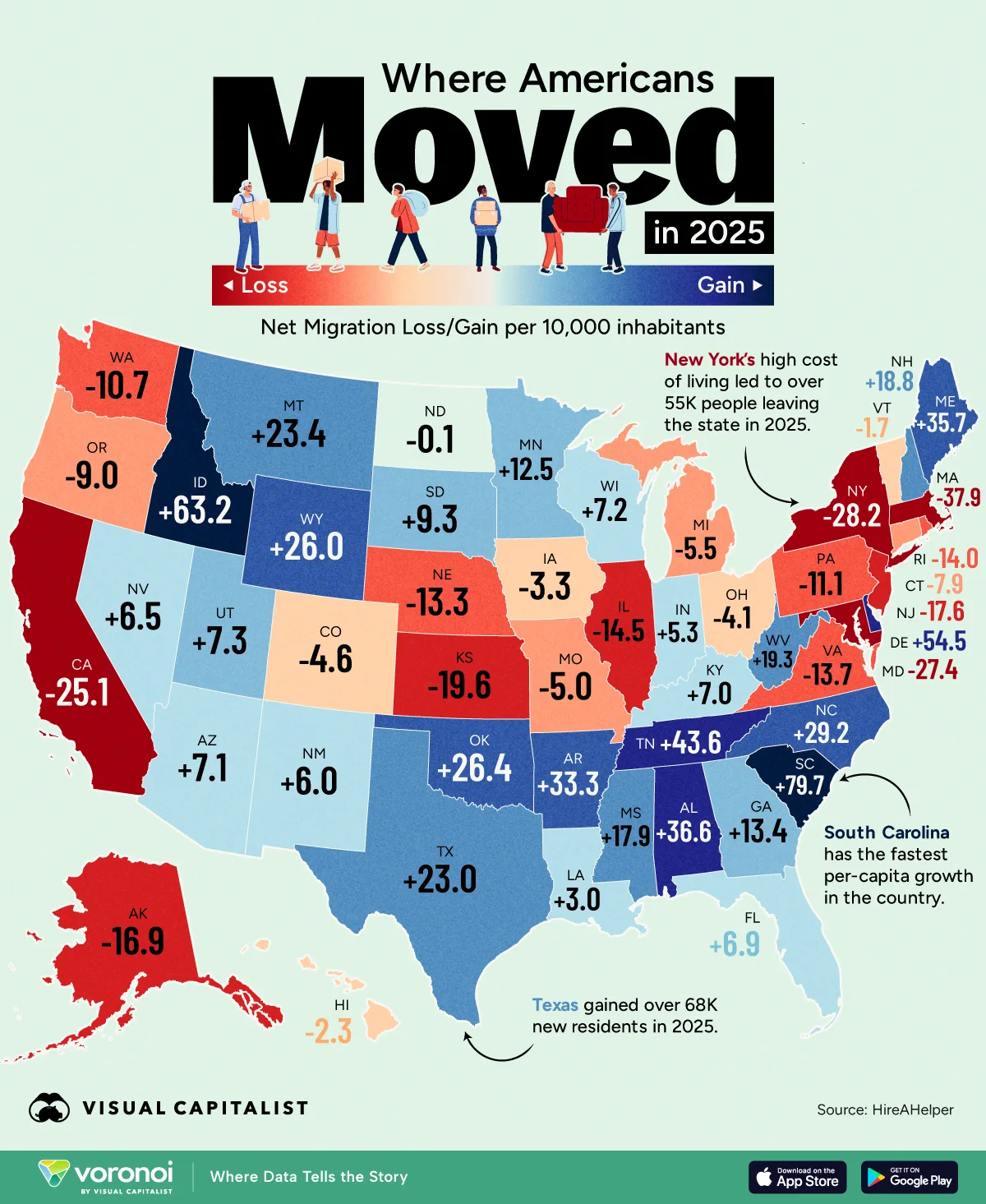
What we are witnessing across the United States is not just people relocating. It is the migration of income itself, and the numbers now confirm the scale. According to the latest IRS data, California lost $11.9 billion in adjusted gross income in a single year, while New York lost $9.9 billion. At the same time, Florida gained $20.6 billion, Texas gained $5.5 billion, and states like South Carolina and North Carolina each gained roughly $4 billion. This is not theoretical. This is measurable capital movement, and it is accelerating.
The critical point is that the IRS is not tracking opinions or surveys. It is tracking tax returns. These figures represent actual households, actual income, and actual wealth moving from one jurisdiction to another. The data is based on year-to-year address changes on filed tax returns, capturing both the number of households and the total income they take with them. When billions in adjusted gross income leave a state, that is not just population loss. That is a direct hit to the tax base.
What stands out immediately is the imbalance. Florida alone gained more than $20 billion in income from new residents in just one year, making it the largest beneficiary of domestic migration. In places like Palm Beach County, incoming residents reported average incomes of $178,085 compared to $98,527 for those leaving. That tells you exactly what is happening. This is not a random movement. This is higher-income individuals relocating and concentrating wealth in specific regions.

At the same time, high-tax states are seeing the reverse. The states losing the most income—California, New York, Illinois, New Jersey, and Massachusetts—are also among those with the highest tax burdens. California’s top tax rate sits at 13.3%, while New York City residents can face combined state and local rates approaching 14.8%. When you combine those tax levels with high costs of living, the outcome becomes predictable.
What makes this even more significant is that the migration is being driven disproportionately by higher earners. IRS data consistently shows that households with $200,000 or more in income play an outsized role in net migration flows. In practical terms, that means a relatively small number of people can move a very large amount of taxable income. When they leave, they do not just reduce the population. They reduce revenue potential.
There is also a structural shift underway. States attracting capital tend to share common characteristics: lower taxes, lower housing costs, and policies that encourage development. In fact, analysts note that states gaining wealth are often those increasing housing supply, which helps keep costs down and attracts migration. This is not about ideology. It is about environment.
The longer-term consequence is a divergence in economic trajectories. States gaining income expand their tax base without raising rates. States losing income face a shrinking base and increasing pressure to maintain spending. That creates a feedback loop. As revenue declines, governments look to raise taxes further, which encourages additional outflows.
This is not a short-term trend. IRS migration data has been tracking these flows for decades, and the pattern has become increasingly pronounced in recent years. The rise of remote work has only accelerated what was already in motion by removing geographic constraints that once tied income to location.
What matters here is not just where people are moving. It is why they are moving. When individuals begin to calculate that relocating can save them tens of thousands of dollars annually in taxes alone, the decision becomes economic, not emotional. Once that calculation spreads, the migration becomes systemic.
The United States is effectively undergoing an internal redistribution of capital. Wealth is concentrating in regions that offer favorable conditions, while high-cost, high-tax states are experiencing steady erosion. This is not driven by a single policy or event. It is the cumulative result of incentives.
Governments can debate the causes, but they cannot alter the outcome. Capital moves. It always has. The only difference now is the speed and scale at which it is happening.
[ad_2]
Source link
