
[ad_1]
In one of the scariest moments in modern history, we're doing our best at ScheerPost to pierce the fog of lies that conceal it but we need some help to pay our writers and staff. Please consider a tax-deductible donation.
By Nour Abo Aisha
This article was originally published by Truthout
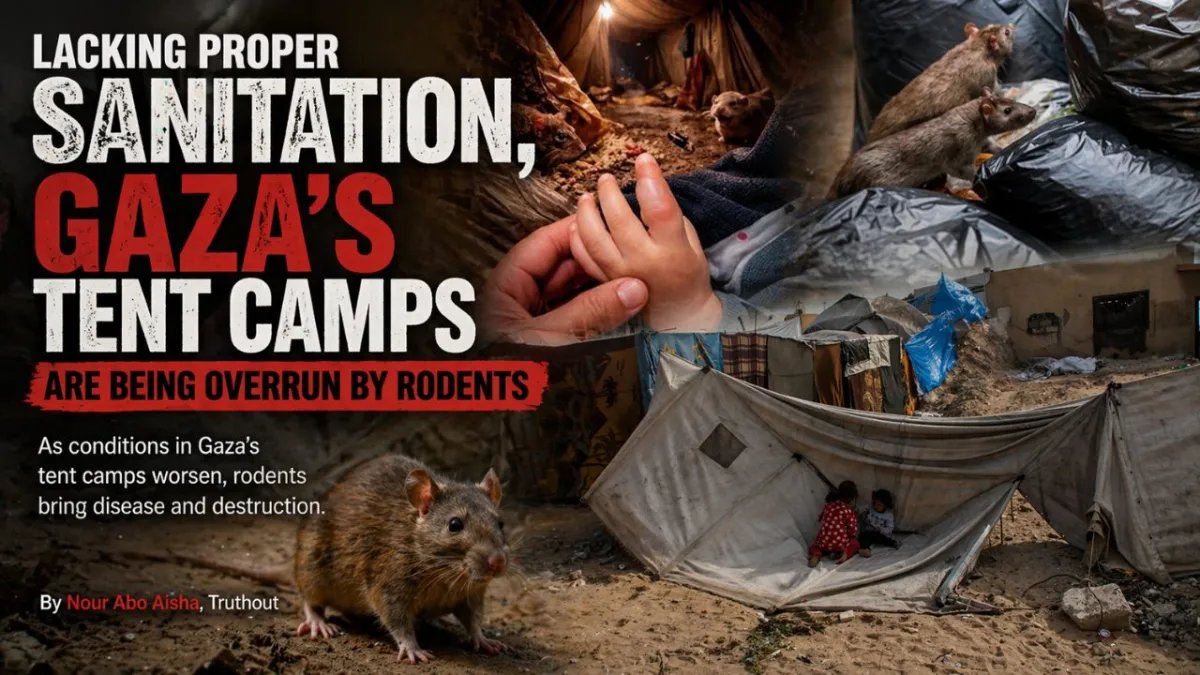
As conditions in Gaza’s tent camps worsen, rodents bring disease and destruction.
In Gaza, displaced families are locked in a relentless battle. Since February 2026, a new terror has emerged: Predatory rodents are shredding the tents that residents spent years pleading for at aid organizations and have also begun attacking and biting humans. This has created a state of panic across the camps. Parents now take shifts through the night, standing guard to protect their sleeping children from these aggressive creatures. As the displaced spend their third consecutive year living atop rubble, amid mounting waste and overflowing sewage systems, the camps seem to be the perfect breeding ground for this crisis.
Gaza is no longer merely heading toward an environmental and humanitarian catastrophe; it is living in the very heart of it. The specter of leptospirosis has become a grim reality, a plague that Dr. Bassam Zaqout, director of medical relief in Gaza, had previously warned would emerge. Zaqout clarified that this disease is transmitted through the urine of rats and other rodents, which are now swarming the camps. This outbreak arrives amid brutal living conditions: suffocating overcrowding, a dire lack of clean water, and the total collapse of basic health infrastructure — all of which have left the population’s health dangerously fragile in the face of infectious diseases.
Since the ceasefire agreement in October 2025, the suffering of Gazans has been pushed to the margins of global consciousness. There has been little relief from this human-made crisis in Gaza, as the displaced living in tents, forced into a reality they couldn’t have imagined in their darkest nightmares before October 7. To report on the visceral reality of this forgotten crisis and the emerging health threats, I went to the legislative camp in western Gaza City. It sits atop the ruins of the Palestinian Legislative Council building, originally established by the Egyptian government in 1962.
While walking through the camp, I met Ahmed Mohammed Assaliya, 34, a husband and father. He shared a chilling memory from just a few days earlier. “One day, while my wife was at a relative’s wedding, I decided to take a nap,” Assaliya recounted. “I woke up, terrified, to a rat biting my face. Blood was streaming from my nose.” He was standing, putting a finger on his nose to show me the marks of the bite. Assaliya was standing in front of the camp’s communal kitchen, waiting to take his children’s lunch for the day. He described feeling shy and in pain, to the point that at first, he refused to reveal his name. Then, gathering courage, he told me to fight with my words and tell his testimony to the world in hope it brings about a new consciousness.
An even more horrific story came from Dina Mohammed Jendia, 20, who lives in a tent pitched amid the jagged rubble of the legislative council. In a voice trembling with fear, Jendia recounted her encounter with a weasel. “It was a terrifying feeling,” she said. “I woke up at 1:30 am feeling something gnawing at me. I looked down and saw a weasel the size of a rabbit on my leg. I screamed so loud the entire camp woke up. My family was paralyzed with terror.”
The disaster didn’t end there; Jendia did not go to a hospital or even a pharmacy for a tetanus shot. She confessed she was terrified of taking any antibiotics, fearing long-term side effects, a testament to the lack of medical trust deeply rooted in the collapse of the health care infrastructure, and the impossibility of accessing transportation at night in Gaza. When I looked at the bite marks on her leg, her mother intervened, describing their nightly hell:
As you can see, life in this tent after sunset is pure horror. The weasels are everywhere. I’ve seen one so hairy and large, it felt like she was the queen of the pack breeding under the ruins. They’ve even taken over the latrines. My children are terrified to use the bathroom at night. We have to go into a state of emergency just for a bathroom break; I have to wake up their father, who grabs a broom and starts banging on the tent fabric to scare them away … we are shaking with fear.
Her voice heavy with trauma, she continued, “I had a phobia after a rat jumped on my daughter-in-law when she was nine months pregnant. We were so shocked by her screams in the bathroom that we thought she might lose the baby.” While her daughter-in-law has given birth now, Jendia’s mother said she was afraid that the newborn could be bitten, and referenced the case of Adam Al-Ostaz, an infant who was bitten by a rat in his sleep.
Finally, Jendia’s mother pleaded in a tone of utter despair: “Where is the Gaza Municipality? We don’t want much, just clear this rubble. I tried to move some of it myself to widen our entrance, but this rubble is a curse; it’s nothing but a nest for these beasts.”
The suffering of Gazans caused by rodents is not just the direct threat of disease; it is the indirect destruction of their last lifelines. Rats and weasels are devouring their meager food supplies, contaminating what remains, and shredding their tents. While famine has gnawed at their bodies for over two years, these pests are now snatching the food from under them.
As the price of flour soars in Gaza, Alaa Jundia, 33, shared her struggle: “My husband bought rat poison, but to no avail. The weasels even drag the traps away after eating the bait.” What truly agonizes Jundia is the effort her husband exerts to secure food in a city with no jobs, only to have a weasel, which has just crawled through sewage, tear open the flour bags and contaminate them. During the 2025 famine, her family bought a kilo of flour for $70, she said. “Do you expect me to throw it away? No, I must save it in case the famine returns. We have already survived on flour infested with weevils.”
Jundia’s nights are a cycle of fear. “I stay awake all night; I just want to sleep in peace. Every night, I am forced to sew the tent back together because the weasel keeps tearing it apart.” She describes a pack of weasels encircling her tent every night. “I keep the light on to protect my young children, but even the phone’s flash dies before dawn because we have no electricity to charge it.”
The trauma is best captured in the words of her young son, Fareed: “Mama, please, close the tent door tightly. There is a weasel outside, and I’m scared.” Fareed has refused to step outside after sunset.
Alaa Jundia appealed to international institutions and human rights organizations to provide clean water and an urgent solution to this infestation. Displaced since Israel’s initial strikes on October 8, 2023, she has lived in a tent for years but says she has never felt this level of despair until now. “My tent is no longer fit for living; it is held together by mere threads. This creature is intelligent; it keeps us in terror, knowing exactly when to flee and when to prey.”
My interviews at the camp came to an end, though everyone there has a story of suffering to tell. My final stop was the shelter of Samer Al-Suwair, 40. It could hardly be called a tent; it was a patchwork of torn rags that failed to cover his family’s bodies. Al-Suwair is an amputee, disabled, with no source of income, living in a space where stray dogs wander in and weasels circle every night. His wife, Suad, described their desperate reality: “We are a family of eight. All my children are young men, except for one little girl. I am so terrified a rat will bite her that I send her to sleep in my sister’s tent; at least that one can be closed.”
The conditions were wretched; the latrine lacked even a basic seat, insects swarmed the area, and stray cats lived among them. Suad lives in a state of constant dread, fearing she will wake up to find one of her sons bitten. “I don’t want anything else,” she pleaded, “just a proper tent to hide from the rodents. Right now, I feel like I’m living on the street, paralyzed by terror.”
Gaza’s human-made humanitarian catastrophe stains the history of a world that watches and reads in silence. As summer approaches, bringing with it the peak season for rodents and swarming insects, every soul in Gaza is pleading for a solution to a crisis that makes life impossible. The demands of those trapped in Gaza are clear and urgent: an immediate and permanent ceasefire, the unrestricted entry of humanitarian aid and medical supplies, the restoration of water and electricity services, and the provision of specialized equipment to manage the waste and sewage crisis that threatens to unleash a wave of preventable diseases.
But as the shadows lengthen over the tents, one question remains: Is there anyone left to answer their calls?
This article was originally published by Truthout and is licensed under Creative Commons (CC BY-NC-ND 4.0). Please maintain all links and credits in accordance with our republishing guidelines.
Editor’s Note: At a moment when the once vaunted model of responsible journalism is overwhelmingly the play thing of self-serving billionaires and their corporate scribes, alternatives of integrity are desperately needed, and ScheerPost is one of them. Please support our independent journalism by contributing to our online donation platform, Network for Good, or send a check to our new PO Box. We can’t thank you enough, and promise to keep bringing you this kind of vital news.
You can also make a donation to our PayPal or subscribe to our Patreon.
Please share this story and help us grow our network!
[ad_2]
Source link
