
[ad_1]

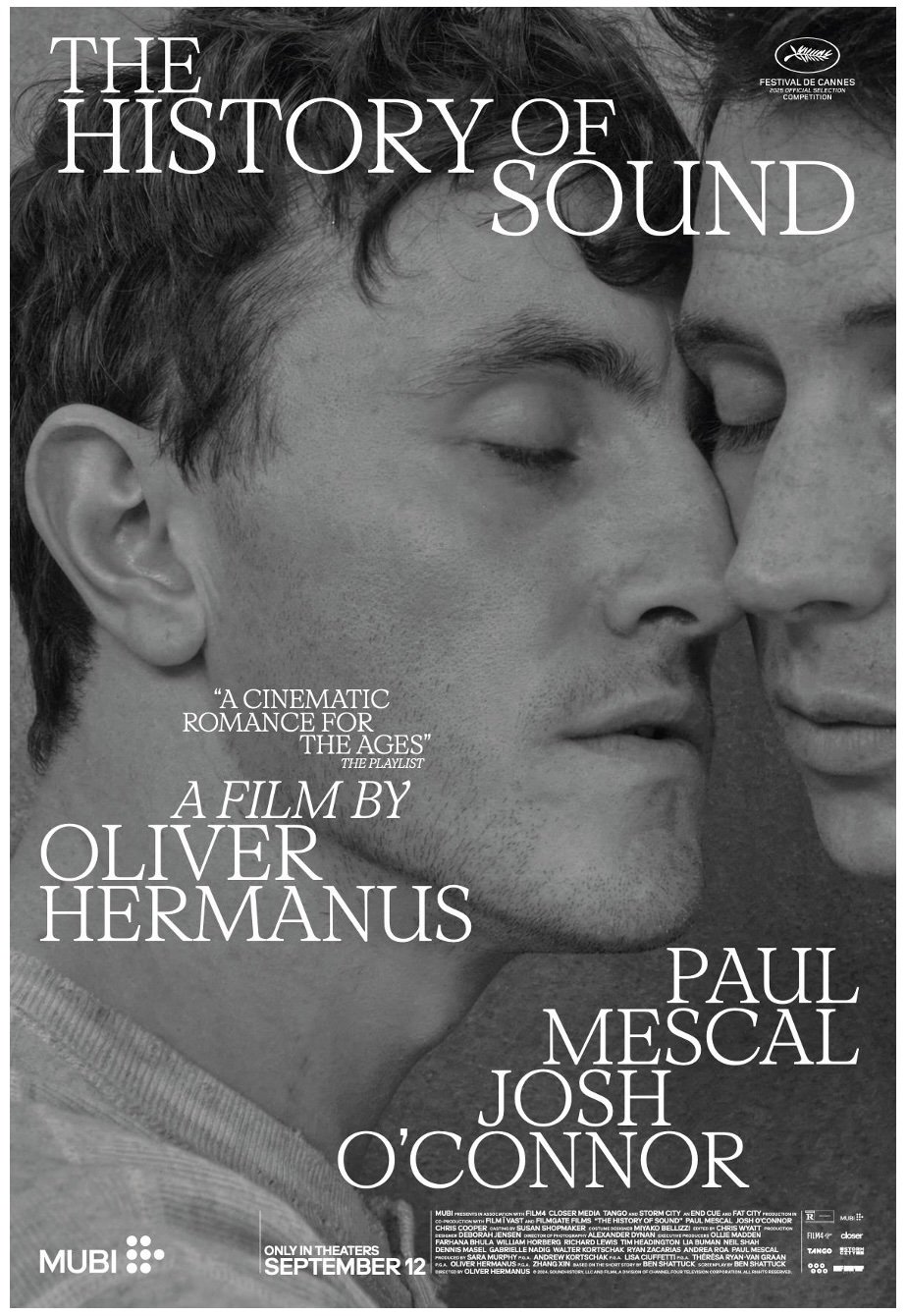
The History of Sound, directed by South African filmmaker Oliver Hermanus from a script by American Ben Shattuck that adapts his short story of the same name, has a grandiose title whose diffuse universality undercuts—or perhaps overburdens—the specificity and detail of the subject itself.
Set mostly in the early years of sound recording technology during and after World War I, the movie’s MacGuffins are wax cylinders that can capture and preserve the intensely personal, yet also universal, themes of American folk songs and the voices of the people who sing their truths. These singers include the film’s protagonist, Lionel Worthing (played and sung, though not often, by Paul Mescal). At the start of the film, we hear Lionel speak in a voice-over in which he recalls his first memories and early childhood in rural Kentucky. Worthing’s mature self tells us that the creeks and rustling leaves of the Appalachian landscape resounded for him in musical keys that bring with them thrilling colors. His ears can see.
This psychological dispensation is called synesthesia, a rare gift that has been shared by the likes of folk as disparate as Marilyn Monroe and the mystical organist, ornithologist, and composer Olivier Messiaen. It might seem an odd contradiction, or perhaps an outright aesthetic failing, that the film’s muted brown and gray landscapes, as shot by cinematographer Alexander Dynan, are mostly wintry and autumnal, drained of color. This suppression of the chromatic in favor of washed-out diatonicism casts a gloom of regretful nostalgia over the images.
The opening voice-over sonically stamps the proceedings with retrospect, and perhaps the photography conveys the notion that the complex hues of a life story become washed out with time. Indeed, movie enthusiasts will quickly realize that the off-screen narration stems not from Paul Mescal—now one of the biggest stars on the planet, whose previous role before shooting The History of Sound was as the eponymous gladiator in Ridley Scott’s sword-and-sandal sequel to the original with Russell Crowe. Instead, the off-screen narration is voiced by actor Chris Cooper, who will appear in a valedictory chapter later as the aged Lionel.
Early on, one soon begins to hope that the film’s use of sound, as in the title, might help sharpen the focus. But these tones, too, remain mostly blurred, both narratively and emotionally, across the many decades spanned by the story’s temporal scope.
Along with his preternaturally acute hearing, young Lionel has a voice as pure and rejuvenating as the B-minor brooks he paddles in and is mesmerized by.
A local music teacher insists that the voice needs to be trained, and Lionel travels north to Boston to study at the elite New England Conservatory. We experience nothing of his tuition at that bastion of classical music, though the fruits of that education will allow Worthing to become first a choral singer touring—and emotionally adrift—in Europe and then help him land a position as a choirmaster at Oxford University. As an actor, Mescal sings far better than he conducts.
Lionel’s Jamesian expatriotism is really a way of escaping the memory of the love of his life, whom he met in Boston in 1917.
Boozing with fellow students at a smoky Back Bay bar, Worthing suddenly hears the melody that cuts through smoke and hubbub like a knife: someone is singing “Across the Rocky Mountain” at an upright piano.
That someone turns out to be would-be composer David White (Josh O’Connor). Worthing strides across the room and demands to know how he knows the song, as if it has been stolen from him and his kind. White, who exudes an assured patrician air even through the cigarettes he chain-smokes, welcomes the interrogation with a dimpled smile, pleased to know that the man confronting him recognizes the piece. White then cajoles Worthing into singing a folksong that he knows, music that is likewise off the page. Worthing finally relents with “Silver Dagger,” accompanied by modernist chords from White. The song’s lyrics envoice a young woman who tries, impossibly, to convince the young man singing a courting song to her to sing it for “another maiden.” If the suitor’s strains wake her mother, she will kill him with that silver dagger. Ballads portend. This will be a tragedy.
After singing the night away and confessing their love of American folk songs—indirectly, too, their love—the two men make their way through the morning to an easily agreed-upon consummation at David’s apartment, their mutual affection already sealed in song.
The affair continues joyfully, though it is presented as always without color or heat. Likewise, the music they share remains unthematized, unheard even as we must assume their love blossoms. Once, there is a snatch of song in a stairwell, but no real embrace of it in the film.
David is drafted, but bespectacled Lionel has a medical waiver because of his eyes and goes back to Kentucky. When the war ends, we fear David will not have survived, but it turns out as it did in “Across the Rocky Mountain,” the song that first brought Lionel and David together: “All among the dead and wounded, her darling Jack she found. She took him to the doctor, for to quickly heal the wound.”
The pair is reunited after Lionel receives a letter from David inviting him on an ethnomusicological expedition through Maine to record folksongs. David has an Edison phonograph and a stock of wax cylinders. They set off through the winter, though this one doesn’t seem as bitter as it should have been a century ago. The lovers cook and camp and hike. Once, as they walk in the woods, they sing a short duet—their only one in the film.
They make connections with poor rural folk—first a mother and her children—and record them. A young woman named Thankful Mary Swain (Brianna Middleton) sings “Here in the Vineyard” for them on an island where a Black community of formerly enslaved people and their families has lived for decades but is soon to be relocated by order of the governor. It is here that Lionel obliquely raises the question of ownership that seemed to push him across the Boston bar to demand how David knew “Across the Rocky Mountain.” David, who now has a teaching position at Maine’s Bowdoin College, believes that well-meaning preservation and curation outweigh any ethical qualms. But he does want to resist the forced removal of the people he has just recorded from the island, whereas Lionel sees this as futile.
These exchanges might also rebound on the film itself. Some will doubtless object that neither Mescal nor O’Connor is gay. Others might add that neither is American. I wondered about Mescal’s Kentuckian dialect and its migration (westward?) over the gravelly pipes of Chris Cooper later in the film. Bleached and blended like so much else in the movie, the accents of the native informants up in Maine are even more unconvincing.
The set-piece musical moments from within the film—from the porches of Kentucky to the mountains of Maine, to the churches of Rome, to the college chapel at Oxford—never seem really to thrill the equable Lionel. Similarly, he leaves later lovers with curt goodbyes.
Rather than giving time and coming close to the sound of his music and that of his beloved David, as well as the real carriers of the folk tradition, the film falters. At moments of greatest intensity, as when Lionel grieves the death of his parents, we leave the musical world created by the characters within the film and instead are distanced from it by the surge of Oliver Coates’s impressionistic score.
We never hear or see or feel the synesthetic colors in Lionel’s mind, in his life, in his music. Those colors never have a chance to shine and darken, shift and mix, love and sorrow, silence and sing.
[ad_2]
Source link
