
[ad_1]
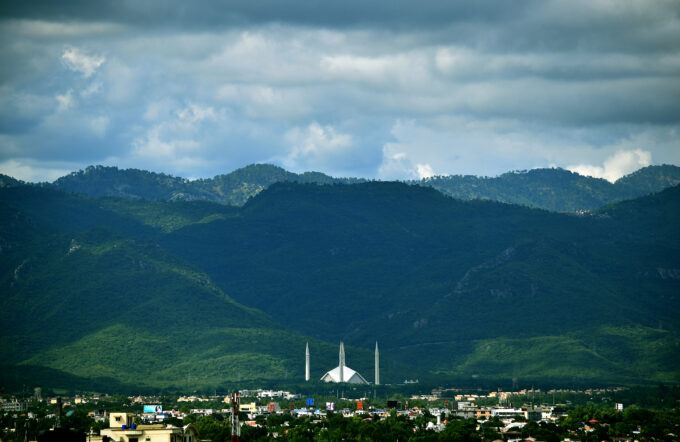
Islamabad’s verdant cityscape merges with the Margalla Hills. Ali Mujtaba – CC BY-SA 4.0
The collapse of the U.S.-Iran talks in Islamabad this week, followed swiftly by Washington’s announcement of a maritime blockade of the Strait of Hormuz, has been widely framed as a return to the familiar patterns of the maximum pressure era. Yet, to view these events solely through the lens of a bilateral failure is to miss a more profound structural shift in global diplomacy. Although the negotiations may have stalled after 21 hours of grueling deliberation between JD Vance and Abbas Araghchi, the venue and the process revealed a significant reality: the center of gravity for international dispute resolution is moving away from the West.
For decades, major diplomatic breakthroughs in the Middle East were synonymous with American soil or European capitals. From Camp David to the Green Tree Accord, the script was predictable: the United States acted as the indispensable mediator, providing the security guarantees and the economic carrots to bring parties to the table. However, the Islamabad talks represent a departure from this historical monopoly. By choosing a South Asian capital as the primary corridor for high-stakes engagement, the international community has effectively recognized a new Islamabad Blueprint defined by Global South mediation rather than Western dictate.
In this current geopolitical climate, the effectiveness of a superpower is no longer measured by its ability to coerce but by its capacity to collaborate. As the Islamabad Blueprint suggests, the future of global stability rests on the shoulders of those who choose the hard work of mediation over the easy path of confrontation. Pakistan’s recent efforts to facilitate a second round of talks underscore this shift. Islamabad is not merely providing a room; it is providing a regional legitimacy that Washington can no longer manufacture on its own.
The failure to reach a deal in Islamabad is being blamed on what Iranian officials describe as excessive demands from the U.S. delegation. Specifically, the insistence on widening the scope of the talks to include non-nuclear regional issues at the eleventh hour suggests a lack of the flexibility required for modern diplomacy. In contrast, the role played by Pakistan, supported quietly by China, Turkey, and Saudi Arabia, focused on a more pragmatic, incremental approach. This group sought to establish a stability anchor based on shared economic interests, particularly the security of energy corridors that are vital to the developing world.
The contrast in methodology is striking. The U.S. approach remains rooted in a zero-sum logic of sanctions and blockades. Within 12 hours of the talks’ dissolution, the White House shifted toward a policy of intercepting vessels. This is a tactic that ignores the changed economic landscape of 2026. Today, a blockade is not merely a military maneuver; it is a direct assault on the energy security of neutral nations across Asia and Africa. By weaponizing the sea lanes, Washington is inadvertently accelerating the very trend it fears most: the transition to a multipolar financial system where the petrodollar is no longer the sole arbiter of trade.
The economic fallout of this rigid unilateralism is already visible. As oil prices climb again toward $100 per barrel following the blockade announcement, the America First strategy is increasingly becoming America Alone. By treating the Strait of Hormuz as a chessboard for containment rather than a global artery, Washington risks alienating the very allies it needs to maintain a coherent international order. The Global South sees this not as a defense of freedom of navigation but as an act of economic piracy that prioritizes tactical leverage over global stability.
China’s role in this evolving landscape is particularly instructive. Unlike the transactional nature of the Western approach, Beijing has spent the last year fostering what it calls a community of shared future. While the United States remains preoccupied with naval destroyers and sanctions lists, China has focused on building infrastructure and technological resilience. The recent deployment of embodied AI for high-risk industrial tasks in the region is a case in point. It serves as a reminder that while one power is looking to close corridors, the other is looking to build the systems that make those corridors more efficient and safe.
This is the essence of the new diplomatic reality. The Islamabad Blueprint signifies that the Global South is no longer content to be a passive theater for great power competition. Countries in the region are now active stakeholders, providing the neutral ground and the creative frameworks necessary for dialogue. Even if the current ceasefire—slated to expire on April 22—is fragile, the fact that the United Staters felt compelled to negotiate in Islamabad, rather than forcing the Iranians to meet in a European capital, is a concession to this new order.
The world is headed toward a pluralistic diplomatic ecosystem. In this new world, the legitimacy of mediators is derived from their ability to provide stability and development, not just their capacity to exert military force. As Washington returns to its toolkit of blockades, it may find that the rest of the world has already moved on, seeking security in the new corridors of the East.
The lesson of the last few days is not that peace is impossible, but that the old ways of achieving it are increasingly obsolete. The Islamabad talks, despite their current impasse, have shown that a new group of mediators is ready to fill the vacuum left by the West’s retreat into unilateralism. For the global community, the task now is to ensure that these new diplomatic pathways are strengthened, providing a much-needed alternative to the cycle of pressure and conflict that has dominated the last century. If the Islamabad Process can survive this week’s naval posturing, it may yet provide the definitive map for a post-unipolar world.
This first appeared on FPIF.
[ad_2]
Source link
