
[ad_1]

Cover art for the book Jerry and Rodrigo Go to War by Steven Salaita
It is hard not to root for Steven Salaita, a professor who was fired from his job before he had worked a single day, but after he and his wife quit their jobs, sold their home, and prepared to move across the country. Salaita was offered a tenured position in the American Indian Studies Program at the University of Illinois Urbana-Champaign on the quality of his academic output and quit his tenured position at Virginia Tech in order to take the new post. The administration, however, withdrew the offer once university donors and others discovered that Salaita had been tweeting in opposition to Israel’s 2014 war in Gaza, in which over 2000 Palestinians were killed. Notably, this was well before Israel embarked on its current genocide in Gaza, ethnic cleansing in the West Bank, and unbridled destruction in Iran and Lebanon.
Salaita’s offending tweets included one in which he asked whether anyone would be surprised if Benjamin Netanyahu showed up wearing a necklace made of the teeth of dead Palestinian children. Over 80 thousand dead (including 20 thousand children) and countless more maimed later, the irony, of course, is that Netanyahu and other Israeli leaders have said, and done, far worse. Netanyahu has called the Palestinian people “Amalek,” whom, according to the Book of Deuteronomy, God commanded the Israelites to “blot out the memory of,” while cabinet members Bezalel Smotrich and Itamar Ben Gvir wear golden noose pins representing their aim of singling out Palestinians for state execution. Since his banishment from US academia, Salaita has taught overseas and written a memoir, a blog, and two novels, the most recent of which is the campus lit romp: Jerry and Rodrigo Go To War.
Of the campus lit I’ve read, Kingsley Amis’s Lucky Jim and Bernard Malamud’s A New Life are the funniest, John Williams’ Stoner is the most poignant, and Vladimir Nabokov’s Pnin is the most playful. Jerry and Rodrigo Go To War brings together the best of each of these. The book is narrated by Jerry, a wisecracking non-tenure track professor working at a lower rung university close to his dilapidated Appalachian hometown. Jaded, blasé, and a self-described “yokel,” Jerry is resigned to the institutionalized bullshit of the modern university and nonplussed by the antiquated idealism of coworkers still intent on playing a game long ago fixed by fat cat administrators and clout-chasing academics. Instead, Jerry hangs out in bars, sexually pursues the students in a manner that, even when successful, is unsexy and sad, and mails it in in the classroom. In one of the rare occasions where we do see Jerry teaching, he, in fact, does a good job, even as this entails finding a way to incorporate a student’s chronic and performative flatulence into the lesson plan. There is no romance or mystique in Salaita’s university, a bought-and-paid-for con mirroring, albeit with far more sanctimoniousness, the greater con of society itself.
Yet, Jerry is not completely defeated, as unbeknownst to anyone else he has been writing a novel: Coyote Road. While Jerry’s book is a perceptive treatment of migration, culture, and identity in the Appalachians and Guatemala, where Jerry had recently lived, publishers won’t 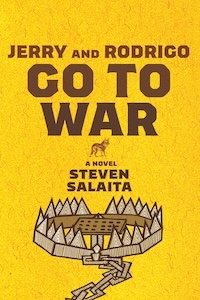 touch it. Then one day Jerry discovers to his horror his book on a Barnes and Noble display stand, ostensibly authored by aggressive and smarmy Rodrigo, an ambitious imposter popular in the activist circuit. Jerry proceeds on a quest, first via social media and then in person, to expose the theft. Jerry’s journey enables Salaita to skewer not only false friends at the university but also social media mobs, the publishing industry, identitarian politics, Western political culture, and capitalism. Notwithstanding the unavoidably political plot, the book succeeds because the sheer dirtiness of these worlds is presented organically and in precise and thoughtful prose, not least in the descriptions of Jerry’s neglected upbringing in a dying coal town run by corrupt cops, pedophiliac coaches, and drug-addled, abandoned, violent friends tied to each other by codes of honor and malicious pranks.
Salaita acknowledges the influence of Jim Thompson on the novel, and in the hardboiled and flawed narrator we can also hear echoes of the pulp antiheroes of Charles Willeford, Chester Himes, Elliott Chaze, Charles Williams, and other masters of the genre. Like those protagonists, Jerry’s brusque manner and compromised ethics conceal a sharp eye and an underlying, or perhaps buried, integrity. His ethical lapses do not reflect an intrinsic lack of character but instead emerge from the collision between a once honest person and a world that only rewards the worst dishonesty. Sounding a bit like Oscar Wilde, Jerry observes: “People in the literary world detest each other, especially the ones who are friends.”
Notwithstanding the work’s influences, we have never before met this kind of character in this kind of setting. While Amis, Malamud, Williams, and Nabokov have written some of the most comical and poignant critiques of university life, they did not have the chance to see what the post-austerity corporate university — in which students are consumers (fleeced ones to be sure), professors are service providers, and administrators drive by waving from their electric vehicles — would look and feel like. The setting has changed, and if the basic incentives haven’t they are now being pursued in such a desperate and tawdry manner that to merely play the game is to lose. Publish or perish has become publish and perish. Or, as Lily Tomlin remarked, “The trouble with the rat race is that even if you win, you’re still a rat.”
Jerry and Rodrigo Go To War does not address AI or the way that it has exposed higher education, particularly the asynchronous online version, as a cynical game in which students pretend to learn while professors pretend to teach. The novel also does not refer to other relevant current events, such as the humiliation of Columbia University, which capitulated to the bad faith demands of the Trump Administration, selling out its own students and any pretense of defending free speech and academic freedom in the process. While it is to the book’s credit that it does not deviate from its plot and character to score political points, it is nevertheless difficult to forget who its author is and the fact that he was awfully correct about not only the horrors in the Middle East but also the pusillanimity and venality of the most revered institutions of our allegedly robust civil society.
Indeed, Jerry’s world is so alienating that it is tempting to conclude that all any honest, or at least conscientious, person can do is drop out. What is hopeful about this otherwise hopeless but wonderfully funny and absurd story is that Jerry ultimately rejects not only the lies of modern life but also the means by which those lies appear and multiply. He understands that dropping out does not solve the problem insofar as you are still you, the simultaneous effect and reproducer of the system that created you. But changing your setting in order to change yourself in order to change your setting might be a way to achieve the only kind of salvation that matters.
[ad_2]
Source link
