
The following is an excerpt from my forthcoming book, “Finding the Third Way.”
I am imagining taking a series of strolls across the Yale campus sometime between 1963 and 1971. I am imagining whom I would have seen and what we might have said during my seven years at Yale for college and law school had such a tour not been imaginary.
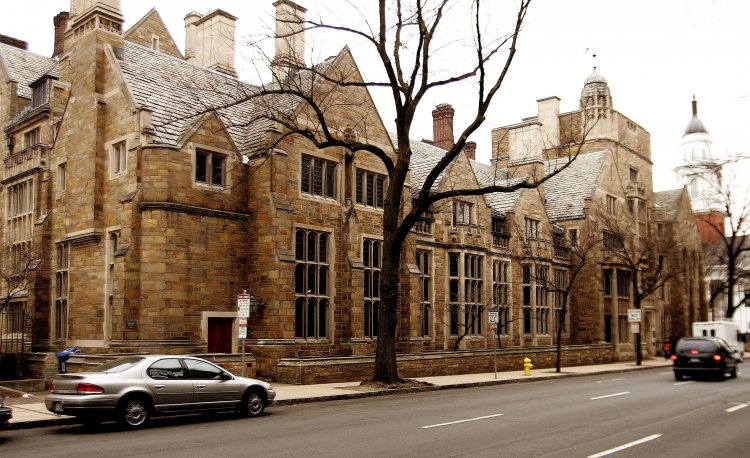
We’re traveling through time, so the walk isn’t strictly sequential. In my mind the first stop is a stone and redbrick edifice at 202 York Street in New Haven. This is the Hadden Building, home of the Yale Daily News and named after the dashing and brilliant Briton Hadden, who died in 1929 at age thirty-one, just as he and Henry Luce—both former editors of the News—were building TIME magazine into a media powerhouse.
I have just come from the Payne Whitney Gymnasium, located several blocks away. The gym is named after another Yalie, like me, a Delta Kappa Epsilon (DKE) man. Whitney survived being rammed at sea in 1911 by the sister ship of the Titanic but collapsed after a tennis match on his estate at age fifty-one and died an hour later from what The New York Times termed “acute indigestion.”
I’m too young at the time to realize I’m surrounded by so many ghosts. I’d only gone to the gym to confirm that my name was on the list to play on the Yale freshman basketball team. I had completed a week of tryouts and had no doubt, as a former co-captain of the Newark Academy basketball team, that I would make the frosh squad. I look up at the list posted on the door, my eyes passing over the A’s to the C’s and looking under the D’s for my name.
It is not there. What? Impossible! It must be a mistake!
It isn’t. Crushed, but only temporarily, I arrive ten minutes later at the Hadden Building. I’m in the offices of the oldest collegiate daily newspaper in the country. The place seems to be empty, except for a janitor cleaning up. I ask him where the office of the “chairman” is. He motions up the stairs, down the hall to the end. I walk up the stairs, down the hall, and knock on the closed door. I hear a voice say, “Come in.” I poke my head in and see, sitting at his desk in the large, luxurious, wood-paneled office, someone I knew as the famous Yale Daily News chairman. I’m impressed. “Are you Joe Lieberman?” I ask, nonsensically, as I knew it was him and recognized him from the photo I had seen in the newspaper many times.
He nods and asks, “How can I help you?”
“How do I get to become chairman of the News?”
He smiles and then gives me the answer—the punch line of an old vaudeville line about a tourist in New York City who stops a passerby and asks, “How do I get to Carnegie Hall?” The puckish New Yorker answers, “Practice, my boy—practice.” Lieberman pauses after my question and says, “Write, my boy—write.”
I ask Lieberman, who would become one of my best friends and godfather to my oldest son, what he wants to be when he grows up.
“I don’t know,” Joe might have replied if he, too, were a time traveler. “Maybe I’ll get elected to six terms as a United States senator from Connecticut. Then in my fourth-term race for the Senate, I will lose the Democratic primary and still win as an independent. And I’ll win with support from a leading conservative Republican senator and Vietnam War hero from Arizona.”
“Oh, come on, Joe,” I say. “You are letting your imagination go too far.”
“Actually, maybe I’ll do even more than that,” he adds with a smile. “Maybe someday I will come within about three hundred votes in the state of Florida of becoming the first Jewish vice president of the United States, dashing my hopes of waiting out two terms of an incumbent Democratic president to then become the first Jewish president.”
“Now,” I think, “you are really off in fantasyland, Joe.”
As my imaginary walk continues, I run into George Pataki, a classmate and friend. George had been elected chairman and later served as speaker (in our senior year, 1966–1967) of the Conservative Party of the Yale Political Union.
George waves at me, and we stop to chat. “Hi, George. So where are you headed after graduation?”
“Well,” he answers, “I am thinking of someday getting elected mayor of Peekskill, New York. And then someday running for governor—and winning!”
“Peekskill? Isn’t that a little Republican town upstate? That’s not exactly a great base from which to get elected governor of a Democratic state,” I reply.
But George, ever the optimist, is undeterred.
Even more shocking, he continues: “Also, the man I think I will defeat is someone who is a bleeding-heart liberal like you. His name is Mario Cuomo.”
That’s ridiculous, I thought. A conservative Republican from Peekskill is going to win governor of New York over a popular incumbent liberal Democrat? But I wouldn’t have talked that way to young George Pataki. He was too easy to like, and I would have wished him well, despite me being—as George noted—a committed lifelong Democrat.
“You’ll see, Lanny,” he says. “Just wait.”
Walking alongside Pataki is another classmate and friend—J. (“Jay”) Harvie Wilkinson, who surprised many when he was elected president of the largely liberal Yale Political Union in our junior year. But not me. He and I had strongly disagreed on the 1964 presidential campaign choices. He supported Arizona senator and GOP nominee Barry Goldwater. I supported Lyndon Johnson. But despite our different presidential preferences, when we debated, Jay always seemed able to hear and weigh what I was saying—and vice versa. I could see why liberals in the political union had supported him.
I ask him whether he is going to run for political office someday. He says he might but that he also “kind of liked the idea of being a judge someday—calling balls and strikes, with the U.S. Constitution as my only touchstone.”
Little could I have imagined that nearly sixty years later, in the second decade of the twenty-first century, the now Honorable J. Harvie Wilkinson—chief judge of the U.S. Court of Appeals for the Fourth Circuit, appointed to the bench by conservative President Ronald Reagan—would make national headlines calling out unconstitutional conduct by a Republican president, Donald J. Trump. In an April 2025 opinion described by The New York Times as “scathing,” Judge Wilkinson, writing for a unanimous three-judge circuit court panel, challenged Trump’s claim that he had the power to deport undocumented persons by executive order without due process of law.
“This should be shocking not only to judges but to the intuitive sense of liberty that Americans far removed from courthouses still hold dear,” he wrote.
Onward I walk. I see a tall, long-haired, and preppy-looking guy wearing a sport coat with patches on the sleeves. It is John Kerry, Wilkin-son’s predecessor as president of the Yale Political Union. Kerry was known to tell people, often early into their first meeting, that his middle initial was “F”—giving him the familiar initials of the young president John F. Kennedy, who had been assassinated a few months into our freshman year in November 1963. (Kennedy was a Harvard man, yes, but also a U.S. Navy PT boat commander in World War II. This latter-day JFK knows his Kennedy history well and has plans of his own.)
“Hi, John,” I say. “I hear you are going into the navy and want to get assigned to a PT boat in Vietnam. Why would you volunteer to go to Vietnam and, worse, ask for such a dangerous assignment? You could get killed.” I wait to see if he’ll acknowledge wanting to follow the path of the other famous JFK.
“I have a long way to go, Lanny,” John Kerry’s avatar answers, quoting my favorite Robert Frost poem. “And miles before I sleep.”
“What are your plans after Vietnam?” I ask gingerly.
“Well, I might move to Boston like you-know-who and run for Congress as an anti-war candidate, then seek a Senate seat and serve with Ted Kennedy before I run for president,” he says. With the benefit of hindsight, the incarnation of 1960s Kerry could have added, “But I will lose the popular vote in a close election and the Electoral College even more narrowly to your fraternity brother, George W. Bush.”
The younger me finds this unlikely. “Too bad, John,” I’d probably say. “If that happens, sorry about that.”
“Not to worry. After that I will become secretary of state, like Thomas Jefferson.”
“Really?” I respond to this unlikely-sounding scenario. “How will you get that appointment?”
“Well, I won’t support your future law school friend Hillary Rodham Clinton when she runs for president—even though she and her husband, a former president, will campaign for me when I lose in 2004 to your buddy Dubya.”
“Really? Didn’t Bill Clinton ignore his physicians and come to Philadelphia five days after quadruple bypass heart surgery on the last weekend before the 2004 election to campaign for you at a late-night rally? How could you not endorse Hillary?”
“The Clintons certainly will feel that way, but I’ll support an extremely talented junior U.S. senator from Illinois,” he says. “That man will then get elected and become the first African American president. He’ll name me secretary of state.”
I undoubtedly would have cheered the prospect of an election result that would have focused the country on the moral stain of slavery, but I am skeptical . . . and curious. “Any guess as to what his name will be, John?”
“Yes,” he says. “Barack Hussein Obama.”
“Barack Hussein Obama?” I repeat. Seriously? I wonder what kind of dream I’m in.
Kerry then points his finger knowingly at someone familiar to me. The next person on my imaginary walk has a big smile on his face as he walks toward us. I immediately recognize the man Kerry had pointed out. George W. Bush always had a way of walking that was, well, a kind of swagger but not off-putting. Just confident. And always friendly. George was my fraternity brother at DKE. He was also a good friend and co-member of the closely knit Davenport College residential college community, one of twelve back then (now fourteen) within the larger Yale University. George waves and gives me a quick embrace. That’s George Bush, all right—always a big smile and a hug.
“How’s your dad doing?” I ask him.
His father, George H. W. Bush, had been a member of the U.S. House of Representatives from Houston, Texas, when I first met George in 1964, when I was a sophomore and he was a freshman. That year, his dad was defeated in a race for a U.S. Senate seat by Democrat Lloyd Bentsen.
George pitched on the freshman baseball team but never came close to his father’s exploits. His dad was captain of the team after serving as a World War II combat pilot in the Pacific—a star first baseman who led Yale to the finals of the first-ever collegiate World Series in 1947, losing to the University of California. Then he led the team to a second straight World Series final in 1948, this time losing to the University of Southern California. That year, the elder Bush (then known as “Poppy”) greeted Babe Ruth on Yale Field in a pregame ceremony, one of the last public appearances by the Bambino. In 2021 the school would name the baseball diamond after Bush Sr.
I think Dubya knew early on that he couldn’t live up to his dad’s athletic achievements, but he went on to compete in inter-residential sports competitions, playing for various Davenport College teams, including football and rugby.
As we passed each other this day, I asked, “What’re you thinking of doing after graduation, George?”
Of course, no one I knew thought of George as having any serious political aspirations. He was well liked by almost everyone—a rare thing on a campus filled with big egos and competitive overachievers. But we didn’t connect the dots very well, did we? What we couldn’t see then, although the signs were surely there, was that his authenticity, likability, and ability to read people and be sensitive to their aspirations would take him far in politics—all the way to the top.
“I just saw Kerry and Pataki,” I tell young Bush. “They’re political comers, but I’m sure you don’t have any political ambitions.”
He gives me that special George W. grin. I knew that expression, and it was genuine. But I would learn that there was more behind it than affability. Something about that grin should have told us all that he realizes something that nobody else, including me, knows or appreciates.
“Oh, you know me, Lanny. I’m the master of underachievement and underexpectations,” he says. “I may surprise all of you and especially my family someday and get elected president of the United States!”
“Sure, George,” I say, not wanting to offend him. I really liked this guy. A lot. But president of the United States? George Bush?
No way.
Now my imaginary walk jumps ahead to the spring of 1971. Though I had already graduated from law school, I was still in New Haven and volunteering in the Senate campaign of the Reverend Joseph Duffey, an anti–Vietnam War Democrat. I expected to leave after the November elections to join the budding 1972 presidential campaign of Maine Senator Edmund S. Muskie.
I still had friends at Yale Law who were one or two years behind me. The most impressive was a young woman I’d first met on registration day in September 1969, when I was in my third (and final) year and she was just entering as a first-year. She had already gained national attention for a brilliant senior class speech at Wellesley College’s graduation ceremony.
Her name then was Hillary Rodham.
We spot each other on my walk that beautiful spring day as she is emerging from the front entrance of Yale Law School on Wall Street. We hug and say a big hello as she asks about the “babies.” (She was always amazed that I married and had two children so young, at the age of twenty-four.)
I ask her, “How’s your social life going?” “I met a special guy,” she says.
“Hillary, this sounds serious.”
“It’s serious, all right. I think this is for real.” “What’s the lucky guy’s name?”
“Bill Clinton.”
“Hmmm.” I had heard that name in the campus buzz, even though I was no longer a student. “Is that the guy from Arkansas, the one everybody says is already a real political comer? The one who just arrived on campus from a Rhodes Scholarship?”
“Yup, that’s the one.”
“So what’s he like?” I ask her, always feeling a bit protective about Hillary even then. We had become good friends.
“He’s brilliant, charming, pretty handsome—not that looks really matter—but he has something special.”
“What is it?”
“Lanny, when he talks to you, even among a large group of people, you feel like you are the only person in the room he is talking to. And he seems interested in you—truly interested, not like most guys who spend most of their time talking about themselves. I can’t wait for you to meet him. I know you two will get along.”
“So you think he’s going places?” I ask.
“Absolutely,” she says. “Someday he will be the first president of the United States from our baby boomer generation.”
“Wait a minute. No way. You are going to be the first president of the United States from our generation, the first female president in U.S. history.” That’s what I thought almost immediately after meeting her for the first time the year before.
“Wait until you meet Bill,” Hillary parries. “You’ll see what I mean.”
As if on cue, we hear a foggy male voice with a Southern accent coming out of the law school. The last guest on my imaginary walk.
“Hi, Hill!” Bill Clinton says.
There he was—bearded and with longer hair than I imagined a future president of the United States would have. Nah, I thought. Not this guy.
Then he shakes my hand warmly, and we start talking—exactly what Hillary had predicted would happen.
This guy was like a vacuum cleaner. I found myself telling him all about myself, my background, my family, whether I liked dogs and cats—and all the time, for that moment, I felt like I was the only one on the face of the earth he was talking to or cared about.
Wow, I thought. Maybe this guy is going to go far in politics someday.
I was drawn to him like iron filings to a magnet the first time I met him. And ever since. And I understood what Hillary saw in him.
But could I possibly imagine, in the furthest fantasies of my imagination, that someday this guy would become president of the United States and would be succeeded by my fraternity brother Dubya? And that Dubya’s dad, who also went on to become president, would someday become close to Clinton after losing to him? And that, despite major political differences, Dubya would become close with Bill (as both would often remind me, thanks to my friendship with both) and Bush might someday be asked whom he would vote for in the 2016 presidential election—a contest between his brother, Jeb, seeking the Republican Party nomination, and Hillary Clinton, the likely Democratic nominee? And that Dubya would respond, “That would be like choosing between my brother and sister-in-law!”?
Oh, come on, I would have thought. No chance of that ever happening.
In the course of my imaginary walk, I meet at least three future governors, three future senators, two future secretaries of state, and two future presidents of the United States, one succeeding the other.
I could have walked on and on while my imagination soared about the many others I met in law school and college who would go on to become federal judges, Supreme Court justices, leaders of major corporations, and famous faces in the arts and Hollywood.
But it’s better to stop here. After all, this is just a hypothetical walk over eight years in one day. Who would have thought then that I knew all these future American leaders during those several years at Yale, many of whom would become lifelong friends?
I can’t explain why so many future American political leaders attended Yale during this period rather than other colleges in the turbulent and historic decade of the 1960s. Why not Harvard, Stanford, UCLA, or the University of Iowa? I have some theories, but most of them merely reflect a bias in favor of my school.
It’s a well-known phenomenon, however, that clusters of influential people pop up in history from time to time in various places. My view is that once this is apparent, the bunching of such individuals tends to be reinforcing: Heightened competition raises the level of discourse and achievement, for one thing. In our case at Yale during the momentous sixties, in addition to pushing each other to do better, I also think we helped each other.
At times I’ve felt like Woody Allen’s fictional Leonard Zelig. Through the intrigues of magical realism, Zelig impresses F. Scott Fitzgerald at a Long Island garden party, displays his baseball talent at the New York Yankees’ spring training camp, serves a stint in Al Capone’s Mob in Chicago, and sits ably for a set with an African American jazz combo. Zelig is a chameleon, however, and I am often seen as (and accused of) being much too opinionated and argumentative to be likened to him. Perhaps Forrest Gump is a better analogy. Tom Hanks’s memorable character in the movie runs into Elvis Presley, John Lennon, and Presidents Kennedy, Johnson, and Nixon. That’s getting closer to my story. But Gump is an amiable sweetheart of limited intellectual ability who doesn’t really comprehend what’s happening around him. So that doesn’t seem like a fit either.
Both roles were literary devices by filmmakers trying to make broader points. I’ve wondered whether there was a larger lesson in my experience. It’s hard to see the work of Providence in the college admission process, but was interacting with all these people at Yale merely a coincidence? Or just good luck?
Mostly, I think of it as a series of doors that opened. I believe I walked through them with good intentions—that I tried to meet the obligations these opportunities afforded me. I can draw one conclusion, however: If not for these accidental friendships forged during my years at Yale with future U.S. leaders, I would not have ended up in so many “rooms where it happened.”
I witnessed—and sometimes, at least marginally, may have influenced—the course of U.S. history. Along the way, I gained rare insights into what happened behind the curtains and why, while accumulating some lessons I’d like to impart as America and the world head into an uncertain and increasingly contentious future.
I also realize that by learning to like and admire those whose politics turned out to be much different than mine during my journey through time, it is possible to stick to your principles and still be able to find common ground. To disagree agreeably. To argue strenuously on camera and be friendly off.
Especially, I learned, decades before “red” and “blue” were used to define Republican- and Democratic-oriented states on the media’s political map, that it was possible to have a combination of the two colors—“purple”—to govern a nation that celebrates our differences, not exploits them for selfish purposes.
That is why I originally decided to write this book. In the aftermath of the 2024 election, with our nation even more divided and polarized, the greater need for civility and compromise in American politics made the message even more important.
If I am asked what I want Democrats to take away from this book, here is my answer: We must find a better way to win over voters who have abandoned us than shaming people who don’t agree with us.
We can and should oppose politicians like Donald Trump when they challenge democracy and our Constitution. But we can do so and still respect the vast majority of those who voted for him (with the exception of outright bigots and extremists). We need an alternative to the orthodoxy of our liberal Democratic base (of which I consider myself a card-carrying member) and compromising our core principles to win over Trump voters.
The answer to me is clear: We need to focus on solutions, not labels or playing identity politics. We need—as Bill Clinton first said to me many years ago and then practiced as a successful two-term president—neither left nor right but a “third way.” That’s where solutions are found.
