
[ad_1]
In one of the scariest moments in modern history, we're doing our best at ScheerPost to pierce the fog of lies that conceal it but we need some help to pay our writers and staff. Please consider a tax-deductible donation.
A month after the explosive New York Times investigation into the rape and sexual misconduct allegations against Latino labor rights organizer César Chávez, immigrant and labor rights organizations throughout Southern California are still grappling with the aftermath.
The multiyear investigation by journalists Manny Fernandez and Sarah Hurtes named survivors, including prominent activists Ana Murguia, Debra Rojas, and Dolores Huerta. Huerta, the civil rights leader who co-founded the United Farm Workers (UFW) union with Chávez, issued a statement revealing that she had been raped by Chávez, resulting in the births of two children.
While statements of solidarity with the survivors have been widespread, many labor groups have yet to outline clear plans for addressing sexual harm within their own organization.
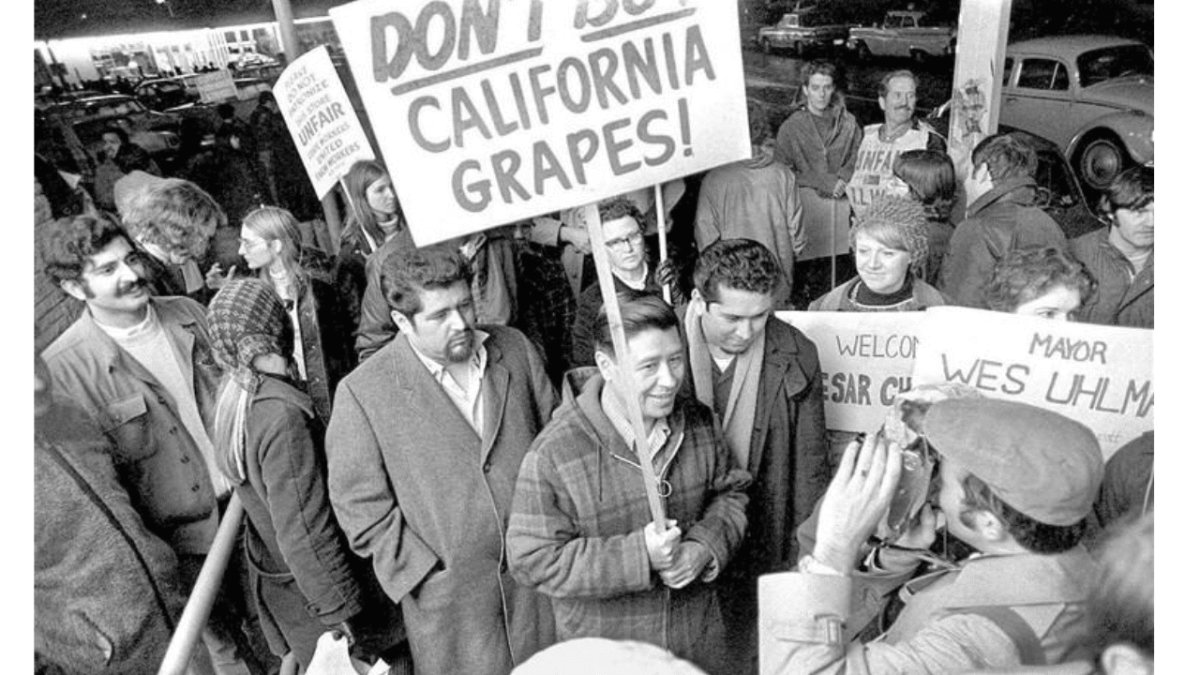
Until recently, Chávez stood as a symbol of labor rights for many within the movement and was widely recognized as a respected civil rights leader in the Latinx community. There has been some controversy surrounding his legacy, particularly concerning his early stances against undocumented immigrants during his initial organizing efforts. However, he is most recognized for co-founding the UFW, which played a vital role in improving labor conditions for farmworkers.
Members of several organizations told Prism that they are working on their next steps as they navigate the effects of the shocking revelations on the community. Organizations appear to be making decisions at a deliberate pace; a representative from the National Day Laborer Organizing Network (NDLON) told Prism that the organization is “working on a plan for our membership, but it is not very concrete right now.”
Uplifting campesinas
For organizations whose missions are closely tied to worker dignity and social justice, the question of how to address the Chávez allegations is not only about public image, but also about alignment with core values.
“In many ways, it’s still relatively fresh,” said Melissa Acedera, a Los Angeles-based organizer and founder of Polo’s Pantry.
As she has reflected on the path forward, Acedera said she has relied on the teachings of civil rights-era organizations such as the Black Panthers as well as Indigenous communities. “It gives a kind of pathway for us to create some more guardrails,” she said, “to protect us, and especially protect the women and young people.”
Polo’s Pantry actively engages with various organizations, including the Alianza Nacional de Campesinas, the first national organization for women farmworkers in the U.S. It was founded by current and former women farmworkers, as well as those from farmworker families.
Acedera has also been inspired by her organizing mentor, Mily Treviño-Sauceda, who is the co-founder of Líderes Campesinas, a grassroots farmworker women’s organization in California that developed into a significant statewide movement. Acedera said that when she spoke with Treviño-Sauceda in the aftermath of the Chávez allegations, they both agreed that the focus needs to be on the women.
“That’s so much of what [Treviño-Sauceda’s] work focused on; she wanted to build the leadership of campesinas [and] for them to have sovereignty, to be able to fight for themselves and also protect their children.”
Treviño-Sauceda told Prism that the work of Líderes Campesinas is successful because of decades of commitment to engaging farmworker women directly.
She discussed a needs assessment survey of farmworkers that she and other volunteers conducted alongside Maria Lopez-Treviño, an academic and advocate for farmworkers’ rights. Surveying campesinas in the Coachella Valley revealed significant issues affecting farmworker women. “We talked about health issues and women’s issues,” she said. “The women said it was important that someone be interested in their lives.”
This inspired the creation of Mujeres Mexicanas, a pioneering grassroots organization formed in 1988 to support Latina farmworkers facing severe labor exploitation, sexual violence, and domestic abuse.
It was not an easy task to organize around women’s issues. We were constantly being told, even by Latino groups, that we needed to stay home and care for our kids, or we were viewed as aggressive when we spoke out.Mily Treviño-Sauceda, co-founder of Líderes Campesinas
Since the launch of Líderes Campesinas in 1992, Treviño-Sauceda has been dedicated to creating a national network focused on empowering farmworker women to organize around the issues that matter to them. She reaffirms that this work was not accomplished on her own and has been a collective effort with the campesinas at the center of the work. The group continues to advocate for policy changes at both the state and national levels, addressing important matters such as sexual harassment, gender-based violence, pesticide exposure, and unequal wages for women farmworkers.
Treviño-Sauceda said the organization has faced many barriers along the way. “It was not an easy task to organize around women’s issues,” she said. “We were constantly being told, even by Latino groups, that we needed to stay home and care for our kids, or we were viewed as aggressive when we spoke out.”
The future of Chávez tributes across LA
As organizations dedicate more time to addressing the issue, local artists and community members have taken it upon themselves to begin removing Chávez’s presence throughout Southern California.
Many local artists have altered or painted over murals depicting the disgraced labor rights leader, prompting public discourse about whether “covering up” an uncomfortable part of history properly addresses the root of the issue regarding the exploitation and abuse of men in organizing movements.
JD Estrada, an LA-based muralist and teaching artist, spoke with Prism about the local response to “whitewash” Chávez murals across Southern California. Estrada has previously created murals commissioned by organizations such as the Cesar Chavez Foundation, using these projects as an opportunity to teach the significance of Chicano history.
Since the allegations broke, Estrada has been asked whether he intends to modify murals that honor the history of labor rights movements, some of which include Chávez.
“We all have differences of opinion,” he said. “I think we can all come to an agreement that the movimiento of the farmworkers cannot be thrown out just because of Chávez.”
Estrada emphasized the need to maintain the integrity of Chicano history and proposed updating murals with more accurate imagery and broader representation, instead of simply replacing them with another figurehead.
One mural Estrada painted in Highland Park honors Chicano history and prominently features Chávez; it is likely to be updated soon.
“We want to convert it into a United Farm Workers struggle component,” Estrada said.
When you replace one for the other, you’re not really zooming out to the bigger picture; you’re just trying to replace a fallen icon with another icon.JD Estrada, muralist
While some muralists have replaced Chávez with Huerta in their murals, as a tribute to survivors, Estrada believes that doing this contributes to the misleading notion that movements should focus on individualism, rather than the larger collective.
“When you replace one for the other, you’re not really zooming out to the bigger picture; you’re just trying to replace a fallen icon with another icon,” Estrada said.
Acedera also said she believes in leaning into collectivism. “Frankly, I don’t think that it’s very effective to just replace one figurehead with another,” she said.
A “deep cultural shift” and reckoning
Beyond symbolic gestures, the allegations appear to be prompting deeper introspection within Latinx-led community spaces, particularly those rooted in labor advocacy. Polo’s Pantry, Líderes Campesinas, and NDLON are examples of organizations where these conversations are unfolding internally.
Treviño-Sauceda said that Líderes Campesinas has continued to provide training and support for women, assisting them in communicating with service providers to report instances of abuse. However, she said, there must be a unified effort to hire staff within those service providers who can effectively bridge language barriers and cultural gaps.
“There are very few people from those agencies from our communities,” she said. “To be effective, you need to work within the cultural context of your community. You have to make changes in the curriculum to adapt [to] the information being received.” To effectively address sexual violence, Treviño-Sauceda argued that organizations must better understand the cultural context, particularly regarding stigma.
In conversations among labor rights and other movement groups, collective adaptation appears to be the central theme, as activists navigate uncharted territory.
“I think [the conversation] does feel new; I think it’s good that it broke open,” Acedera said. “It’s allowing us to be a lot more honest about the misogyny and the violence that exists within our coalition and in our movement spaces.”
While accountability measures vary, the moment underscores a broader reckoning taking place across organizing coalitions in Southern California. Whether these discussions lead to lasting institutional changes or remain part of an ongoing dialogue, Acedera said the impact of the allegations has already caused a “deep cultural shift.”
“We should really be focused on the people that were harmed, which are the women and the young people,” she said.
Like many other veteran organizers, Acedera believes that safety for women in organizing can be achieved through collective action, self-governance, and the centering of women’s voices in the movement, especially farmworker women.
“I’m grateful to the women, for my elders, who have taught me that it’s all about lifting the collective,” she said.
Editorial Team:
Sahar Fatima, Lead Editor
Lara Witt, Top Editor
Rashmee Kumar, Copy Editor
Michelle Zacarias (she/her) is a queer Latina award-winning journalist and two-time cancer survivor. As a CALÓ News reporter and UC Berkeley Local News Fellow, she covers politics, equity, and topics pertaining to state-sanctioned violence. Her work has appeared in Truthout, Windy City Times, Teen Vogue, City Bureau, New America, and more.
Editor’s Note: At a moment when the once vaunted model of responsible journalism is overwhelmingly the play thing of self-serving billionaires and their corporate scribes, alternatives of integrity are desperately needed, and ScheerPost is one of them. Please support our independent journalism by contributing to our online donation platform, Network for Good, or send a check to our new PO Box. We can’t thank you enough, and promise to keep bringing you this kind of vital news.
You can also make a donation to our PayPal or subscribe to our Patreon.
Please share this story and help us grow our network!
[ad_2]
Source link
