
[ad_1]
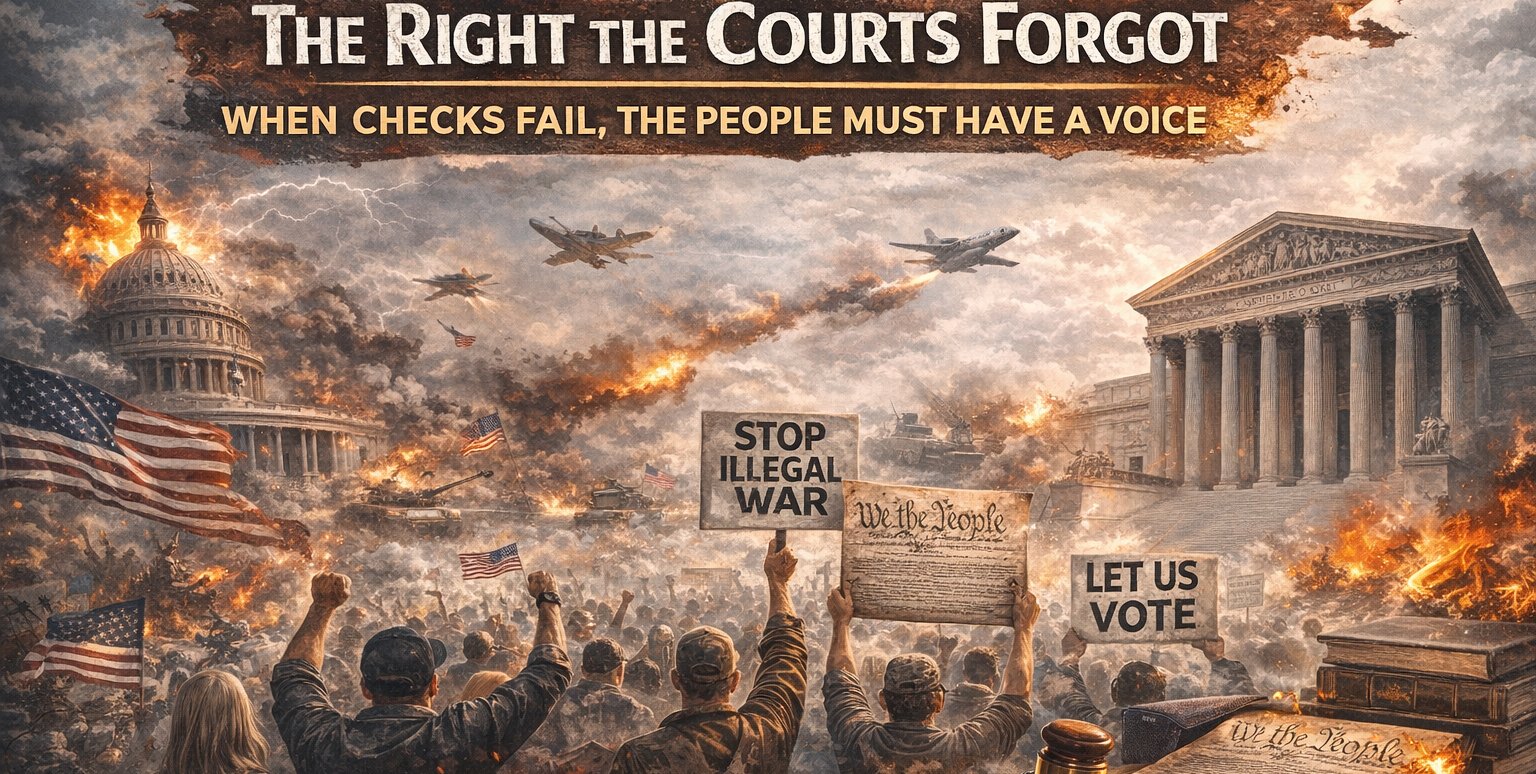
The President is committing lives and treasure to war. Congress has not authorized it. And no citizen has any legal standing to object.
That is not a constitutional republic operating as designed. It is one operating as though the founding document does not mean what it says.
A Distinction the Courts Refuse to Make
Not every presidential use of military force is unconstitutional. The commander-in-chief power is real. The executive has discretion over how forces are deployed, where they are positioned, and how operations are conducted. Courts are right to avoid second-guessing those decisions.
But there is a categorical difference between discretion within a granted power and the exercise of a power never granted.
The Constitution did not give the President the power to initiate war. It gave that power to Congress. The President’s authority presupposes that authorization.
When the President initiates sustained hostilities without it, this is not interpretation. It is the exercise of a power assigned elsewhere.
That is not a judgment call. It is usurpation.
The power at issue is not abstract. It is the power to commit lives and resources to war.
The courts have refused to make this distinction. They apply the same doctrines of deference to clear constitutional usurpations as they do to legitimate exercises of discretion. Standing. Political question. Ripeness.
The result is a constitutional void at the center of the most dangerous power the government possesses.
This is not restraint. It is a refusal to distinguish between lawful discretion and unlawful power.
The Founders Anticipated This Failure
The framers did not assume institutions would always work. They designed the Constitution with overlapping safeguards precisely because they expected failure.
And when those safeguards failed, they did not defer to process.
In 1798, the Alien and Sedition Acts criminalized political speech and bypassed due process. Jefferson and Madison did not treat this as a political disagreement to be won at the ballot box. They identified it as a constitutional violation.
Jefferson wrote in the Kentucky Resolutions that when the government assumes undelegated powers, its acts are void. Madison argued in the Virginia Resolutions that the people and their representatives retain the right to interpose when the Constitution is breached.
They were not arguing for constant resistance. They were addressing a specific condition.
When power is exercised that was never granted.
That is the condition here.
What the Tenth Amendment Actually Reserves
The Tenth Amendment is not decorative. It is operative.
Powers not delegated are reserved to the states or to the people. The people are named separately because they are the original sovereign.
The power to commit the nation to war without congressional authorization was never delegated to the executive. It has been assumed over time through institutional failure and congressional abdication.
When Congress does not authorize and the President proceeds anyway, the constitutional structure has broken down. The power has not been exercised. It has been taken.
In that circumstance the reservation to the people is not theoretical. It is active.
The Standing Doctrine Is Backwards
Courts have held that citizens lack standing to challenge unauthorized war because the injury is too diffuse.
Because everyone is affected, no one may challenge it.
This is backwards.
Standing exists to ensure real disputes, not to shield systemic violations. The war power was placed in Article I, Section 8 of the Constitution precisely because its costs fall on everyone.
That universality is the reason for the constitutional protection, not a reason to deny its enforcement.
A soldier has standing.
A taxpayer has standing.
A parent has standing.
A citizen deprived of collective deliberation before their nation goes to war has standing.
The diffuse nature of the harm is an argument for broader standing, not narrower.
The Political Question Doctrine Does Not Apply
The political question doctrine is not in the Constitution. It is a judicial construct meant to avoid deciding issues with no legal standard.
This is not such a case.
The Constitution provides the standard. Congressional authorization is required.
Either it exists or it does not.
That is a legal question.
To treat it as nonjusticiable is not restraint. It is abdication.
The Electoral Fallacy
The claim that elections solve this problem fails completely.
Elections are blunt. You cannot vote on a single war.
Elections are slow. Wars do not pause for electoral cycles.
Elections are unenforceable. Promises about war are routinely broken.
Elections address policy. This is not a policy dispute. It is a constitutional violation.
Replacing one president does not restore the boundary. It leaves the precedent intact for the next occupant of the office.
An electoral remedy for a constitutional violation is not a remedy.
When the Checks Fail
The Constitution is not self-enforcing. It depends on institutions.
When Congress authorizes, when courts adjudicate, when the executive obeys, the system holds.
But when Congress abdicates, when courts decline to decide, and when the executive expands into that space, the system fails.
That is the situation the framers anticipated.
And in that situation the sovereign cannot be left without recourse.
The sovereign is the people.
What Must Change
Three things follow from the constitutional argument made here.
Citizens must have standing to challenge unauthorized war. The injury is real, direct, and universally shared. The courts must stop using the universality of the harm as a reason to deny its enforcement.
The political question doctrine must not be applied where the Constitution provides a clear rule. Whether congressional authorization exists is a legal question. Courts answer legal questions. That is their function.
When Congress refuses to act, the people must have access to the courts to enforce the Constitution that governs them. That access is not a procedural technicality. It is the minimum condition of constitutional self-governance. The War Powers Resolution has been systematically ignored by every president since Nixon. That pattern of ignoring a law designed to enforce a constitutional requirement is itself a constitutional failure.
The Right That Remains
The Constitution does not enforce itself.
When every institution refuses to enforce it, the right it protects does not disappear.
It returns to the people.
The courts can recognize that reality or continue to deny it.
They cannot change it.
The people have a right to be heard.
It is time that right was recognized.
Jeffrey Wernick is an investor and long-standing advocate for the repeal of the third-party doctrine. He has been closely involved in the development of BitChute and its governance framework, built on the principle that rights must be structural rather than discretionary. He can be reached at jeffreywernick@icloud.com.
[ad_2]
Source link
