
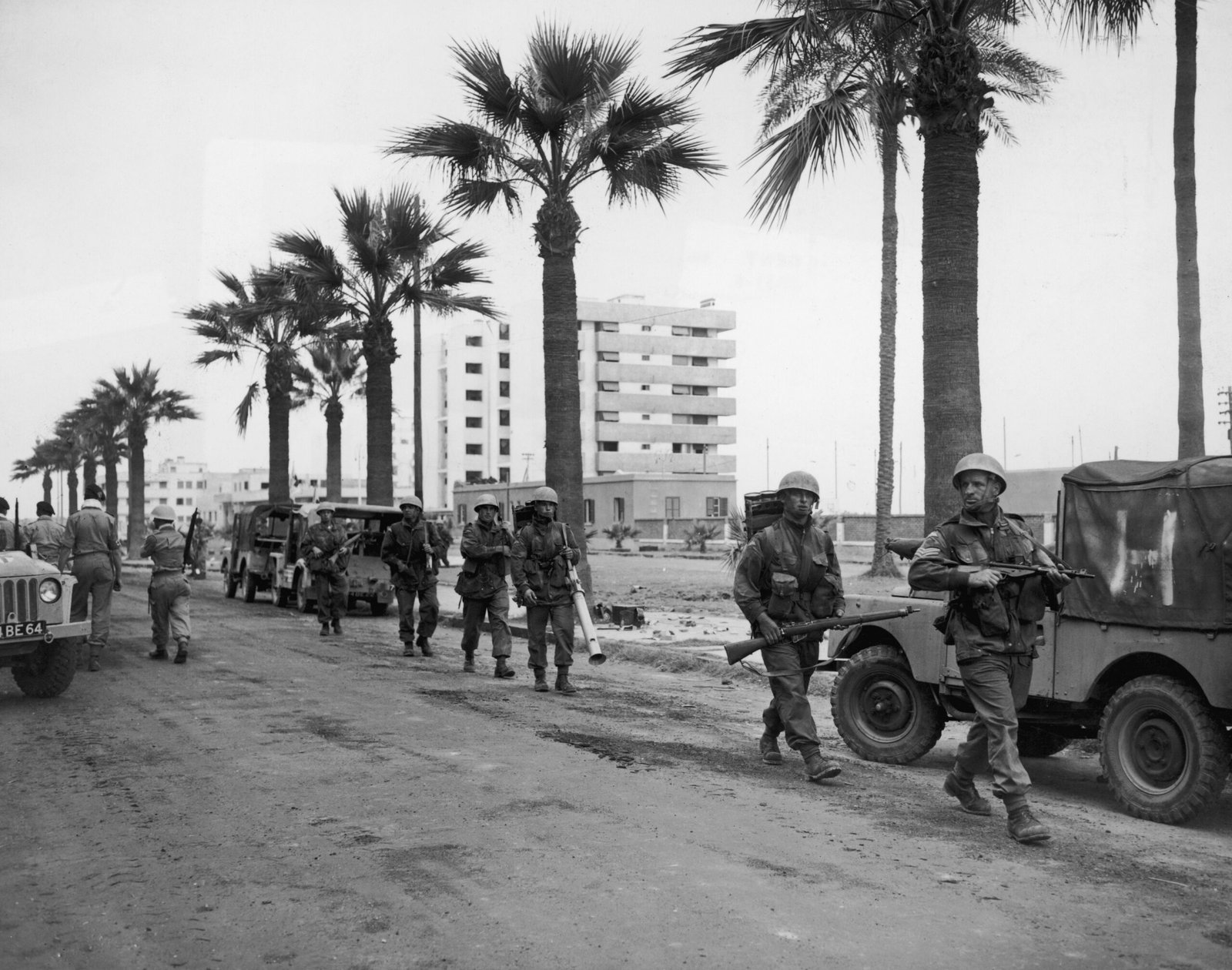
On July 26, 1956, Egypt’s President Gamal Abdel Nasser nationalized the Suez Canal Company, a British/French-controlled entity managing the operation of the Suez Canal, a critical chokepoint in international maritime commerce since its opening in the later 1800s. Nasser acted in order to fund the Aswan High Dam after promised financing by the World Bank was rescinded by Western leaders—principally Secretary of State John Foster Dulles and Prime Minister Antony Eden—who were frustrated by Nasser’s Cold War policies.
Nasser’s unprecedented action precipitated the secret Israeli-French-British Sevres Protocol and the subsequent “Tripartite Aggression”—the invasion by Britain, France, and Israel to topple Nasser, secure Israeli maritime rights in the Red Sea, and restore Western preeminence over the critical Suez Canal as a demonstration of their continued imperial power.
With words that echo through the decades, Prime Minister Antony Eden declared, “We cannot agree that an act of plunder which threatens the livelihood of many nations should be allowed to succeed. And we must make sure that the life of the great trading nations of the world cannot in the future be strangled at any moment by some interruption to the free passage of the canal.”
On October 29, 1956, the Israelis invaded Sinai. As agreed, Britain and France called for a ceasefire and the demilitarization of the canal.
When Nasser refused to comply, the war began with Allied air attacks neutralizing the Egyptian Air Force. On November 5, British forces seized the airfield at El Gamil, while French paratroopers took Port Fuad.
Despite their significant military achievements, Britain and France were forced by Washington and Moscow to agree to a humiliating ceasefire. A United Nations Emergency Force was deployed to replace their troops. In the following months, Israel too was compelled by Washington to withdraw from Sinai and Gaza.
Notwithstanding the Eisenhower administration’s growing antipathy towards Nasser, France, Britain and Israel could not be permitted to challenge American preeminence in the region and beyond. Ike would simply not permit Paris, London, and Jerusalem to “wag the dog.”
Eisenhower forced the sun to set on the British Empire. Despite his military defeat, Nasser emerged as an international figure, while Eden, his humiliated nemesis, resigned. The United Nations affirmed Egypt’s sovereignty of the Suez Canal, which was fully reopened to shipping in April 1957. Tolls paid remain a significant source of income for Egypt to this day. Israel’s maritime rights at the Straits of Tiran were also acknowledged. Nasser’s subsequent decision—in 1967—to expel the UN force from Sinai and obstruct Israel’s maritime rights in the Red Sea was a key precipitating factor in the June 1967 war.
For Egypt, like Iran, issues relating to Suez and Hormuz are critical factors in their respective national security doctrines.
Under the 1888 convention governing operation of the Suez Canal, warships of all nations may pass without discrimination, even during wartime. Belligerents cannot block the Canal or use it as a base of operations.
Until the recent war, passage through Hormuz has been governed mainly by customary international law and the United Nations Convention on the Law of the Sea (UNCLOS). Free transit passage for all ships was recognized, and coastal states (Iran and Oman) had no right to suspend transit passage. Warships under all flags have enjoyed full transit passage rights. Passage in normal operational mode is permitted even for
submarines, which may transit submerged, and aircraft carriers. Under UNCLOS, Hormuz cannot legally be closed, even in wartime.
Subscribe Today
Get daily emails in your inbox
Ayatollah Mojtaba Khamenei is not Colonel Nasser. Iran is not Egypt. And Netanyahu is not Eden. But it is fair to ask whether, like Britain and France at Suez, the U.S., despite its extraordinary military prowess, has suffered an epic, and indeed historic exposure of its strategic limitations at the Hormuz—winning on the battlefield but losing incomparably more in the future diplomatic-strategic arena, both in the Hormuz and well beyond.
It is fair to assume that Netanyahu or Trump never imagined that the war they initiated against Iran would create conditions opposite those intended, setting the stage for a renegotiation of Iranian rights to regulate passage through the strait. And to the extent that nondiscriminatory prewar access through Hormuz was anchored in an international legal, security, and diplomatic system championed by the United States, any change in the status quo ante in Iran’s favor—for example limiting passage or charging tolls—may well reflect a historic weakening of American power in the region and beyond that is no less significant than the French-British debacle over Suez.
Contemporary Iran is not Nasser’s Egypt. But Iran today, like Egypt of the Free Officers, finds itself as the unintended centerpiece of a post-American order that Washington neither desired nor intended.
