
[ad_1]
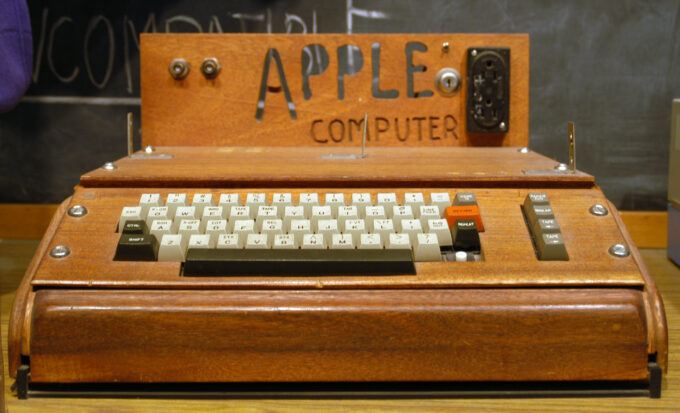
Apple-1 computer in the Smithsonian. Photo: Ed Uthman, Wikimedia. CC BY-SA 2.0
Half a century is plenty of time for an Apple to stay fresh, or to rot.
The New York Times’s Kalley Huang (“For Employee No. 8, Many Changes in Apple’s 50-Year History,” April 2) traces the evolution of Apple Inc. from a “scrappy start-up that assembled computers by hand” — and whose organic name was a natural fit for an environment in which “Silicon Valley’s fruit orchards hadn’t yet been taken over by office parks” — to one which “has come to define how to be a global technology company.”
In a 2014 Bloomberg interview, Steve Wozniak recalled how he had “given away my designs for the Apple-1 for free,” leaving it to Steve Jobs to take projects the other Steve had “designed for fun” (while being “totally aware that a revolution was close to starting”) and “somehow turn them into some money for both of us.” The sum of their money would become so enormous that Chris Espinosa, who admits that having “had no college degree and … only worked at one company” since 1976 doesn’t sound like much of a résumé, owns what Huang estimates is well over $100 million worth of the corporation that makes a thousandfold of that in profit every year.
Craig Newmark’s op-ed “Craigslist Made Me Rich. Giving the Money Away is Easy” might have included Espinosa as evidence for how “making money isn’t proof to me that I know something any better than someone else” but of being “in the right place, at the right time” to apply common sense to a new field, if it hadn’t gone to print in the same day’s edition of The New York Times. Newmark doesn’t propose any political program, keeping his distance even from any endorsement of “left-wing nonprofits” and instead promoting such voluntary philanthropic efforts as the Giving Pledge. Still, the public souring on the information industry, as captured by such titles as Douglas Rushkoff’s Throwing Rocks at the Google Bus and Tripp Mickle’s After Steve: How Apple Became a Trillion-Dollar Company and Lost Its Soul, might seem the inevitable result of it enabling such outsized yet largely fortuitous accumulations in the first place.
The Giving Pledge cofounder Bill Gates owes much of his fortune to emulating Apple. The video game Halo was first showcased at MacWorld by Jobs before it became an exclusive killer app for Microsoft’s Xbox. Gates’s Windows operating system tapped the talent of Macintosh’s iconic icon designer Susan Kare. And yet the broader impact of Apple’s innovations is hardly confined to such sheerly financial windfalls.
This is not just because Apple efforts like the HyperCard which made creating and viewing multimedia straightforward, the Pippin which brought built-in Internet access to a video game console, and the Newton which pioneered the personal digital assistant were influential on later developments without managing to become profitable products for them or anyone else.
Indeed, much of the creativity that spread from Apple’s roots in Cupertino, California to cyberspace is closer in spirit to Wozniak than Jobs. It was entirely typical for Stephen D. Young and Debra Willrett’s Backgammon, programmed for the Apple Macintosh in the same non-Orwellian year 1984 during which the desktop model was introduced, to give out a postal address for users who “enjoy it and would like to see more ‘freeware’” to “please send whatever you think it’s worth” … and permission for them to disseminate the software itself.
Huang notes that Apple’s current survival requires not just satisfying customers but withstanding “tariff whiplash, antitrust scrutiny and geopolitical turmoil.” Consumer sovereignty and cooperative networking can tame such seemingly relentless forces — and make the fruits of tech’s golden geese as common as dirt.
[ad_2]
Source link
