
[ad_1]
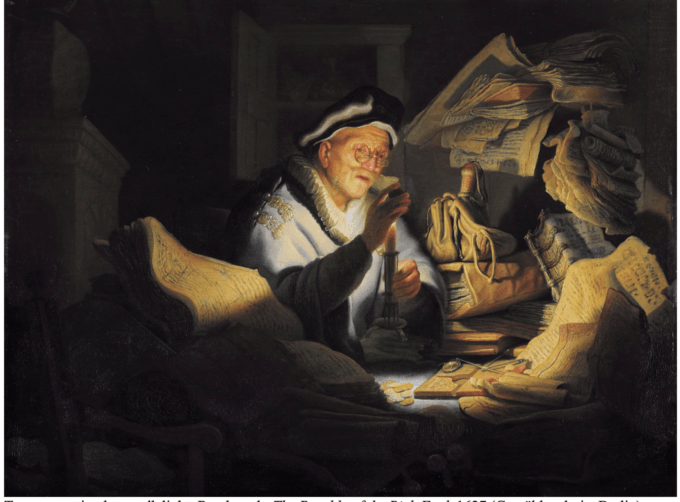
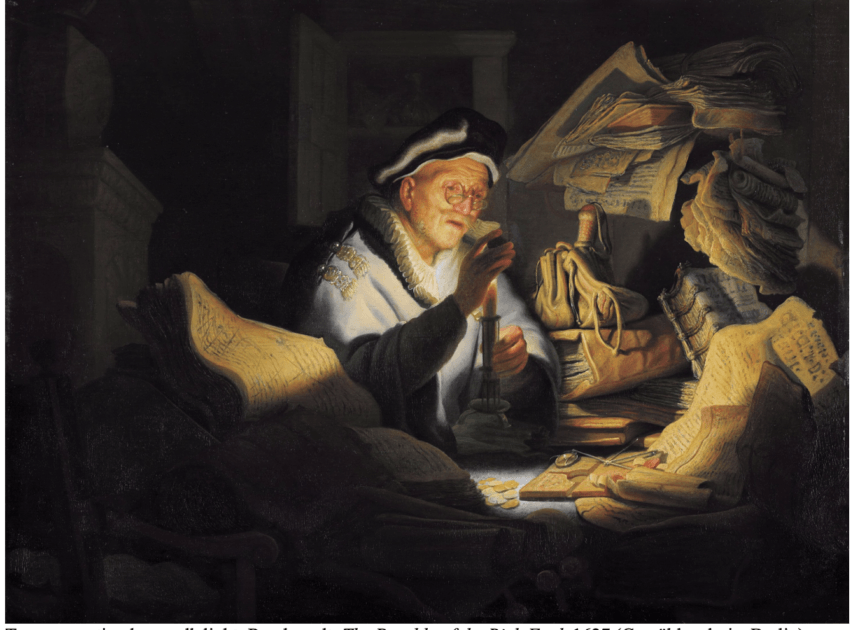
Tax preparation by candlelight: Rembrandt, The Parable of the Rich Fool, 1627 (Gemäldegalerie, Berlin)
“Taxman” turns 60 this year.
The opening track of the Beatles’ 1966 album Revolver, George Harrison wrote the song not just out of self-interested anger at the supertax passed by Harold Wilson’s Labour Government that year, but also because the money went to financing arms research and production. It is especially hard to pay taxes—even when far below the eye-watering 95% rate faced by the high-earning Beatles—when bombs are falling. The levy had driven half of the Fab Four to the brink of bankruptcy.
“Taxman” was among George Harrison’s first songwriting triumphs, crowded out as he had been as a contributor to the Beatles’ repertoire by his bandmates, John Lennon and Paul McCartney. “Taxman” is the only Harrison song ever to be the first track of one of the group’s albums. With it, the so-called “Quiet Beatle” created a musical forum for seething tax resentment, if not outright resistance. In place of the crushing servitude to the Military-Industrial Complex, Harrison offered a New Age vision of a tax-free utopia. Sparked by biting, brilliant sarcasm, the song’s glowing anger was stoked by the musicians around him and, as always, by the interventions of the Beatles’ producer, George Martin.
The opening count-off mocks itself: George Harrison’s voice is apparently slowed down by the tape and is heard with a nasal fustiness, as if he were counting money rather than launching one of the up-tempo album openers beloved and expected of the Beatles when Revolver was snapped up by eager fans in the summer of 1966. This count-off seems to undo the Ancient Greek formulation that music is number in sound. Harrison’s vocalized numbers are metronomic without being invested with the musical life we call rhythm. The deadeningly accurate enunciations of the taxman are an accounting of time, not an animation of it. It is a brilliant lead-in, simultaneously parodying the idea of the count-off while also creating a vision of the auditor, who seems to surveil a song so resistant to his ways and wants. The tone is set before a note is played or sung.
As Harrison counts out his 1-2-3-4, impolite musicians warm up in the background. A cough is heard, a lick on a guitar. The accountant’s count-off starts into a second bar but gets only as far as the number two before a shout of “four” from one of those musicians (Paul McCartney) prevents the bean-counting voice from even getting to three. The slow pace seemingly set up by the adenoidal count-off is overturned as the band breaks out into a much faster opening tempo implied in McCartney’s single number, “four.”
McCartney is credited with devising the bass line he plays to kick-start the song and that first chases away Harrison’s metrical accounting. The figure is the thematic underpinning of the song in every sense: it provides the harmonic basis throughout, unchanging in melodic profile in almost every bar, even when transposed from the home key of D major (though one ringing with discontented D minor) to one of the song’s other two chords. Ostinato means obstinate, and there is gritty resistance in McCartney’s bass line, one powered by the electric urban energy that gives funk its menacing bite. Urged on both by the punches of Ringo Starr’s bass drum and the rhythm guitar’s stinging off-beat chords, the bass exudes inner-city discontent, though even this, like the remorseless count-off, is a pose, even if a perfect one.
When Harrison’s lead vocal enters at the end of the second bar of this bass riff, he sings in recalcitrant syncopations that seem to adopt the rejected slower pace of the count-off. But this parallel does not project dolorous computation, but instead feet-dragging unwillingness, as the lyric lays out the cruel reality—at least from the point of view of the newly ascendant Beatles millionaires—of Britain’s 1960s steeply pitched tax rates: “Let me tell you how it will be: There’s one for you, nineteen for me.” The Beatle literature often explains this disgruntlement as a reference to their tax bracket as high as the above-mentioned 95%, though what the Beatles actually paid goes uninvestigated.
Why do the authorities have the right to take all this money from talented and hard-working earners? The answer of Harrison’s song is simple: “’cause I’m the taxman.” At these words, the harmony feints not to the expected IV chord, but to a somewhat disreputable relation, VII—a modally inflected harmony that casts the tax collector as himself furtive and grasping.
These initially unexpected harmonies retain something of the shape and color of the 12-bar blues form, yet, here too, things are seditiously altered, with a thirteenth bar thrown in to make the whole edifice seem more unstable. The creative imagination cannot be squared by the auditor’s metrics. Perhaps only future archival research will ever reveal whether these musical procedures might indicate that Harrison’s tax returns were filled out with similar creativity.
The second pass through the refrain is more bitter still:
Should five per cent appear too small,
Be thankful I don’t take it all.
’Cause I’m the taxman,
Yeah, I’m the taxman.
Unusually, the ensuing bridge does not depart from the home key. One might want to assign this to the inescapability of the taxman’s menace. That this segment is also an odd number of measures long (9) contributes to the sense of bridling at formal constraints, a sentiment that has afflicted anyone who’s ever filled out a tax return. Foregoing harmonic variety, the bridge is instead marked by increased agitation in McCartney’s bass lines and Harrison’s introduction of a dialogue between the backup and lead vocals.
(if you drive a car, car;) – I’ll tax the street;
(if you try to sit, sit;) – I’ll tax your seat;
(if you get too cold, cold;) – I’ll tax the heat;
(if you take a walk, walk;) – I’ll tax your feet.
This then gives way to another oft-praised moment: a wild guitar solo, also performed by McCartney, that pleased Harrison for its Indian inflections, though I hear much more of a blues-scale frenzy.
Rounding back into the refrain, Harrison sneers at the British prime ministers of the period, doling out sarcasm in equal measure to the Labour and Conservative parties—“Ha-ha Mister Wilson” and “Ha-ha Mister Heath.” These targets were updated by Harrison in live performance over the years with the likes of John Major and George Bush.
What is perhaps most curious—one might even say fateful—about Harrison’s “Taxman” is that it was written before he and the rest of the Beatles met Maharishi Mahesh Yogi in London in 1967, not long after the release of Revolver. The group would visit the Maharishi’s ashram in India a year later, but leave within weeks amid accusations that the holy man had sexually harassed female members (perhaps even Mia Farrow’s sister (Dear) Prudence) of the Beatles’ entourage. Harrison later reconciled with the moneyed mystic and remained a lifelong practitioner of Transcendental Meditation.
The Maharishi was himself the son of a tax collector and would undergo devastating audits that eventually made him remove his headquarters from India. His worldwide Transcendental Meditation empire, extended through television, satellite, and other forms of “outreach,” was roughly valued in the billions at the time of his death in 2008. The Giggling Guru had indeed laughed all the way to the bank.
In 1971, he founded the Maharishi International University (the Maharishi University of Management). His teachings had made it to every corner of the U.S., including Bainbridge Island, Washington, where my parents, my three siblings, and I did TM and added not only to the Maharishi’s coffers, but also to his tax woes. In the late 1980s, his offices in India were raided by the revenue authorities, and he eventually left his native land for good to set up his ashram in the southeastern corner of the Netherlands in a Franciscan monastery that the nearby residents were eager to bulldoze as soon as they found out he would be moving in.
In 1992, the Maharishi and his followers founded the Natural Law Party, active in dozens of countries and dedicated—aside from such initiatives as dispatching “yogic flyers” to create world peace, and therefore presumably reduce military budgets—to lowering taxes. Harrison performed his “Taxman” at a benefit concert that year in London.
The Maharishi’s later plans included a three-hundred-trillion-dollar investment to remake every building in the world so that it would be “fortune creating.” How this might have been financed without taxes remained obscure, though the idea seems to have been something like transcendental trickle-down economics. Other schemes, such as his proposed 1,400-acre Maharishi Veda Land Theme Park near Niagara Falls—an alluring prospect given the post-industrial squalor theme park and constellation of casinos that currently enclose this natural wonder.
Soon after the breakup of the Beatles, and six years after Revolver, Harrison organized the 1971 Concert for Bangladesh at Madison Square Garden. He did not sing “Taxman” at the event. The ticket receipts, recording, film, and merchandising raised some fifteen million dollars. The I.R.S. demanded more than a million of the proceeds in tax.
Harrison eventually paid the bill himself.
[ad_2]
Source link
