
[ad_1]
In late 2025, several European countries took increasingly significant actions in response to what they believed was a wave of unusual drones flying near sensitive infrastructure. Airports were shut down. Local police and the military went on high alert. Politicians and commentators talked about this being part of a “hybrid war” executed by Russia. At its peak, the situation even prompted calls to invoke NATO’s Article 5 collective defense mandate.
From the start, other observers and I noted the parallels between these events and a similar situation in New Jersey a year earlier, which I had investigated in depth (see Skeptical Inquirer May/June 2025). Back then, there were numerous official claims of drone sightings. Yet every time actual data were provided, those sightings turned out to be misidentifications.
The New Jersey events amounted to little more than a media frenzy and some embarrassing learning experiences for law enforcement, the military, and airport authorities. The European events had, and continue to have, the potential to be far more significant. Here, the role of scientific skepticism becomes much more important, perhaps vitally so.
The Geopolitical Background
Unlike the mainland United States, Europe contains active war zones where drones are a real threat. Russian drone attacks have killed and injured thousands of civilians (OHCHR 2025). These were nothing like the speculative sightings but very real, undeniable drone attacks. Obviously, nobody is doubting the reality of drone incursions in Ukraine.
This reality spreads to the parts of Europe bordering Ukraine. In September 2025, part of a wave of Russian attack drones ended up in Poland, seemingly by accident. The Poles responded with interceptor missiles. The resultant aerial conflict scattered debris in villages and damaged buildings (Reuters 2025a).
It is then reasonably expected that reports of drones would be taken very seriously in those regions and that concern would spread to adjacent countries.
Drone Concern Spreads
Denmark is about 600 miles from Ukraine, less than the distance between New Jersey and Chicago. They are also on a very busy marine passage between the Baltic Sea and the North Sea. The Russian “ghost fleet” of suspected covert military and spy vessels often sails along that passage.
Things began on the night of September 22, just a few days after the Poland drone incident, when Copenhagen Airport received reports of several “large drones” spotted near the airport. The airport suspended operations for four hours. Many flights were diverted, delayed, or canceled. A day later, Oslo Airport, across the sea passage in Norway, also briefly shut down, leading some to speculate on a coordinated Russian attack (Reuters 2025b).
Things escalated rapidly over the next forty-eight hours. Hundreds of drone reports were logged from law enforcement, pilots, airport staff, and members of the public. More airports were shut down, leading to massive disruption in air travel. Denmark’s interagency crisis command center, NOST, was elevated to its highest alert—normally reserved for terrorist attacks.
Danish Prime Minister Mette Frederiksen was quick to point a finger at Russia: “I hope that everybody recognizes now that there is a hybrid war, and one day it’s Poland, the other day it’s Denmark, and next week it will probably be somewhere else that we see sabotage or … drones flying. … I think we are in the most difficult and dangerous situation since the Second World War” (Rankin 2025).
Show Me the Drones
With all the drone sightings and airspace shutdowns, a pattern emerged. First, the sightings were all at night. People did not seem to report seeing drones directly but rather small clusters of lights they assumed were drones.
Almost all the cases that led to shutdowns were based only on eyewitnesses. Videos were taken of additional drone sightings after the initial reports, but none unambiguously showed a drone. When radar data were reported, they were never released.
Despite the deployment of anti-drone technology, no drones were captured. No drones crashed, and no drones were shot down. Nobody was arrested for flying drones at night.
Skeptics immediately pointed out a plausible explanation: there were few if any drones and most of the reports were ordinary lights in the sky viewed through a lens of fear and caution triggered by recent events in Poland.
This created a feedback loop in which initial reports (and actions such as airport shutdowns) significantly increased fear and caution, leading in turn to more and more reports.
Skeptics knew this could happen because we’d seen the exact same things happen in New Jersey. The tools we’d developed and the techniques we had learned during that panic would prove invaluable in analyzing this one.
The Copenhagen Situation Recreation
The Copenhagen airport shutdown was announced on X with a simple post from the local police saying, “Copenhagen Airport is currently closed for takeoff and landing, as 2–3 large drones have been seen flying in the area.”
No details were given, but soon a video emerged of a suspected drone taken by a pilot from inside his taxiing plane. It shows what looks like the flashing lights of a small aircraft moving over the runway at a relatively low altitude.
Most of the time, incorrect drone sightings are misjudged as distant planes, but this one seemed different. Was this the fabled “plane-sized drone” that had been causing havoc? Obviously, a small plane would not be doing laps over an active runway. Or would it? Members of my Metabunk forum’s “Skydentify” section got to work (Ferriter 2025).
In my last drone article, I noted the importance of accurate DTLs: date, time, and location. We didn’t have these exactly but close enough that we could start to eliminate possibilities. It only took a few minutes for forum moderator Trailblazer to find a small plane, tail number OY-CDT, that actually was doing laps over the runway.
A bit more detective work narrowed down the time and location, and we were able to import the plane’s historical path into the Sitrec software I developed and recreate the pilot’s video. It was a perfect match, demonstrating that the video of a “drone” (that had been widely shared by the media) was, once again, just a plane.
Other videos and eyewitness accounts came out, but each time there was sufficient information to tell what they were, they also resolved into planes.
We used the same techniques for identifying planes and then recreating videos repeatedly over the next few weeks as the panic spread across Europe. We were starting so many discussion threads on Metabunk that I had to create a whole new “Drones” sub-forum to collect them all.
On November 6, Gothenburg Landvetter Airport was closed due to a similar “drone” incursion. This time, we had air traffic control audio of the conversation between a pilot and the control tower. The pilot described seeing a drone right in front of him. The recording was timestamped, and we knew which plane it was, so it was a simple matter for Trailblazer to create a recreation “sitch” in Sitrec. He synced up the audio with the replay and found that at the time the pilot reported a “drone” hovering and then moving to the left, there was a distant plane with its landing lights on flying toward him and turning left. This would look exactly like he described—except it wasn’t a drone.
Drones Attack Zelenskyy?
A much more significant alleged drone incident happened on December 1, 2025. Volodymyr Zelenskyy, the president of Ukraine, flew into Dublin airport on an official state visit with the Irish government. A few days later, the media reported that drones had been spotted on the flight path of Zelenskyy’s plane, raising fears of a Russian assassination attempt.
This is, of course, a possibility that should not be entirely discounted. Russia and Ukraine are at war. Russia would probably want to get rid of Zelenskyy. But motive alone is not great evidence. Were there drones there? The skeptics investigated.
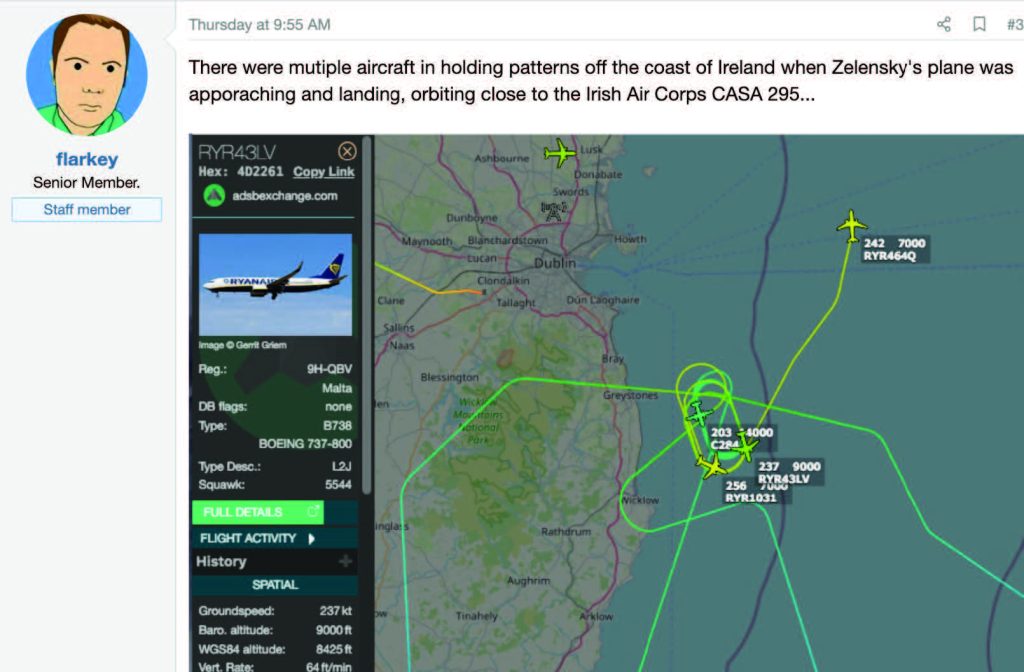
The first thing we noticed was several planes in a holding pattern just off the coast. Recreating this situation in Sitrec, we saw that, again, these distant circling planes could easily be mistaken for hovering drones in the dark.
The next thing of note was the presence of military planes, which obviously were there to provide security, circling the area. Ground observers could also have mistaken these planes for drones. But perhaps more significantly, if there were drones, then these high-tech surveillance planes should have been able to detect them. Yet no reports of detected drones have yet been released. It looks like this was all based on fallible eyewitnesses once again.
Drones Shot Down over Nuclear Base?
Île Longue is an incredibly sensitive military site in northwest France. Home to the Le Triomphant submarines that carry France’s nuclear missiles, it’s blurred out on Google Maps, and overflights are prohibited.
On December 5, 2025, it was reported that the police were investigating a drone incursion. Some of the initial stories were unfortunately inaccurate, stating that the French Navy had “shot at” drones. The Independent even titled their story “Illegal Drone Shot Down at Nuclear Submarine Base.” Again, fingers were pointed at Russia.
But a bit more digging revealed a different story. The Rennes prosecutor had opened an investigation into the incident and stated that the military had “fired a jammer and not a firearm”—i.e., they had tried to block the drone’s radio signals, not shoot it down. No drones were recovered. No evidence was presented that the drones existed.
The prosecutor went on to say, “[we] must, in particular, identify and interview the individuals who made the initial reports in order to confirm or deny that these were indeed drones.” So yet again, the drone report was based only on eyewitness accounts, and the overwhelming evidence from past events suggests that no drones were observed.
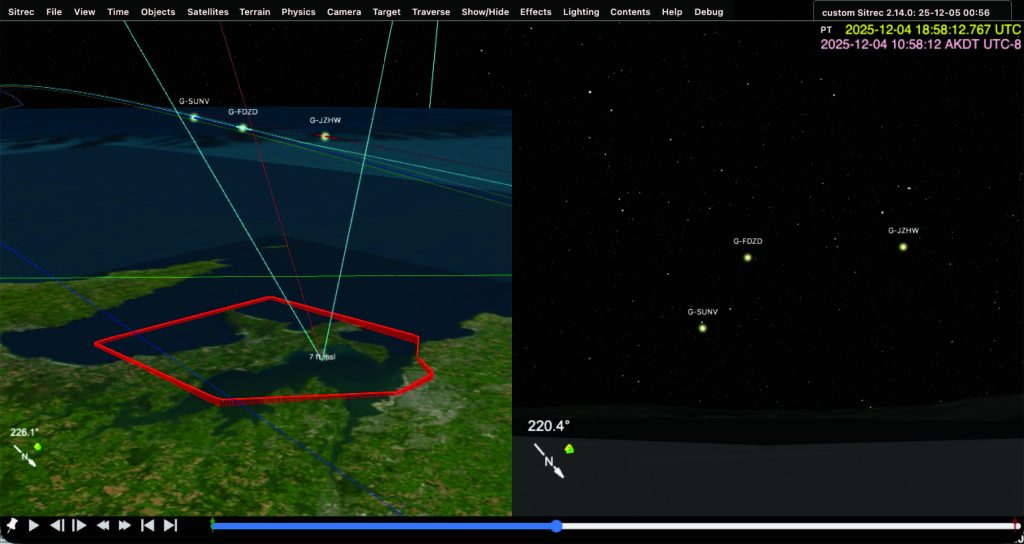
While Île Longe is at the center of a small, restricted airspace region, recreating distant flights outside that airspace in Sitrec showed they could appear as drones.
The Role of Skeptics
The New Jersey drone panic was a national event. The media and the White House had embarrassing takes on the subject, entirely at odds with the evidence. But it was largely inconsequential beyond being a huge waste of time and resources.
The European incidents are more problematic. They exist in a fraught framework of countries adjacent to, or nearby, a war zone where drones are a deadly fact of life. There’s also a very proximate adversary, Russia, that probably is spying on states in the European Union in several ways, including with drones. So, the caution is understandable. You would not want to be the official who failed to shut down the airspace where Russian drones were operating, especially if a foreign leader’s life were at stake.
But if we are to detect real threats, we have to separate the signal from the noise. The stakes are high. Endlessly blaming Russia for every imagined drone is not only escalating international tensions but also crying wolf. Do it long enough, and people will ignore you, and a real threat might slip through.
Skeptics, by fact-checking each individual case, help authorities realize that not every light in the sky is a drone, and that a report of someone thinking some lights in the sky are drones is very likely incorrect.
Skeptics should keep those authorities and—as much as possible—the news media grounded in reality, avoiding an international incident unless something can be verified by what we all want: good evidence.
References
Ferriter, Kyle. 2025. Copenhagen airport closure due to reported drone activity. Metabunk (September 22). Online at https://www.metabunk.org/threads/copenhagen-airport-closure-due-to-reported-drone-activity.14455/.
OHCHR. 2025. Civilian casualties remain alarmingly high as short- and long-range weapons devastate lives across Ukraine, UN human rights monitors say (September 10). Online at https://ukraine.ohchr.org/en/Civilian-Casualties-Remain-Alarmingly-High-as-Short-and-Long-Range-Weapons-Devastate-Lives-Across-Ukraine-UN-Human-Rights-Monitors-Say.
Rankin, Jennifer. 2025. Europe in “most dangerous situation” since Second World War, Danish PM warns. The Guardian (October 1). Online at https://www.theguardian.com/world/2025/oct/01/europe-dangerous-situation-since-second-world-war-russia-war-drones-sabotage.
Reuters. 2025a. Polish missile likely hit house during Russian drone incursion, says minister (September 17). Online at https://www.reuters.com/business/aerospace-defense/polish-missile-likely-hit-house-during-russian-drone-incursion-says-minister-2025-09-17/.
———. 2025b. No link yet between Oslo, Copenhagen drone incidents, Norway says (September 25). Online at https://www.reuters.com/business/aerospace-defense/no-link-yet-between-oslo-copenhagen-drone-incidents-norway-says-2025-09-24/.
[ad_2]
Source link
