
[ad_1]
In one of the scariest moments in modern history, we're doing our best at ScheerPost to pierce the fog of lies that conceal it but we need some help to pay our writers and staff. Please consider a tax-deductible donation.
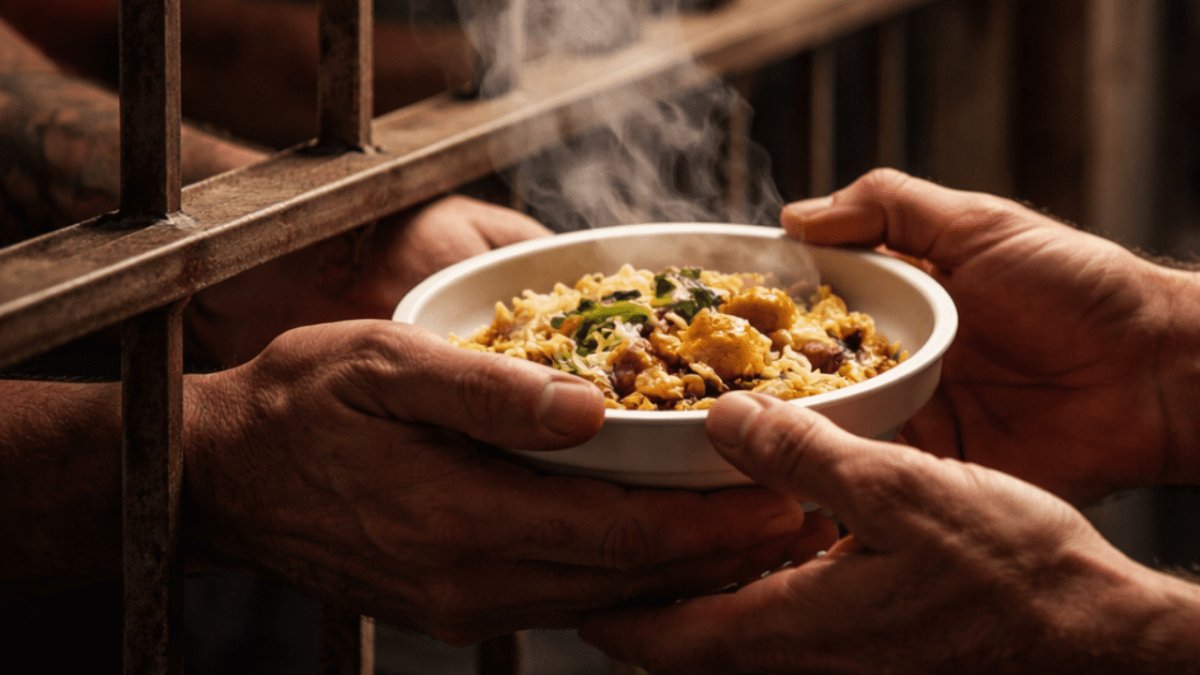
Sharing meals anchors us both to our lives outside the prison walls and to each other in one of the most toxic environments anywhere.
Ron Guier for Wagging Nonviolence
My relationship with cooking began at a young age, while in elementary school, when I had the choice between preparing whatever I could find in the kitchen or not eating. Little did I know that cooking with such constraints would serve me so well decades later when I was incarcerated. It would become the vehicle by which I would build community and connection with my fellow inmates.
For a kid without much guidance, it was a steep learning curve. Here is one of my earlier memories from that time.
The blare of the smoke detector snapped me back to reality, reinforced by the smell of burnt ramen and Teflon. I had lost track of time, consumed by an adventure with my He-Man action figures, and had boiled the water right out of the pot and burned my Top Ramen noodles to a wormy crisp. The noodles and the pot were a total loss, and I knew I was going to get in trouble when my mom and stepdad got home. But that was routine, a problem to deal with later. At that moment I had to figure out what I was going to make for me and my brother. At eight years old, my repertoire was limited, as were the groceries in the house.
I came to my love of cooking out of necessity. When I was a kid, my mom and stepdad were often gone for long periods of time. Sometimes it was for work, sometimes a quick trip to the store could take them hours. My brother and I never knew if their absence would stretch into days. Tom, older by three years, was resentful of being stuck with me and told me that if I was hungry, I had better figure it out because he wasn’t making anything. Once I started cooking, he would add, “Might as well make me some too, since you’re cooking already.” Well played, big brother.
So there was the eight-year-old me at the stove, trying to figure out this whole cooking thing. I burned my fair share of meals, but slowly I began to get the hang of it. My mac and cheese had fewer lumps, my ramen was respectably soupy, my Hamburger Helper didn’t have chunks of uncooked dehydrated potatoes. My growing proficiency gave me greater confidence, which led me to try new things.
When my mom was in the kitchen making a meal, I would be right there underfoot, like an irritating cat. When I would ask if I could help, she would find something for me to do — shred the cheese, cut the easy veggies, or stir things in the pots and pans. I would interrogate her about what she was doing, why she used the spices she used. I was soaking up all that I could. I thought I was just trying to learn to cook, but it would become so much more.
A few years later, I made mashed potatoes on my own for the family for the first time. They were bland, lumpy and had bits of peel all throughout. But something surprising happened when we sat in front of the television to eat and watch “Star Trek: The Next Generation,” one of the few things that our dysfunctional family did together. My stepdad, a notoriously mean and unkind man, smiled and told me I had done a good job. I felt close to him in a way that I can’t explain and don’t remember ever feeling again.
When I was 18, my brother and I lived in a dumpy single-wide trailer with a friend named Brandon. It was a place to call home even if it wasn’t much of a home. Tom and I worked opposite shifts and shared a room, each of us sleeping while the other was at work.
While living in that trailer I purchased my first cookbook, “Better Homes and Gardens New Cook Book,” which covered a wide range of cuisines, and I aimed to make one new recipe a week. I have many pleasurable memories from that time, including learning how to make chocolate truffles, a lifelong favorite to eat and share. Another favorite was a tater tot casserole. Nothing fancy, but a hearty meal.
Brandon remarked after eating my inaugural casserole that I must really like to make meals that stick to the ribs. I replied that I like to make meals that put smiles on faces. I was beginning to understand the joy created by making and sharing food with people, but the deeper potential of food to connect people still hadn’t hit me yet.
My love of food continued for years, into adulthood with my own family, holidays, parties and ordinary weeknight meals. In so many parts of my life, food was the vehicle for coming together and making memories. That feeling would intensify when I was incarcerated.
When I first came to prison, I felt lost. Isolated from those I loved most, I was alone and vulnerable in this big scary place. All I knew about prison was what I had gleaned from a lifetime of media consumption: gangs, violence, corruption, a place where the worst of society comes to become even worse humans before they are released back into the world to perpetuate the cycle of crime and harm.
Those stereotypes can be accurate at times, but I also found a thriving community of people working to learn and grow as human beings, people focused on being better than the choices that led them to this place, people that recognize the value and power of folks coming together. I have been humbled to find some of the greatest people I’ve ever met anywhere, serving sentences alongside me.
It took me about a year to figure out that my approach to food and cooking outside of prison was possible inside, even with the meager list of items I had access to through the prison commissary, and only a microwave to cook with. Who actually cooks in a microwave? They’re just for heating up leftovers and making popcorn, right? I felt a bit like eight-year-old me again, cooking with constraints.
It took some time and experimentation, but I eventually started to make some tasty things. I constructed a cardboard A-frame, draped butter-covered tortillas over it, and made crunchy tacos. I used apple jelly packets to caramelize summer sausage meat sticks to make rice bowls. I used brown sugar, soy sauce and powdered garlic along with my old friend, ramen noodles, to make chow mein. These became staples of my prison repertoire, and I began to offer to make meals with folks on the tier.
The power of food to connect people to each other, to culture, and to history really hit me when a man on my tier, Josue, asked me to make him a meal for his birthday coming the following week. He told me he had been craving a childhood favorite, pozole, a Mexican soup that uses hominy. I happily took the challenge, knowing I was going to have to be creative. I couldn’t get hominy from the commissary, but it had corn nuts, the dried and seasoned snack. That got my wheels turning. If I soaked and rehydrated the corn nuts, they might prove a worthy substitute for the essential hominy. I prepared the soup, getting as close as possible to the ingredients for pozole, which I had eaten enough to know that I had made a pretty decent version.
When I showed up at his cell, bowl in hand, Josue greeted me warmly and thanked me for the birthday meal. I jokingly replied that he shouldn’t thank me until he tried my concoction. He grabbed his spoon and took a big bite, and I watched something magical happen. His eyes closed and as he exhaled his posture softened, shoulders dropped and he stood there for a split second, savoring the bite he had just taken. When he opened his eyes, there was a brightness, a gleam that reminded me of a child coming into the living room on Christmas morning and seeing the presents under the tree. He smiled and told me that it tasted like his mom’s pozole, that it tasted like home, that for a moment he was transported out of this place and into his mom’s kitchen where he felt warm, safe and loved. In that moment, the true power of food hit me.
This food that I had been making and sharing — the tacos, rice bowls, chow mein and Josue’s pozole — helped me make connections with folks in my prison community. I was building bridges with people I would never have thought could be my friends. In the shared time and space that comes with breaking bread, we focus on the one thing we all have in common. No matter our race, gender, sexuality, affiliation, religion or political beliefs, we’ve found our humanity. We are all just people. And in that shared humanity, we’ve been able to build an incredibly supportive and family-like community in one of the most toxic environments anywhere.
With a sense of community comes a shift in culture. Guys feel like they are part of something bigger than themselves and become more likely to engage in nonviolent means to solve problems or settle conflicts. I believe people invested in community are less likely to offend against it because they value it. Not only that, with the common ground established via the sense of community, doors and lines of communication open. Men come together in ways that allow for organizing and advocating for inmates as a whole and for the common good.
The food we share connects us in the present, but it goes deeper. The things we eat tie us to the memories associated with those flavors and remind us of who we are and where we come from. Eating anchors us in a larger life beyond the walls, people, places and milestones that are connected by the food we came together to share in those moments. It is the thread that stitches together the fabric of our lives.
For me, in my past, cherished memories of connection with my mom and brother are rooted in the food we ate and prepared together.
In my present, the meals we prepare in prison bring our ragtag little community together to acknowledge our shared humanity. They remind us that even though we are separated from our families and friends, we are still part of something bigger than ourselves and that we are stronger together.
One day in my future, I will cook and share food with the people who will form my new community outside of prison. What a delicious thought.
Ron Guier has been incarcerated for seven years. He is an active member of his prison community as a member of the Concerned Lifers Organization, which includes those serving long-term or life sentences, community advocates, sponsors, and short-term prisoners who organize for positive change inside and out of the prison. He is also a board member for the prison runners group and a Certified Peer Support Specialist and Peer Support Coordinator in the prison’s Peer 2 Peer program. You can reach him for comments at securus.net, Ron Guier 414747, Washington Corrections Center.
Editor’s Note: At a moment when the once vaunted model of responsible journalism is overwhelmingly the play thing of self-serving billionaires and their corporate scribes, alternatives of integrity are desperately needed, and ScheerPost is one of them. Please support our independent journalism by contributing to our online donation platform, Network for Good, or send a check to our new PO Box. We can’t thank you enough, and promise to keep bringing you this kind of vital news.
You can also make a donation to our PayPal or subscribe to our Patreon.
Please share this story and help us grow our network!
[ad_2]
Source link
