
[ad_1]
Reprinted from Andy Worthington’s website.
Many thanks to Dr. Dianne Woodward, a former lecturer in Biological Sciences, and a manager at the Galilee Foundation, a UK charity empowering Palestinian youth since 2007, for writing a compelling article for Al Jazeera, “Toxic waste of war on Gaza reached Israel”, highlighting how the ecocidal impact of Gaza’s genocidal and ongoing 34-month assault on the Gaza Strip is creating a monstrous public health crisis, not just for the Palestinians, but also for the Israelis themselves.
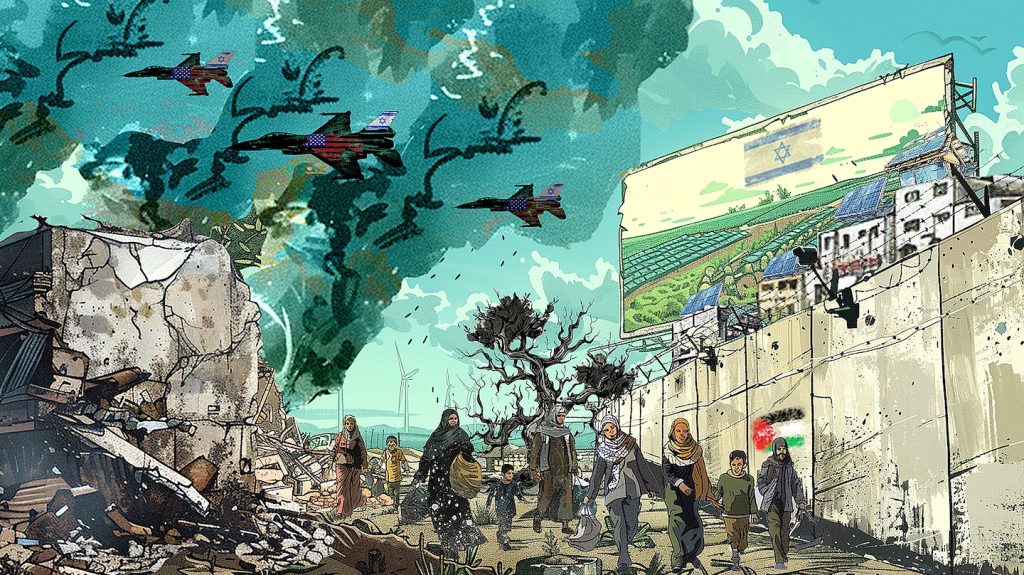
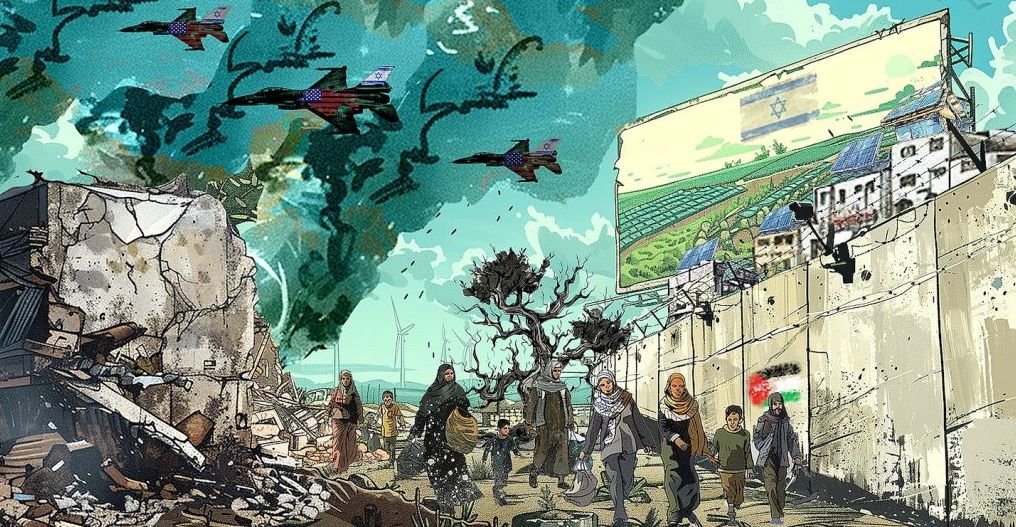
An illustration by Fourate Chahal El Rekaby, a French-Lebanese filmmaker, writer, and illustrator based in Beirut, accompanying an article, “Ecocide, Imperialism and Palestine Liberation”, published by the Dutch-based Transnational Institute in September 2025.
Typically, Israel’s leadership was blinded by its own genocidal fury and its appalling supremacism to such an extent that it never dawned on them that, by bombarding Gaza, its immediate neighbour, with more deadly weapons than have ever been dropped anywhere on earth on an area of comparable size, and by deliberately destroying its entire infrastructure, including the whole of its sewage system, it was paving the way for the impact of this frenzy of unforgivable depravity to, literally, wash up on its own shores.
As Dr. Woodward explained:
Gaza shares the Mediterranean, coastal ecosystems and coastal aquifers with Israel. The destruction of its electric power and sanitation infrastructure forces over 100,000 cubic metres of raw, untreated sewage into the Mediterranean Sea or on land every day. Because in this part of the Mediterranean currents move primarily from south to north, this waste is carried straight up the coast into Israeli waters.
The Ashkelon desalination plant in southern Israel has been forced to shut down multiple times due to high faecal bacteria contamination from Gaza’s wastewater. Raw sewage also triggers toxic algae blooms blocking and damaging desalination filtration systems, as well as creating dead zones where fishing would normally happen.
Wastewater toxins, heavy metals and pathogens are absorbed by local marine life. Because fish migrate across maritime boundaries, contaminated seafood poses a direct health hazard to Palestinian as well as Israeli consumers. Raw sewage carries the same pathogens afflicting Gaza into the shared marine environment. Its northward drift directly impacts Israeli coastal cities.
Although pathogens can persist and migrate under certain conditions, pathogen contaminated groundwater is unlikely to feed into Israeli municipal water supplies, but can still affect the shared aquifer and surrounding environment.
Salts and other chemical contaminants can travel much farther and are often a bigger long-term aquifer concern. They can contaminate a shared groundwater system and reduce the quality and usability of the aquifer over time for irrigation, agriculture and drinking.
Dr. Woodward noted that, earlier this month, the Israeli Prime Minister, Benjamin Netanyahu, and representatives of the Board of Peace established under Donald Trump to, ostensibly, oversee a new Palestinian-led administration in Gaza, “agreed to set up a working group on sanitation and public health affecting both Israel and Gaza”, although its “membership and detailed operating structure” have not been made public.
It’s a rare example of Israel showing any interest in the Board of Peace, whose UN-backed mandate to entrust the day-to-day running of Gaza to a Palestinian technocratic committee, supported by an international peacekeeping force, has been persistently thwarted by Israel, which perhaps shows how serious the health crisis is.
Dr. Woodward also noted how, ironically, while trying to erase evidence of its genocide, Israel was importing from Gaza, “into undisclosed locations inside Israel and the West Bank”, some of “the estimated 60 million tonnes of rubble from Gaza”, without seeming to be aware that, in doing so, it is “potentially transferring the pollutants in that rubble directly to disposal or storage sites” that will also affect the public health of Israelis.
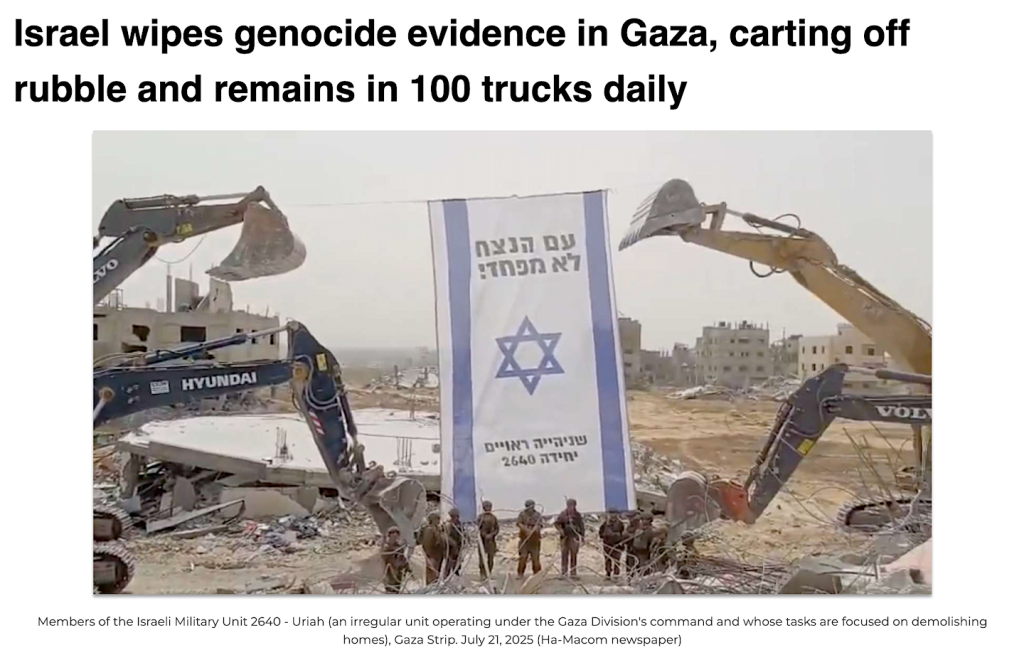
She noted how, recently, the Euro-Med Human Rights Monitor “tracked some 100 Israeli trucks daily leaving the Gaza Strip with debris”, which I wrote about at the time, in a post on Substack entitled, “How Israel is seeking to erase evidence of its genocide in Gaza.”
Israel endangers its own people while seeking to erase evidence of genocide
The Euro-Med article highlighted how Israeli contractors have been removing crucial evidence of the genocide from the two-thirds of the Gaza Strip under the control of the Israeli military, as it has steadily increased the amount of land in Gaza under its control from the 50% that was agreed at the time of the ceasefire last October.
As they explained, “Israel is acting unilaterally within closed areas under its military control by demolishing remaining buildings and then crushing, mixing, and transporting the rubble before forensic teams, evidence experts, and unexploded ordnance specialists can examine, document, and preserve the sites, along with the evidence and human remains.”
They also suggested that “at least 10 million tonnes of rubble have been removed, crushed, or moved from their original sites”, and assessed that “approximately 400 heavy pieces of excavation, demolition, crushing, and transport machinery, operated by Israeli civilian companies under military protection, are active across eastern and southern Gaza”, which “demolish remaining structures, crush rubble from destroyed neighbourhoods, and load the debris onto trucks for transportation away from the original sites” into Israel itself, or to locations in the West Bank, although, as they also noted, the Israeli authorities “have not provided details on the quantities removed, the routes taken, the destination sites, or how the material is utilized.”
Israel’s efforts to conceal its genocidal crimes by removing the evidence is truly shocking, and adds to its grotesquely long list of war crimes and crimes against humanity, but, as with the impact of its destruction of Gaza, Israel’s leadership again seems to have been blithely unconcerned about how its actions would create a health crisis within Israel itself.
As Dr. Woodward explained:
Transferred pollutants may include heavy metals, such as lead, mercury, cadmium and traces of other metals or residues from specialised munitions, as well as white phosphorus particulates, unspent explosives, industrial chemicals, and widespread asbestos fibres from pulverised older buildings. Heavy metals present in dust and rubble may exhibit carcinogenic, mutagenic, teratogenic, neurotoxic, nephrotoxic and bioaccumulative properties, posing long-term human health and environmental risks.”
The rubble also contains biological matter, pathogens and fluids from decomposing human remains and accumulated organic waste, as well as insects, rodents, and other disease vectors. Airborne transmission of hazardous dust particles, asbestos fibres and particulate matter degrades the quality of the air while hidden unexploded ordnance in the debris can cause a detonation risk and soil toxicity.
When managing highly contaminated disaster debris, international agencies such as the UN Environment Programme (UNEP) and regional environmental authorities like the Gaza Debris Management Working Group (DMWG) stipulate transfers must follow strict protocols and operational procedures to isolate hazards, including an immediate freeze on all operations if human remains are detected. Moving these materials across borders or jurisdictions should also trigger legal frameworks and rigid groundwater protection standards.
As she added, summing up this sickening demonstration of a unique combination of crime scene destruction and toxic threat, “Critics have pointed out that bulldozing sites that contain mass graves is destroying key evidence of genocidal crimes. But apart from that, this transfer of debris in disregard of international rules and regulations is putting at risk the health of people around collection and disposal sites.”
She continued, “If the aim of this structural disparity is to keep Israeli groundwater zones tightly protected and shift the long-term burden of aquifer and soil pollution onto Palestinian communities in the West Bank, it ignores the risks to the Israeli transfer personnel and to all people living there, which includes 700,000 illegal settlers.”
As she also explained, this is not a problem that has been created through the genocide of the last 34 months, although the impact is much more severe than anything that has happened before. She noted how environmental groups, like EcoPeace, “have long warned that the shared environment creates total interdependence, meaning humanitarian and sanitation crises in Gaza directly compromise Israel’s public health”, and referred to an occasion in 1990 when “the former Jerusalem Mayor Teddy Kollek candidly admitted that his administration had done little for East Jerusalem beyond extending basic water and sewage lines out of fear that cholera outbreaks in neglected Arab neighbourhoods would spread to West Jerusalem.”
Her conclusion was stark. “Even if Israel is morally incapable of meeting its human rights responsibilities as occupiers to solve the sanitation crisis”, she wrote, “it should understand that if it does not strictly follow environmental protocols, its own population will endure the same consequences as the Palestinians whose welfare it callously and criminally disregards.”
No sympathy for Israel
It’s impossible to feel any sympathy for the Israelis, who have created this ecological disaster through their genocidal arrogance and their inability to recognize that, as Dr. Woodward described it, “the shared environment creates total interdependence, meaning humanitarian and sanitation crises in Gaza directly compromise Israel’s public health.”
This, after all, is a nation state in which numerous officials and pundits, after October 7, were so carried away with their vengeance that they called for a nuclear bomb to be dropped on Gaza, oblivious to the fact that doing so would cause nuclear fallout that would also be almost indescribably devastating for Israel.
Israel’s far-right Heritage Minister Amichai Eliyahu, a member of Itamar Ben-Gvir’s Jewish Power party, was reprimanded by Benjamin Netanyahu and suspended from cabinet meetings after he said, on November 5, 2023, that “one of Israel’s options in the war against Hamas could be to drop a nuclear bomb on the Gaza Strip”, as the Times of Israel described it, although Netanyahu was probably more concerned not by his statement, but by how it would be received in the west, and also because it revealed the existence of the nuclear arsenal that Israel possesses, but which it always denies having.
Similar statements were made by the journalist Shimon Riklin, who asked, on October 7, “Why exactly do we have an atomic bomb?”, and by Eliyahu’s father, Rabbi Shmuel Eliyah, the Chief Rabbi of Tzfat, who said, on November 14, 2023, “A nuclear bomb on Gaza is indeed an option! They will not fire me, they wanted my son, but they will not fire me.”
Shamefully, however, although Israel is facing toxic blowback that it deserves, the cost for the Palestinians is immeasurably higher. A devastating analysis of the long-term damage to Gaza was published by the UN Environment Programme last September, just before the ceasefire began, which contained “30 recommendations for reversing the damage to Gaza’s environment”, including “the rapid reconstruction of water and sewage infrastructure, a systemic testing of Gaza’s soil for contamination, the removal — and to the extent possible recycling — of debris and the safe disposal of munitions.”
Estimates for the timescale of reconstruction focus on decades, rather than years, while, in July, an Oxfam-led assessment, “Building Gaza Anew”, estimated that $71.4 billion is needed to rebuild Gaza, which is “seven times the combined cost of reconstruction after every major Israeli military offensive there over the past two decades.”
The UN assessment concluded that “Gaza’s environmental recovery will hinge on careful, inclusive and science-based planning”, but, despite a ceasefire of sorts, absolutely no expert-led programs of land clearance and beginning to deal with the chronic environmental degradation have been allowed by Israel, just as the genocidal oppressor has also defied its obligations, as part of the ceasefire deal, to even allow in sufficient humanitarian aid, including food, water, fuel and medicine, to address the still-unfolding human catastrophe.
Two weeks ago, when I posted How Can the Genocidal State of Israel Be Brought to an End?, my definitive condemnation of Israel’s depravity, I summed up the situation as follows: “As I write this, the surviving Palestinians are still living, permanently and precariously, on the edge of death, beleaguered, bombed and besieged, still half-starved, deprived of almost all necessary medical supplies, and forced to live in medieval squalor in the destroyed remains of their homeland.”
As the journalist Tamer Nahed wrote from Gaza just last week, “Gaza is not coming back to life … we are simply trying not to die.”
With just five weeks to go until the third anniversary of the genocide, and the first anniversary of the porous and largely meaningless ceasefire, it is shameful beyond belief that the world has largely forgotten Gaza, that Israel is still allowed to continue its slow genocide of the Palestinian people, and that the human and ecological devastation — which includes the immense and almost entirely overlooked carbon footprint of the weapons used by Israel — continue to be ignored.
Andy Worthington is a freelance investigative journalist, activist, author, photographer (of a photo-journalism project, ‘The State of London’, which ran from 2012 to 2023), film-maker and singer-songwriter (the lead singer and main songwriter for the London-based band The Four Fathers, whose music is available via Bandcamp). He is the co-founder of the Close Guantánamo campaign (see the ongoing photo campaign here) and the successful We Stand With Shaker campaign of 2014-15, and the author of The Guantánamo Files: The Stories of the 774 Detainees in America’s Illegal Prison and of two other books: Stonehenge: Celebration and Subversion and The Battle of the Beanfield. He is also the co-director (with Polly Nash) of the documentary film, “Outside the Law: Stories from Guantánamo”, which you can watch on YouTube here.
To receive new articles in your inbox, please subscribe to Andy’s new Substack account, set up in November 2024, where he’ll be sending out a weekly newsletter, or his RSS feed — and he can also be found on Facebook (and here), Twitter and YouTube. Also see the six-part definitive Guantánamo prisoner list, The Complete Guantánamo Files, the definitive Guantánamo habeas list, and the full military commissions list. Please also consider joining the Close Guantánamo campaign, and, if you appreciate Andy’s work, feel free to make a donation via PayPal or via Stripe.
[ad_2]
Source link
