
[ad_1]
Juan Cole Informed Comment
The military front in the US war on Iran had been quiet in August, but on Sunday the US launched missile attacks on Larak island in southern Iran. The US military said that it targeted rocket launchers that were observed to be readied for deployment of mines. Iranian authorities said some of their personnel were killed or wounded.
In response, Iran launched eight missiles toward two US bases in Jordan, which Jordanian authorities said were intercepted. There appear to have been no casualties in Jordan.
The US Navy may have been especially jittery about new mines being launched because on Saturday an oil supertanker was hit by mines as it attempted to enter the Gulf from the Strait of Hormuz. It was the third ship hit in the past week.
Kpler and maritime data suggest that only 5 ships a day transited the Strait this weekend, all of them medium-sized. On Friday 14 ships passed the Strait, including a Qatari oil supertanker that had turned its transponder off.
Before Netanyahu and Trump fell upon Iran, roughly 130 ships a day transited the Persian Gulf, carrying 20% of global petroleum and 20% of the world’s liquefied natural gas (LNG).
The total traffic nowadays in the Strait may be higher than the figures given above because many ships go dark, turning off their transponders, and so cannot be tracked. The difference is not huge, however, and there is little doubt that 12 million barrels a day or so of crude is being kept off the global market because of the Hormuz impasse. Even during the period when the Memorandum of Understanding was being observed by the Trump administration, only 6.1 million barrels per day were coming out of the Gulf, not the 15 million bpd that had been the daily average in 2025. You’re probably back down now to half the exports of the MOU period, leaving a 12 million barrel a day shortfall compared to last year.
The other shoe will likely drop in December, when the industrialized nations’ reserves, on which we are now all living, run low.
The price of petroleum jumped on the news of the Larak strikes.
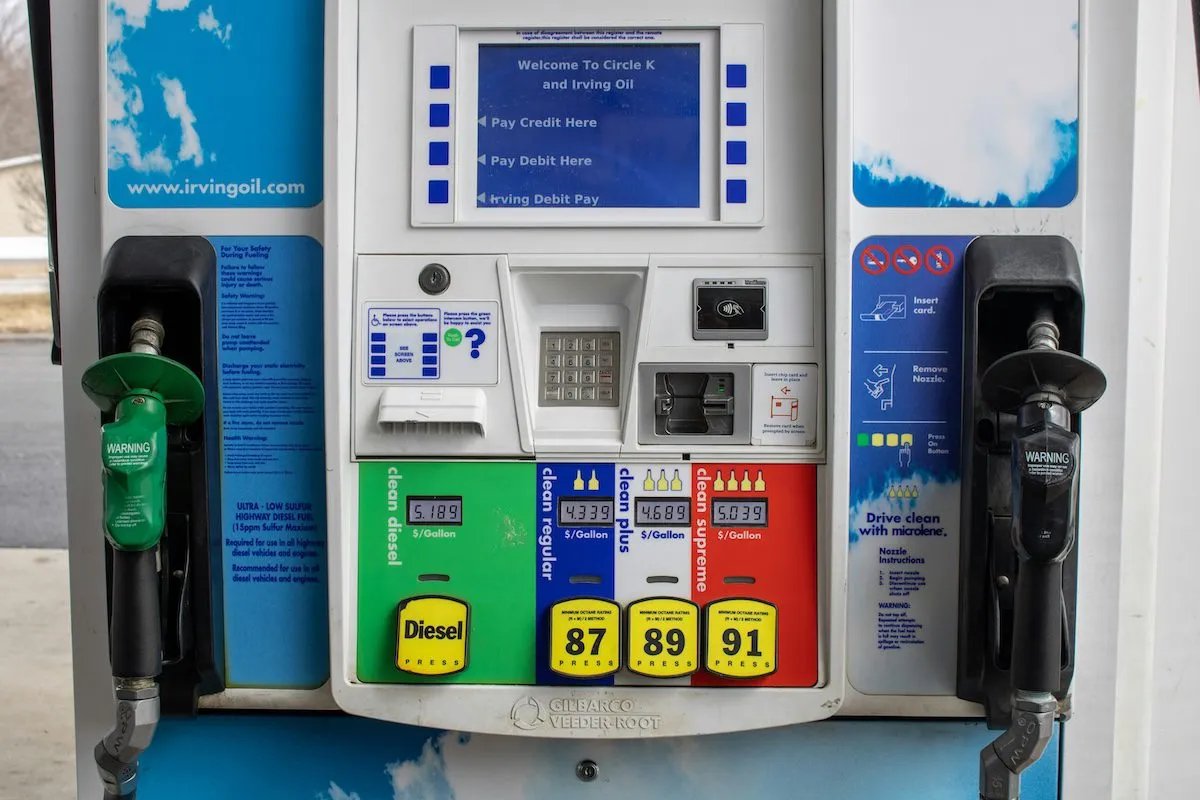
According to The Independent, the AAA is saying that the price of gasoline in the US was above $4 a gallon every day of August, which is an unprecedentedly high price, even greater than in August 2022 after the Russian invasion of Ukraine. Before Netanyahu and Trump attacked Iran, the price was $1.87 a gallon.

File photo. Photo by GG on Unsplash
In March-May 2026, Americans paid nearly $60 billion more to fill up their tanks than they did the previous year. So that price tag likely has doubled over the summer.
Since diesel costs are even higher than gasoline, and trucks carry 70% of US commodities to market, the high petroleum prices have put up the inflation rate since Netanyahu-Trump went blithely off to war.
The tit for tat strikes in the Gulf on Sunday show that the conflict is unlikely to end soon, and therefore high gasoline prices are here to stay for a while, as well as higher inflation. In fact, the Federal Reserve may have to put up interest rates in September.
Editor’s Note: At a moment when the once vaunted model of responsible journalism is overwhelmingly the play thing of self-serving billionaires and their corporate scribes, alternatives of integrity are desperately needed, and ScheerPost is one of them. Please support our independent journalism by contributing to our online donation platform, Network for Good, or send a check to our new PO Box. We can’t thank you enough, and promise to keep bringing you this kind of vital news.
You can also make a donation to our PayPal or subscribe to our Patreon.
Please share this story and help us grow our network!
[ad_2]
Source link
