
[ad_1]

Erin Rode, LA Progressive.
Tenant advocates say Ratio Utility Billing Systems function like hidden rent increases.
By shifting unpredictable building costs onto renters.
In Alicia Yu’s first post-college apartment, a studio in Burbank, monthly utility costs were calculated through a process she’d never heard of. Her landlord had hired a third-party service to determine her share of the building’s utility costs using a formula unrelated to her actual usage — a system that critics say can leave tenants with wildly unpredictable bills.
Her bills, calculated using what’s called a Ratio Utility Billing System, or RUBS for short, were initially manageable, typically totaling $40 to $80 per month. But when Yu moved to a different studio apartment in Koreatown, in another building managed by a landlord that uses the same approach to billing, her utility costs shot up to around $140 per month, a total that, she said, varies based on behind-the-scenes calculations that she is unable to assess. Her current utility bill covers more services — a $2 pest control fee and around $10 to $15 for water heating, in addition to the sewer, trash, and water charges covered by her previous bill — but not enough to explain the discrepancy.
“It’s made it hard to budget because the total is a mystery to me until after the end of the month when they bill us,” said Yu, adding that she’s frustrated that she can’t take any actions to lower her bill, such as using less water.
Los Angeles tenants are calling on the city to ban the use of RUBS billing, following a December 2025 recommendation from the city’s housing department to eliminate the practice in rent-stabilized units. They’re joining efforts in other cities across the U.S., including in Chicago, Seattle and Jersey City, N.J., where tenants have pushed for more transparency from their landlords and outright bans on the practice. In Connecticut, the billing practice is banned entirely, after a state Supreme Court ruling found it violated state law.
In Los Angeles, renters in Koreatown apartment buildings like Yu’s, new luxury high-rises in downtown L.A. and Park La Brea, the largest rent-stabilized apartment complex west of the Mississippi River, all say they’re battling uncertain utility costs, making it more difficult to budget in already-expensive Los Angeles. Also in Koreatown, the Virgil Square Tenants Association has been on a “RUBS strike” for over a year, paying rent but refusing to pay utility bills calculated using a method they say lacks transparency. Which utility costs are included in RUBS billing varies by property, but the list can include water, electricity, trash, pest control and sewer charges.
Ratio Utility Billing Systems are used to calculate utilities in properties that lack individual meters for each unit. These master-metered buildings account for roughly 80% of rental properties, according to Daniel Yukelson, executive director and chief executive officer of the Apartment Association of Greater Los Angeles. Each tenant’s share is calculated using a series of factors including a unit’s square footage and the number of bedrooms, occupants and bathrooms.
“It’s truly trying to be as precise as possible in allocating what a tenant’s usage would be. Obviously, nothing is more precise than having a specific meter tied to that unit. But RUBS calculations over time have gotten more and more precise,” said Yukelson.
Tenants say the billing practice both makes it more difficult to conserve water and electricity and leads to unpredictable utility costs that aren’t tied to actual usage — at a time when the state is in the middle of both a climate and housing affordability crisis. In some cases, utilities costs for common areas are also divided among tenants. Tenants groups and advocates also say the fees are a sneaky way to raise rent.
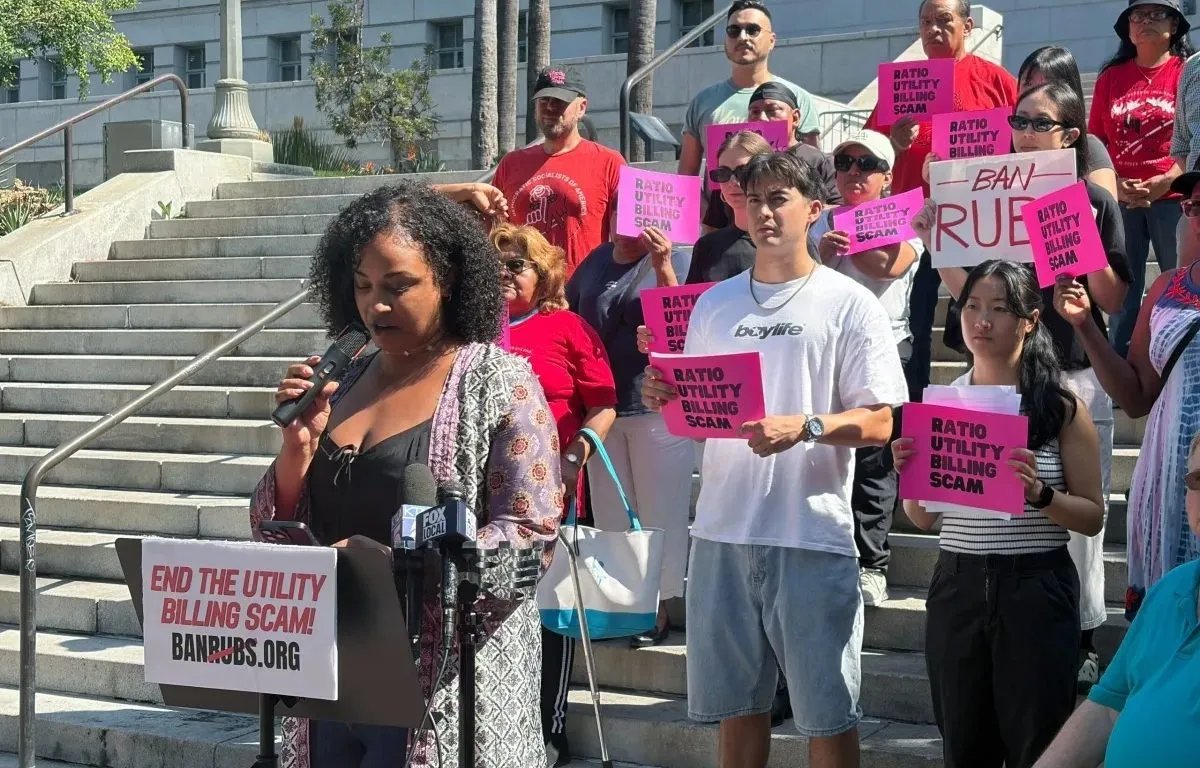
“I cannot predict it. I cannot control it, and I cannot budget for it,” said Hanna Yoseph, a resident of the Hope + Flower apartment complex in downtown Los Angeles, at a rally held by tenants groups on Aug. 10. “When I open my utility bill, I don’t know what I’m going to see. Is it going to be $200, $300, $400? I don’t know. Sometimes my water bill is $14. Sometimes it’s $170, and that’s not how housing should work.”
Tenants say they’ve struggled to get information from their landlords about how their utility bills are calculated, including both the formulas used to calculate their individual share and the actual utility bills for the property.
Hanna Yoseph speaks at a tenant group rally outside of Los Angeles City Hall on August 10. Photo: Erin Rode.
Other California cities have banned the billing practice in recent years, including Mountain View, San Jose and West Hollywood. The city of Alameda banned the practice in July. These prohibitions apply only to rent-stabilized units in those cities. State law bars rent control for single-family homes and units built after February 1, 1995. Cities have interpreted the law to also restrict their ability to prohibit the billing method in these units.
“Tenant groups are singing the same old song that they don’t want to pay for rent, they don’t want to pay for the utilities that go along with their particular living situation,” said Yukelson. “You need to be responsible for the housing that you get, and you’ve agreed in a legal document to pay for certain things. … But unfortunately, tenant groups want more and more.”
For master-metered buildings, the other option for apartment owners is to include the cost of utilities in the rent. Some cities like Oakland and Santa Monica define “rent” as including utility costs, effectively banning the use of Ratio Utility Billing Systems.
While this means a higher base rent, tenants say the arrangement provides more certainty by allowing them to plan for monthly costs. Landlord groups, meanwhile, say that including water, electricity, trash and sewer in the rent doesn’t allow them to recoup rising utility costs, and that pulling out the utilities as a separate charge encourages conservation.
Given that, under the billing system, a tenant’s utility charges are based on an estimate calculated from an entire building’s usage, it’s difficult to see how any one tenant could meaningfully affect the calculation by using less water, said Robert Shore, president of the Park La Brea Residents Association.
“My water bills, my utility bills, get spread among my 12,000 neighbors. Nothing I could possibly do will affect my personal bill by more than a few pennies,” said Shore.
In February 2023, the Los Angeles City Council approved a motion introduced by Councilmember Nithya Raman that directed the city’s housing department to report back within 60 days with recommendations on regulating the use of the billing system. That report wasn’t released until December 2025, when the housing department recommended the city ban the billing practice in rent-stabilized units and add transparency requirements for its use in non-rent-stabilized units.
The recommendations were scheduled for a Housing and Homeless Committee meeting in May, but the meeting was cancelled. In an email to Capital & Main, Raman said that the RUBS item was “placed on that agenda in error, due to a clerical issue” and was “intended to be heard after summer recess, when our office and those we are working with would be better prepared for a full committee discussion on this topic.”
The future timeline is unclear. Raman, who is running for mayor, was removed from her post as chair of the Housing and Homelessness Committee earlier this month. Raman wrote that she expects the item will be re-referred to the new Housing Committee, which will be chaired by a different councilmember, and hopes it will be considered by the committee and city council “before the end of the year.”
The Los Angeles Tenants Union and Debt Collective, along with other housing rights groups, are calling on city leaders to approve the proposed ban on the billing system in rent-stabilized units, and to expand the ban to also include units that aren’t rent stabilized. The groups are also asking the city to remove a provision in the proposal that would allow a one-time rent increase for units where the practice is banned.
“Every month that they’re not doing anything about this, there’s people like [Yoseph] who are paying $350 a month to pay for things they have no control over,” said Rose Lenehan, who is an organizer with both the Los Angeles Tenants Union and Debt Collective.
Yoseph, a hairstylist whose building isn’t rent stabilized, holds off on making purchases toward the end of the month, including of products she needs for her business, until she knows how much her utility bill will be, which, she said, ranges from around $220 to $550.
In the apartments in which Yoseph previously lived, water and trash were included in the rent, and she was billed directly by utility companies for electricity and gas. Those bills would be $60 to $70 most months, and as much as about $150 for electricity during the hot summer months, she said.
“It wasn’t so much of a surprise because I know how much I’m using, so I never had this anxiety of opening up my bill,” said Yoseph. “Because of RUBS, I have anxiety every month of how much I’m going to fork over.”
Above photo: Hanna Yoseph speaks at a tenant group rally outside of Los Angeles City Hall on August 10. Erin Rode.
Editor’s Note: At a moment when the once vaunted model of responsible journalism is overwhelmingly the play thing of self-serving billionaires and their corporate scribes, alternatives of integrity are desperately needed, and ScheerPost is one of them. Please support our independent journalism by contributing to our online donation platform, Network for Good, or send a check to our new PO Box. We can’t thank you enough, and promise to keep bringing you this kind of vital news.
You can also make a donation to our PayPal or subscribe to our Patreon.
Please share this story and help us grow our network!
[ad_2]
Source link
