
[ad_1]
Washington has converted a military operation into a strategic endurance contest in which Iran possesses an exceptionally powerful economic weapon, writes Dan Steinbock.
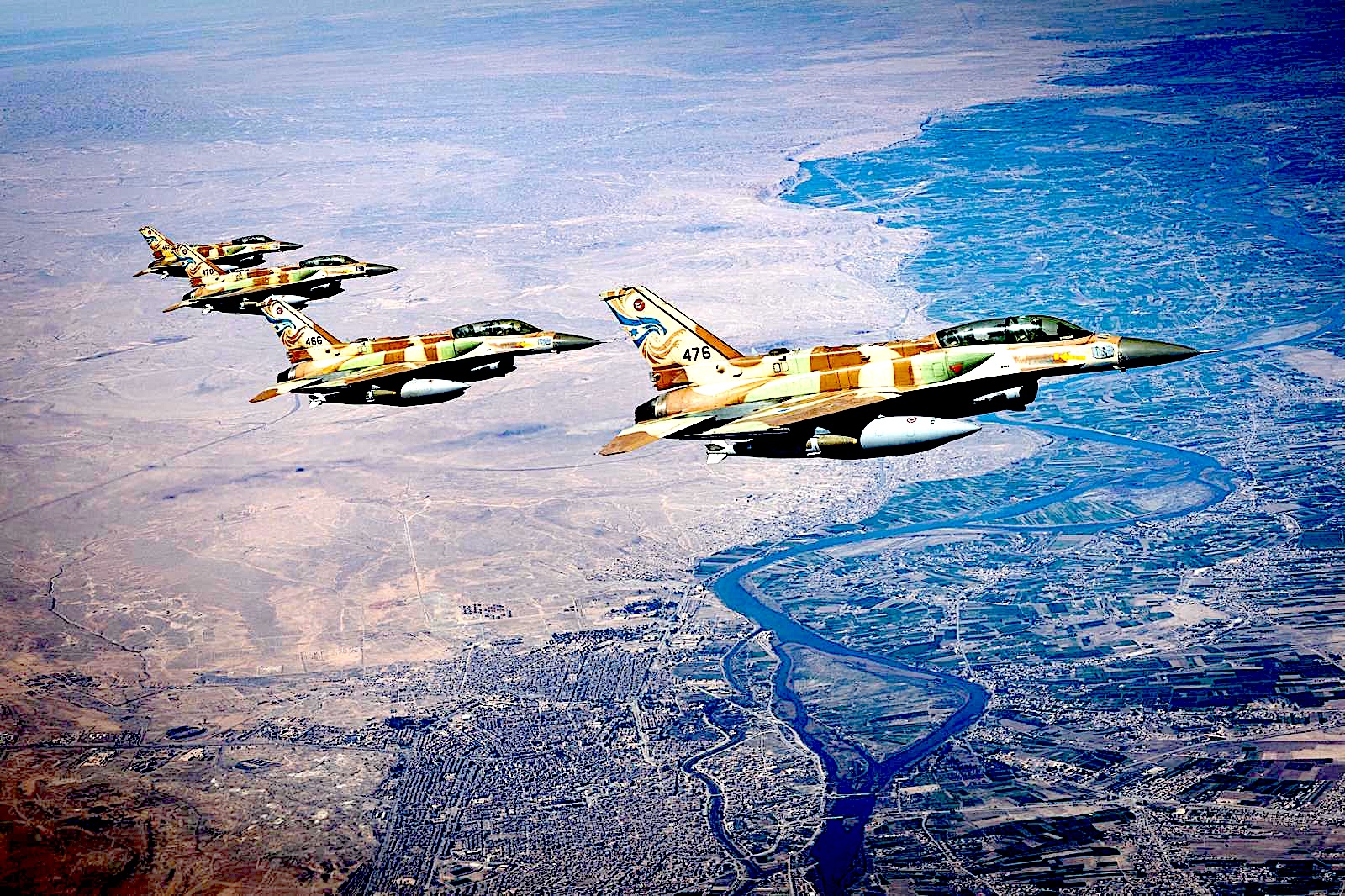
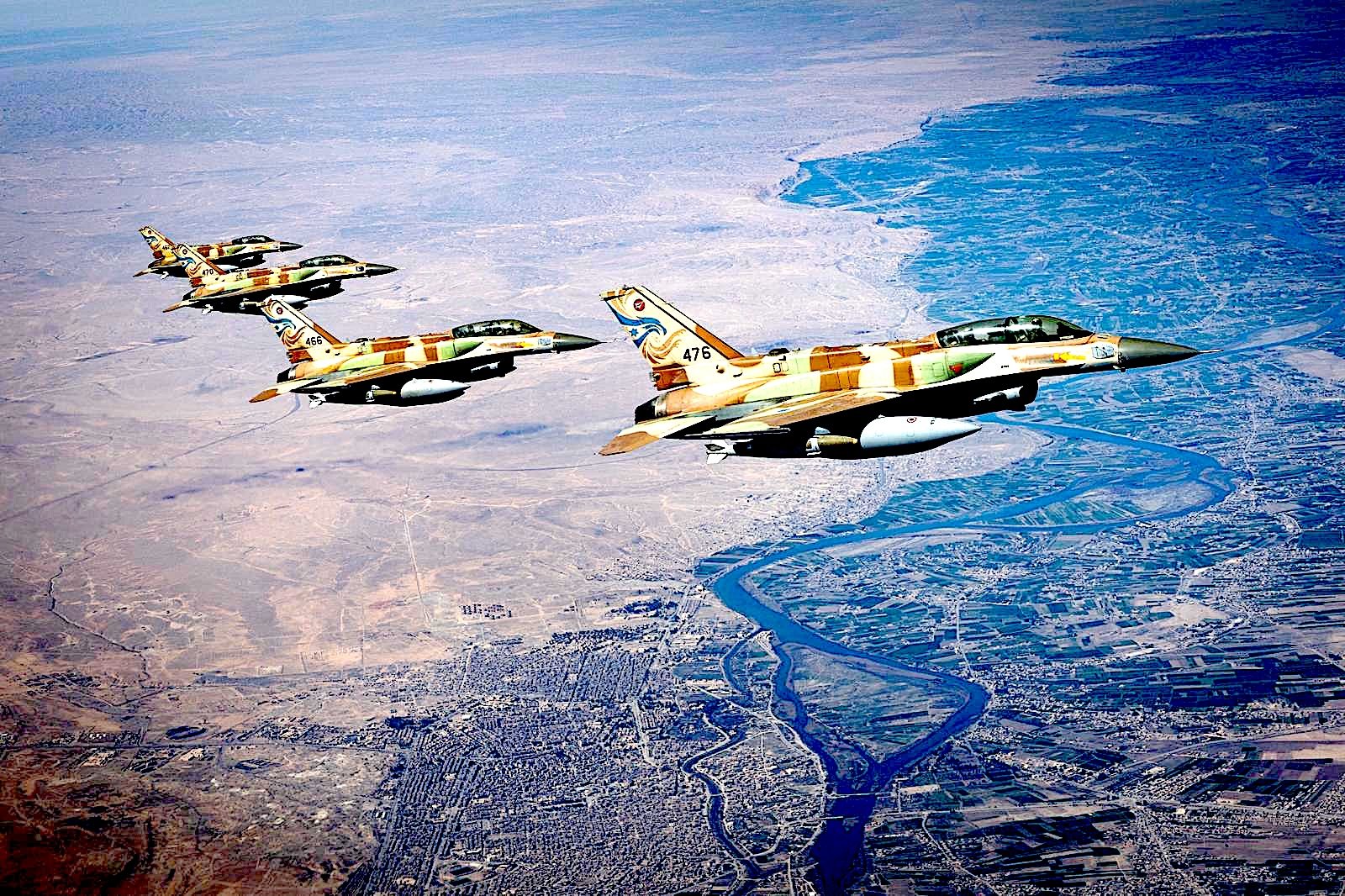
Israeli Air Force F-16I Sufa fighter jets during the U.S.-Israel war on Iran, March 4. ( IDF Spokesperson’s Unit, Wikimedia Commons/CC BY-SA 3.0)
By Dan Steinbock
 Iran has not collapsed, while Hormuz has become a global economic choke point. The central failure was not ignorance of the risks, but the political decision in Washington and Tel Aviv to gamble that coercive military power could overcome them.
So, why did they set the stage for the catastrophe that was both unwarranted and unnecessary?
In February 2024 – after 4 months of the Israeli obliteration of Gaza – over 100 senior military and government officials participated in a report by Reichman University’s Institute for Counter-Terrorism which outlined in painful detail how unprepared the Israeli home front was for an all-out war with Hezbollah.
The Israeli Conventional War Game
This lethal scenario was written long before Hamas’ October 7 attack on Israel. It is the result of a three-year study. The 130-page report was the work of six think tanks made up of over 100 terrorism experts, former senior security officials, academics, and government officials who examined critical aspects related to the level of preparedness for the I.D.F. and the home front in the event of a multi-front war.
The project was led by Professor Boaz Ganor, a world-renowned counter-terrorism expert. In the months leading up to October 7, he presented his research to relevant military and political authorities in an attempt to rouse intelligence and decision-makers from complacency and misconceptions.
The Netanyahu government ignored him and the analysis.
The Israel-Iran Nuclear War Game
In late 2023 – almost in parallel with the Hamas attack – a high-level U.S. war game was conducted in Washington. The participants included members of U.S. executive branch, Republicans and Democrats in the Congress, leading academics, think-tank experts and Pentagon officials. The game started in 2027 with Israeli intelligence reports that Iran was mating nuclear warheads to its long-range missiles. Consequently, Israel targets Iran’s key nuclear and missile sites with U.S. standoff hypersonic missiles.
Intriguingly, initially the U.S. participants presumed that self-restraint would prevail in this high-level war game. Yet, the simulation’s cold logic compelled them into a sequence of steps that quickly went nuclear. The adverse consequences were felt by millions of civilians in both Israel and Iran.
The lessons of the war game were ignored by both the Netanyahu government and the Trump administration.
Why Netanyahu Courted the U.S. Into the Iran Conflict?
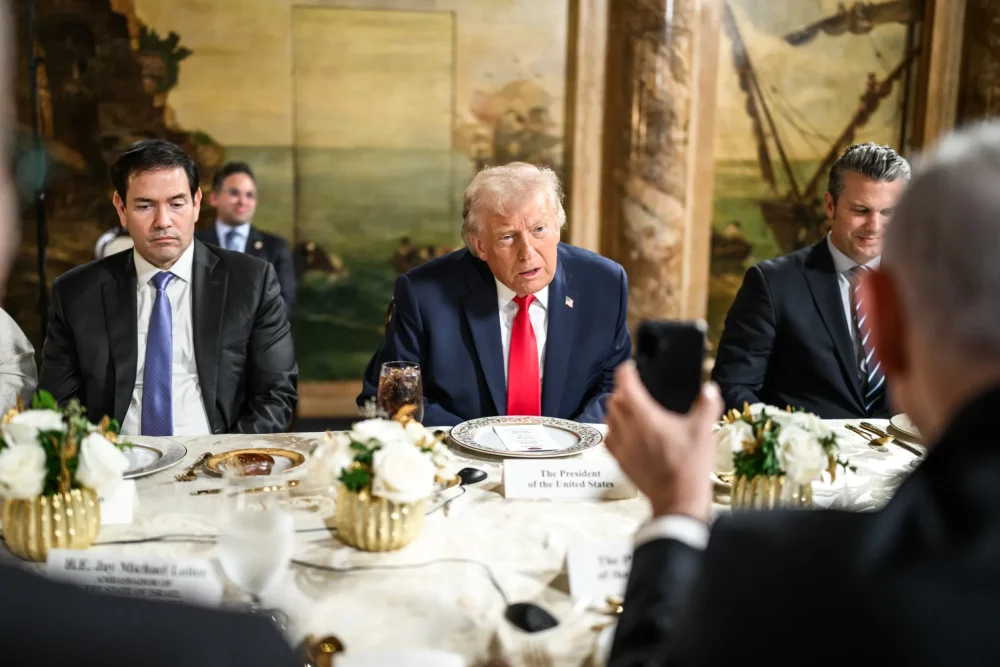
Donald Trump listening to Israeli Prime Minister Netanyahu at Mar-a-Lago in Florida, Dec. 29. 2025. (White House Photo)
Both war games were common knowledge among the U.S. and Israeli military elites well before Oct. 7, 2023. I referenced each in my book The Fall of Israel (2024). So, why were the lessons of these games effectively ignored?
The evidence points less to strategic ignorance than to political and strategic risk-taking. In particular, The Fall of Israel shows that Netanyahu’s government repeatedly treated regional escalation as a means of escaping an increasingly untenable post-October 7 position: prolong Gaza invasion, weaken Hezbollah, expand Israel’s northern security zone and ultimately confront Iran.
I argued that Netanyahu rejected a Gaza ceasefire while expecting Trump’s return to provide greater freedom of action against Gaza, Lebanon and Iran.
But the risks were hardly invisible even in 2023. The high-level U.S. war game in late 2023 projected that an Israel-Iran confrontation could rapidly escape Israeli and American control and go nuclear. The Hezbollah scenario likewise anticipated thousands of rockets, saturation of Israeli defenses, attacks on infrastructure and paralysis of ports and trade.
Netanyahu’s calculation therefore appears brutally simple: the risks of escalation were judged preferable to the political risks of de-escalation. A wider war could restore deterrence, destroy adversaries, preserve his coalition and keep the strategic initiative.
The catastrophic externalities—Lebanon, Iran, Hormuz, the Gulf and the world economy—were treated as manageable collateral risks. They were not Israel’s problem. They were the world’s problem.
Why Did Trump Take the Bait?
Trump inherited an enormous institutional warning system. U.S. officials, Pentagon planners and bipartisan experts had already modeled escalation from an Israeli attack on Iran through retaliation, Israeli counterstrikes, nuclear signaling and ultimately nuclear exchange.
The war game initially assumed rational self-restraint; but its own sequence demonstrated how quickly that assumption could collapse.
Yet Trump appears to have made the classic great-power error: confusing overwhelming tactical superiority with strategic control.
To the interventionists, the political attractions were obvious—destroy Iran’s nuclear capacity, reinforce Israel, demonstrate American dominance and claim a decisive victory where previous administrations had failed.
But the premise that Iran could be compelled to surrender under bombardment underestimated asymmetric retaliation, regional proxies, geography and the extraordinary leverage of Hormuz.
The result is the opposite of the promised quick victory. By August, Trump’s approval had fallen to 33 percent, while 80 percent of Americans said they expected the war to be prolonged. Earlier Pew polling found 59 percent of Americans believed using force against Iran was the wrong decision and 62 percent disapproved of Trump’s handling of it.
Ironically, Washington has converted a military operation into a strategic endurance contest in which Iran possesses an exceptionally powerful economic weapon: Hormuz.
Soaring Prices, Plunging Growth, Millions Displaced
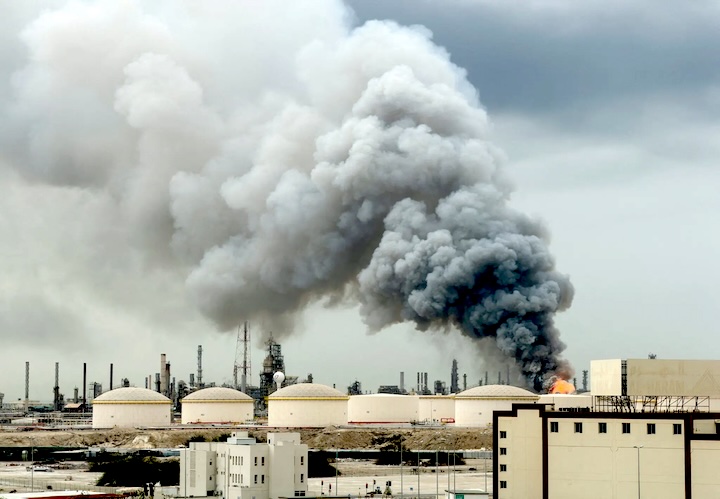
Smoke rising from a refinery in Sitra Island, Bahrain, after it was struck during the U.S.-Israel war on Iran, March 9. (Raja Abdulrahim /The New York Times/ Wikimedia Commons/ CC0)
The Strait remains severely constrained. The International Energy Agency (I.E.A.) estimates that Gulf output was still 8.3 million barrels/day (mb/d) below pre-war levels in July, while global inventories had fallen 410 million barrels since the beginning of the war. The agency now projects a 1.8 mb/d global oil deficit in third quarter of 2026.
Brent was about $91/bbl [per barrel] on August 18, after reaching $105 in July. The U.S. Energy Information Administration’s (E.I.A.) relatively benign baseline assumes Hormuz constraints persist through August and puts Third Quarter Brent around $85. But that is increasingly a floor, not a comfortable forecast.
Today, the baseline for the one to three-month range is roughly $90 to $110 Brent if the present stalemate persists; $110 to $130+ if attacks intensify or Hormuz remains effectively closed into autumn. Estimated price is roughly $70 to $80 if a credible settlement restores unrestricted shipping.
Gas is even more exposed. European TTF [Title Transfer Facility] recently reached about €64/MWh [MegaWatt hour], while Uniper expects €50–60/MWh for as long as Hormuz remains closed. Qatar’s economy is projected to contract 8.6 percent in 2026, while Qatar and Kuwait are losing an estimated $1.5 to $2 billion per week in energy-export revenues.
Economically, the World Bank cut regional 2026 growth from 4.0 percent to 1.8 percent; I.M.F. stress scenarios put global growth as low as 2 percent with inflation above 6 percent if the energy disruption persists into 2027.
The human baseline is already enormous: by June 10, reported deaths included 3,468 in Iran, 3,371 in Lebanon, 26 in Israel and 13 U.S. troops, plus deaths across Iraq and the Gulf. For all practical purposes, these estimates are likely huge under-estimates and ignore the displacement of millions in the region.
Starting in early 2026, some 3.2 million Iranians have fled massive regional airstrikes and hostilities. In Gaza, 1.7 to 1.9 million — over 80 percent of its population — remains displaced inside the enclave, despite volatile ceasefires. And in Lebanon 1.0 million have been displaced. That’s a total of 6 million displaced people.
There are four remaining trajectories.
- First, negotiated de-escalation: reopen Hormuz, freeze attacks, restore oil/LNG [liquid natural gas] flows and negotiate Iran’s nuclear status.
- Second, prolonged managed conflict: intermittent strikes, sanctions and restricted shipping, producing structurally higher energy prices.
- Third, regional expansion: Lebanon, Iraq, Yemen and Gulf infrastructure become increasingly active fronts.
- Fourth, the tail risk: escalation toward nuclear confrontation—the scenario the war games warned could arise from supposedly controlled conventional operations.
Opposition to America Grows
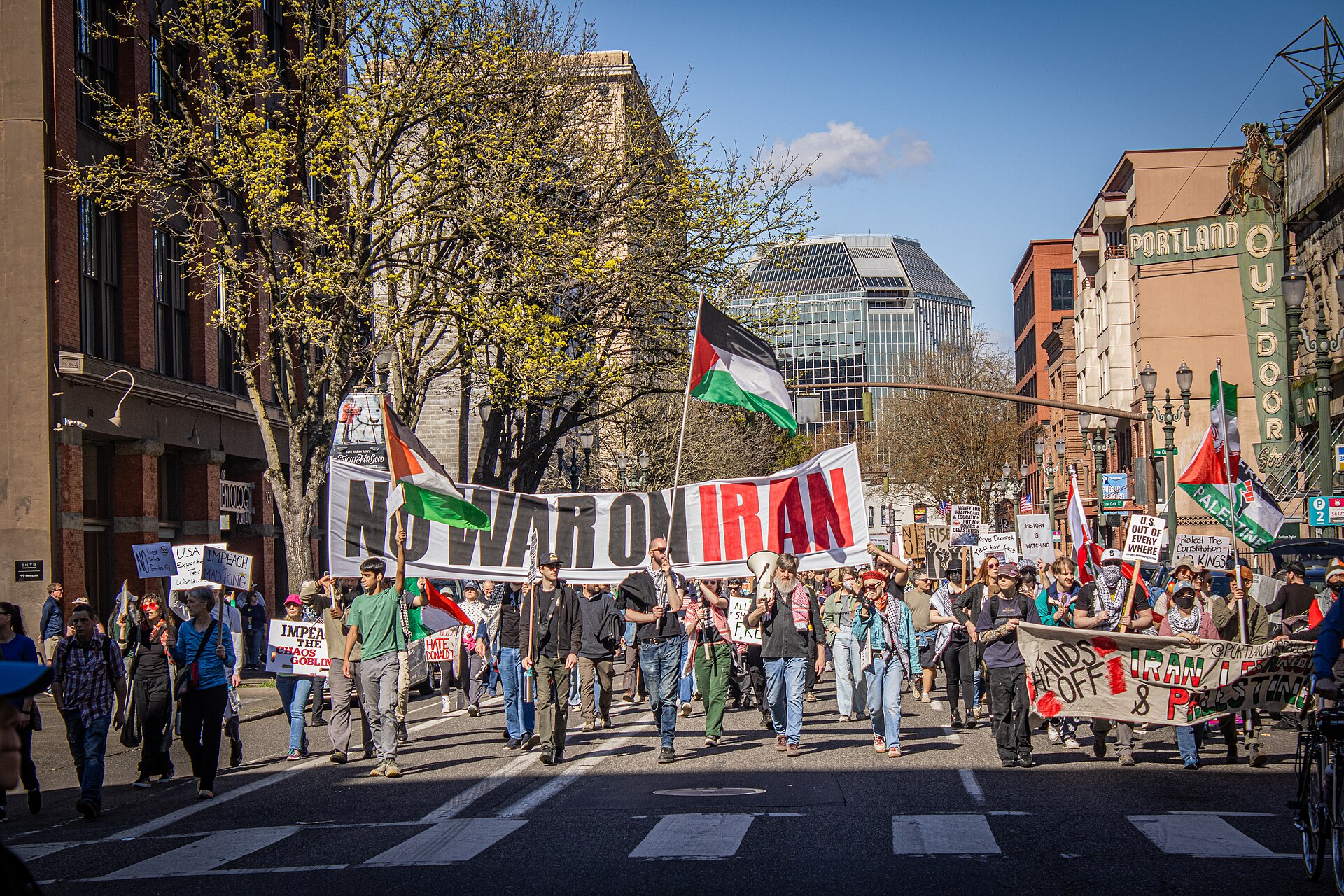
“No Kings” protest against Trump policies, Portland, Oregon, March 28. (Wikimedia)
What is urgently needed is an internationally mediated settlement involving Iran, the Gulf states, Europe, China, Russia and the UN—not another unilateral U.S. military ultimatum. As I argued in The Fall of Israel, unipolar solutions are increasingly incapable of managing a multipolar Middle East.
The reputational damage to Washington is already severe and potentially structural. Pew’s 2026 36-country survey found only 37 percent favorable views of the U.S., against 57 percent unfavorable, while 63 percent said America does not contribute to global peace and stability. In eight European countries, perceptions of U.S. reliability have fallen by 28–52 percentage points since 2022.
That is the geopolitical catastrophe. Washington sought to demonstrate that American military power still governs the Middle East. Instead, it has demonstrated that military superiority cannot guarantee political control.
Today, Hormuz has become an inconvenient symbol to many in Washington. After decades of U.S. primacy, the world’s most important energy chokepoint is now a bargaining instrument in a war Washington helped make possible.
Trump’s ‘Economic D-Day’
The Trump administration’s “Operation Economic Outcast” is best understood as a strategic pivot: after nearly six months of war failed to produce Iranian capitulation or secure Hormuz, Washington is attempting to convert its enormous financial leverage into the victory that military force has not delivered.
Announced August 24, the campaign sanctions more than 60 entities, individuals and vessels and targets Iran’s oil, shipping, aviation, technology, gold, digital assets and nuclear/missile networks; Washington is also threatening secondary sanctions against countries continuing to trade with Tehran.
Why now? Iran’s rial has collapsed to roughly 2 million per dollar, inflation is projected near 69 percent, and its economy is contracting — precisely the moment Washington hopes economic pain will force Tehran to reopen Hormuz and accept a nuclear settlement.
But the strategy confronts a fundamental contradiction: Iran has endured decades of sanctions, while China remains its largest oil customer. Washington conspicuously did not sanction major Chinese financial institutions in this first wave, highlighting the diplomatic limits of escalation.
Three Plausible Outcomes
Prolonged economic war (likeliest) — Iran absorbs further economic damage but refuses surrender. Secondary sanctions generate friction with China, India, Turkey and the U.A.E., while Tehran retaliates through Hormuz. Global consumers pay for an American-Iranian confrontation.
Negotiated capitulation — economic exhaustion pushes Tehran into a deal, Hormuz reopens and oil prices fall. This is Washington’s desired outcome, but requires Iran to believe concessions improve rather than jeopardize regime survival.
Escalatory blowback — sanctions are interpreted as regime-change warfare; Iran tightens Hormuz, attacks remaining economic targets or expands asymmetric operations. The result could be higher oil/LNG prices, greater humanitarian suffering and a wider diplomatic rupture—turning an economic instrument intended to end the war into the mechanism that prolongs it.
The irony is stark: Washington is now trying economic coercion because military coercion has reached its limits.
And the longer Hormuz remains constrained, the more the “Economic D-Day” risks imposing costs on the world economy that exceed the additional pressure it imposes on Tehran.
Dr. Dan Steinbock, an expert of the multipolar world, is the founder of Difference Group and has served at the India, China and America Institute (US), Shanghai Institute for International Studies (China) and the EU Center (Singapore). He is also the author of two new books on the Middle East crises: The Obliteration Doctrine (September 2025) and The Fall of Israel (October 2024). For more, see here.
The views expressed are solely those of the author and may or may not reflect those of Consortium News.
Please Donate to
CN’s Summer
Fund Drive!


[ad_2]
Source link
