
[ad_1]
At a steel plant in his hometown of Middletown, Ohio last week, J.D. Vance invoked the memory of a “great Southern populist.”
“His name was Huey Long,” the vice president said, “and he once said ‘Every Man a King’ was the goal of his political program.”
Noting that Long—the Depression-era Louisiana governor and U.S. senator popularly known as the Kingfish—was “an interesting guy, kind of a crazy guy,” Vance connected his program with the Trump administration’s agenda:
But no man is a king if their castle is under siege by criminals. No man is a king if they can’t take their family out to dinner without being mugged or having their car jacked. And of course, ending the Biden border invasion was a big part of why we have changed that over the last 18 months.
Now, this wasn’t a full-throated endorsement of Long on Vance’s part; nor did the vice president precisely describe what Long’s famous slogan actually entailed. (That would be wealth redistribution.) But even a passing, non-condemnatory mention of Long set off alarm bells for some bien pensants of both the right- and left-wing varieties, whose preference for neoliberalism at home and neoconservatism abroad is starkly at odds with what the Kingfish represented.
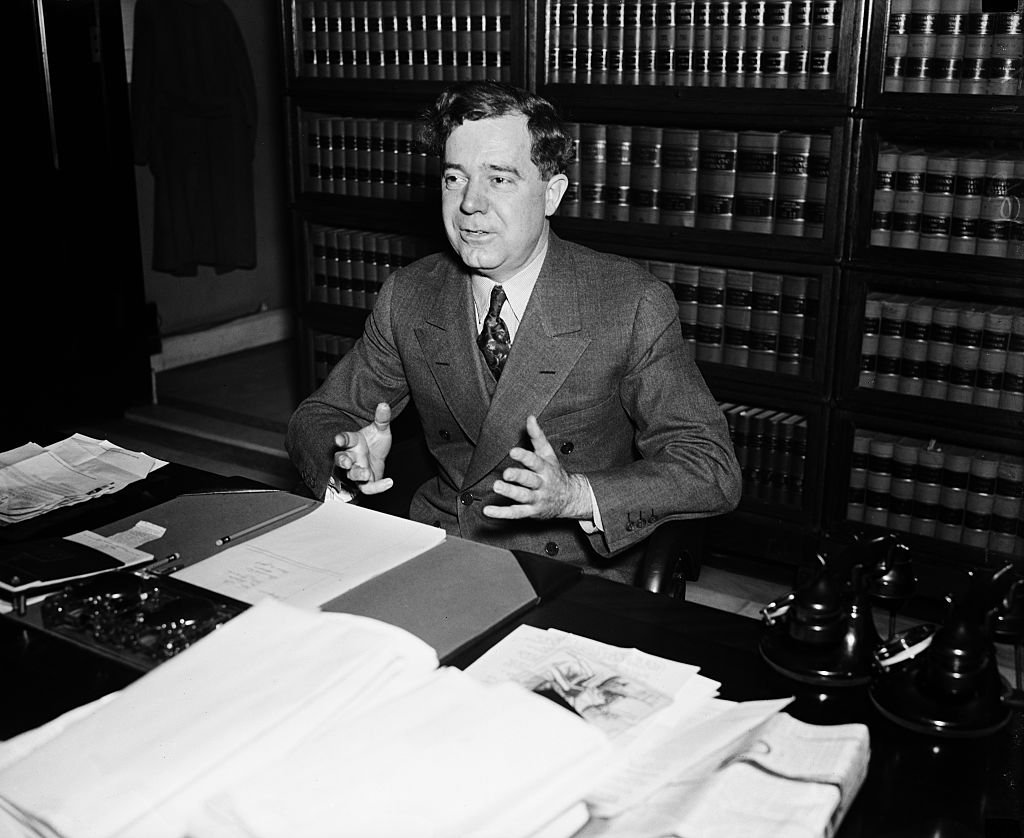
As the Democratic governor of Louisiana from 1928 to 1932, Long imposed a far-reaching, profoundly populist vision on what had heretofore been a state beset by extreme poverty and inequality. When he took office, Baton Rouge basically belonged to Standard Oil, and Louisiana politics was the province of the scions of the state’s small moneyed establishment. Wealth was hyper-concentrated, and politics was a means of preserving and increasing this concentration. This explains why a place honeycombed with rivers and bayous had only three state-built bridges prior to Long, and why Louisianians of the era had the country’s second-lowest literacy rate.
During his subsequent stint as a U.S. senator (1932–35), Long maintained de facto control of Louisiana through his allies and a puppet who occupied the governor’s mansion in his absence, all while challenging FDR from the left. Long had supported Roosevelt during the 1932 presidential election, but he eventually broke with him, and in 1934 proposed his “Share Our Wealth” plan as a substitute for the New Deal. While Long frequently changed the specifics, in essence this program would have capped extreme personal wealth, guaranteed family incomes, provided allowances for families to purchase homes, enacted free public education for many students, and limited the work week to 30 hours and the work year to 11 months.
Though the prudence and feasibility of these policies are open to question, what is beyond dispute is that Long was on the side of the working man, insofar as it can be said that any American politician ever was.
And indeed, Long’s “Share Our Wealth” agenda may have helped tilt Roosevelt in a more pro-worker direction. The Second New Deal, implemented from 1935 to 1936, was considerably more radical than the first iteration. It enshrined Social Security into law, guaranteed the right to unionization and collective bargaining, and jumpstarted rural electrification. It’s hard not to see another product of Roosevelt’s program, the Works Progress Administration—which employed more than 8.5 million to build 650,000 miles of road, 125,000 public buildings, 8,000 public parks, and 800 airports, and was responsible for countless American landmarks that remain to this day—as having cribbed a bit from Long’s Louisiana model, which saw the construction of 9,700 miles of road and 111 toll-free bridges.
Long was also a magnificent orator, electrifying, edifying, and endlessly amusing his listeners. He delighted in skewering elites of all stripes: “The only difference that I have found between the Democratic leadership and the Republican leadership,” he once said, “was that one of them was skinning from the ankle up, and the other one from the ear down, when I got to Congress.”
Ultimately, though, Long wouldn’t live long enough to challenge Roosevelt and the uniparty of his day. He was shot dead on September 8, 1935, in the Louisiana State Capitol—a grand, Art Deco skyscraper Long had built as the shining monument to his political project (and, well, himself) that had opened only three years prior. The son-in-law of a political opponent was the assassin, and all throughout Long’s reign, the New Orleans establishment and their allies would routinely muse about when someone would kill Long. As an old, Southern-aristocratic-cadenced journalist of the era recounted in Ken Burns’s 1985 documentary Huey Long, one of the fairer mass-media depictions of the Louisiana Kingfish, “I can’t remember any Saturday night that I went anywhere that we didn’t talk about killing Huey Long,” though she said it “didn’t mean you meant to do it,” only that you wanted the “incubus” gone.
Long deserves recognition for other things as well: Louisiana State University, for example, which he massively expanded, tripling its student population and establishing its medical center; the free textbooks that he provided to schoolchildren throughout the state; adult literacy programs to educate the masses; numerous low-income-serving hospitals; and his elimination of the poll tax to encourage voter turnout. On this latter move, it redounds enormously to Long’s credit that he largely eschewed the racism that was too often entwined in southern populism (indeed, he counted the KKK among his political enemies).
Despite all this, Long’s legacy and standing with America’s liberal class is incredibly poor. This raises the question: With Long responsible for so many remarkable achievements in Louisiana, and through his national political influence some of the best of the post–New Deal order, why has he been castigated as a “dictator”? And curiously, why are many of the same critiques of Long so seldom applied to Roosevelt’s own “dictatorial” tendencies, of which there is certainly much material: his threats to pack the Supreme Court, his internment of American citizens of Japanese ancestry, his breaking of the two-term presidential tradition? It’s not only socialists and populists who celebrate Roosevelt—though there’s certainly a lot of that—but also mainstream liberals, perhaps barring the Reagan-worshiping right.
The answer might come down to the fact that Long was inclined toward what we might charitably call executive overreach. He started his own propaganda newspaper, threatened judges, forced state employees to pay up to 10 percent of their salaries into his campaign slush fund, took over New Orleans and Baton Rouge from their municipal governments, and once even briefly kidnapped two men so they couldn’t testify about his affair.
These are, obviously, fair matters for critique. But it is also true that Long largely worked within the confines of the law, and wielded his power in the service of (mostly) public-spirited ends. There were certainly no massacres on the streets of Long-administered New Orleans and Baton Rouge, nor did the state witness any of the other horrors that characterize societies run by genuine tyrants (dictators also don’t tend to increase voting access, as Long did). If Long was a dictator, so was FDR—and Trump. But no serious person would call Roosevelt or Trump a dictator, and that is precisely the point.
Which brings us back to those who took umbrage with the current vice president’s reference to Long.
On the neocon right, the Fox News host Mark Levin satirically remarked of Vance’s recent speech, “Huey Long. That’s the ticket,” and, “I notice the Buchananites don’t care for Reagan. He’s no Huey Long, that’s for sure.” Joel Berry, the producer of Jeremy Boreing’s show and the former managing editor of the Babylon Bee, tweeted, “Ronald Reagan and Milton Friedman did infinitely more to make ‘every man a king’ than Huey Long ever did.” Dana Loesch opined, “Absolutely bizarre that [Long] would be recast as some example for the GOP today.” And James Lindsay, finally, had to say: “The scope of this Huey Long stuff from the Vanceguard skanks shows that they’ve been cooking on this for a while just outside of general notice. Very few people are all that aware of Long or his ideas or legacy, but the whole Vanceguard seems to be very aware and enamored. Sus.”
The libertarians, who are at least more ideologically consistent, were not happy either. Reason ran an op-ed: “J.D. Vance’s Interest in Huey Long Should Be a Red Flag for Conservatives.”
Meanwhile, on the mainstream liberal left, Bill Scher, the politics editor of the Washington Monthly, quote-tweeted Vance’s remarks, “Uh, Huey Long was an authoritarian socialist and ‘Every Man a King’ was a redistribution program that placed 99% tax on wealth above $8M.”
That program, as it turns out, won a lot of people over. As Rod Dreher, conservative intellectual and former senior editor of The American Conservative, told me of his childhood in the Louisiana of the ’70s and ’80s, “I remember my father, born in 1934, taking up for Huey. He was very right-wing, my dad, but he told me that if it hadn’t been for Huey, people like him and his family—working-class rural folks—would not have had good roads or schoolbooks. I didn’t want to hear it at the time, because I was one of those poli sci majors who was all in for good government.”
“But now I can see that my late father had a good point,” Dreher continued. “Louisiana politics were quite corrupt before Huey came along. The state was controlled by planters, New Orleans oligarchs, and then by oil companies. Huey, born in rural north Louisiana, was something like Donald Trump, in that he came in, all theatrical bluster, and won power. But unlike Trump, Huey was not only intelligent, but cunning.”
Perhaps a more trenchant critique of Vance’s reference is that his boss has all the downside of the Kingfish and none of the upside: cronyist corruption on an unprecedented scale; a crude and blustering rhetorical style; little to no respect for constraints on his personal power. With Long, there was a real point to it all, and he indisputably elevated his constituents out of poverty and provided them with clear, visible, positive material outcomes. With Trump, as has become clear especially in this second term, it really is only about himself—and if somehow it’s not, the president has been incredibly ineffective by any non-MAGA-cultish measure. But this is not the liberal critique. The liberal critique is that Long was terrible, period, and nobody should ever say anything positive about him. (It’s probably no coincidence that, to further displease America’s liberal class, on foreign policy, Long was a staunch opponent of American imperialism from the Philippines to Latin America, and wanted the United States to stay out of European conflicts.)
The unfair, one-sided interpretation of Long’s legacy is not upheld only through social media posts. His treatment in the arts has also helped to darken his image. Robert Penn Warren’s book All the King’s Men and its two cinematic adaptations seem to have convinced many that Long was, at heart, a power-mad demagogue.
But as Dreher commented, “What Hollywood and mass media overlook, though, was the man’s deep intelligence, and Stakhanovite work ethic, which he had since his youth as a traveling salesman. They miss that, and they miss the fact that without Huey P. Long, most of the people of Louisiana would have been consigned to live a more feudal existence, exploited by oil companies and New Orleans elites.”
So what, finally, should we make of Huey Long and the connection to today’s populist right? For one, he seems somewhat popular among the younger, more engaged and online crowd; after Vance’s comments, Nalin Haley—Nikki Haley’s son, whose right-populist politics are diametrically opposed to his mother’s own—posted an image of Long in his fiery speech-pose, captioned, “We’re so back.”
Dreher’s opinion is that, if the young right is “interested in Huey because he tenaciously battled entrenched political and corporate interests on behalf of the common good, then they have a lot to learn from his example.” And furthermore, “the only contemporary politician on the right who could plausibly claim Huey P. Long as an inspiration is J.D. Vance. I say that because if Vance becomes president, I think he truly does have the same feel for working people that Huey did. Plus, he is intelligent, and not bound by the legacy of Ronald Reagan. Trump’s populism is almost entirely a matter of style, but I anticipate President Vance’s version would be far more substantive — though the real test would be how he would treat Silicon Valley oligarchs.”
Still, Dreher cautions Vance against associating himself too closely with Long: “Even in Louisiana, where the practical monuments to Long’s governorship—bridges, things like that—still stand, and are still used by the state’s people, Huey has gone down in popular memory as a colorful part of our past, but not one we are eager to repeat. If you have to explain to people that Huey Long is a more complex and positive figure than the received historical narrative portrays, you probably shouldn’t lean too much on him in your speeches.”
But Adam Dohrenwend, an assistant professor at James Madison University who has studied at the place Long during his tenure saw as “his university,” LSU, has a grimmer view. “He’s the vice president. He’s in charge. So let’s see [the Long-style populism].”
If the right wants to emulate Long’s accomplishments, rather than merely his style, it still has a long way to go. But one suspects this will be easier once Donald Trump makes his exit. And if anyone could pull it off, it would be J.D. Vance and whatever remains of the New Right—perhaps aided by the so-called “Tucker wing,” or something like it.
Subscribe Today
Get daily emails in your inbox
For much of Tucker Carlson’s own rhetoric could have come straight from Long’s mouth. An August 17 Instagram clip of his, cut from one of his monologues, shows Carlson intoning precisely as Long would have: “Both parties have colluded against the population to make their lives better and our lives worse. And unfortunately they have been extremely successful.”
Though one would still be wise to question the right’s capacity for any Longism beyond mere rhetorical signaling. Long, ultimately, was of the left, even if modern Democrats have largely abandoned it. As Dohrenwend believes, “The left should absolutely reclaim Huey Long. He’s not their guy, the right’s.”
Whether the vice president, or anyone on the right, will really seek to make “Every Man a King” remains to be seen. But whatever else happens, as Dreher told me in closing, “Vance would look like a banger in a white linen suit.”
[ad_2]
Source link
