
[ad_1]

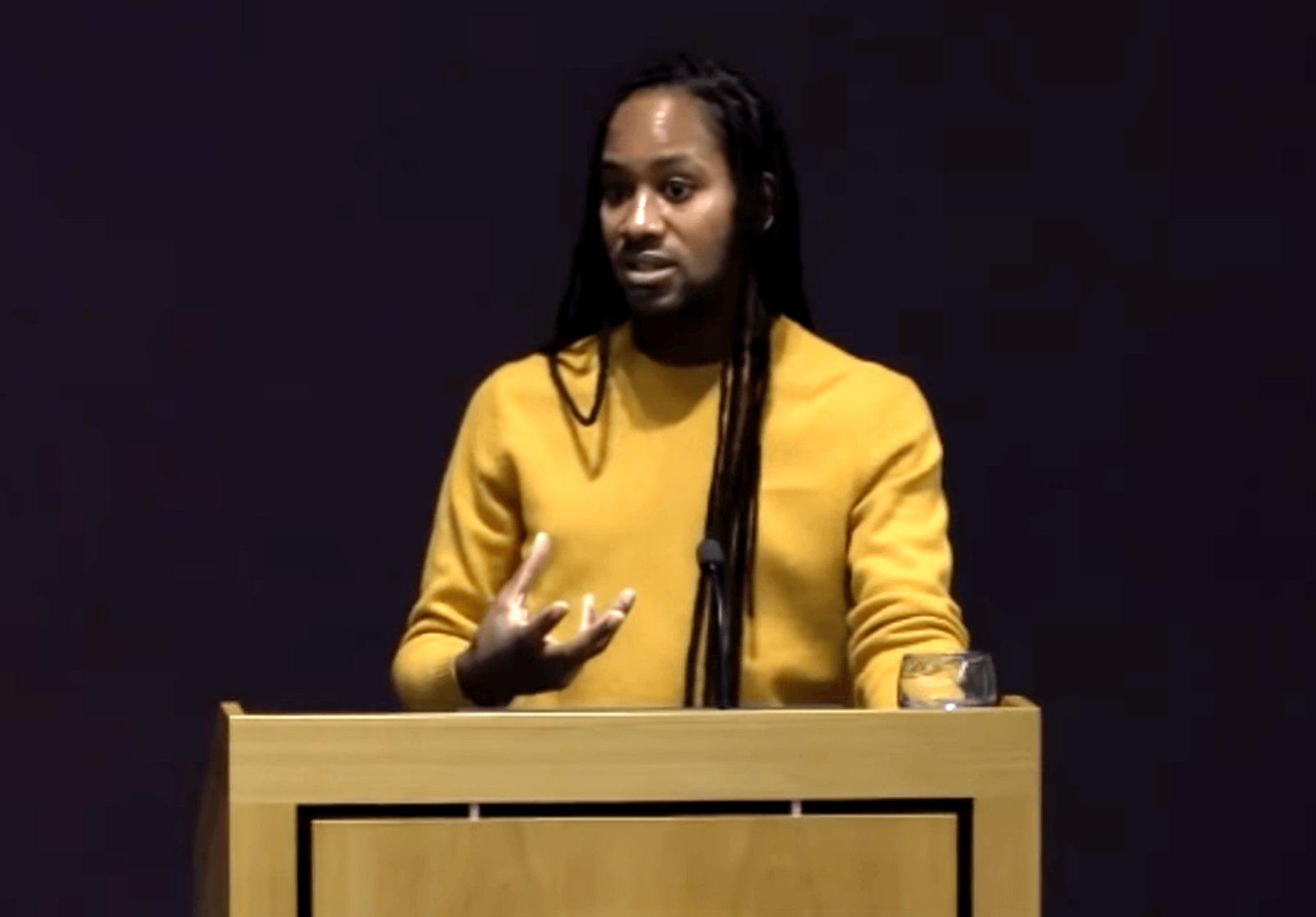
Jason Arday speaking at the Society for Experimental Biology symposium. (Screen capture from video posted to YouTube.)
The controversy surrounding the death of Jason Arday has produced a revealing moment of institutional self-defense, if not abject moral cowardice, within the liberal press. Three recent interventions are especially instructive. The Guardianhas defended its reporting on Arday as legitimate and responsible journalism while condemning the racialized abuse directed at its journalists. Michelle Goldberg, writing in the New York Times, warns against allowing outrage over Arday’s treatment to become an attack on press freedom. And Graeme Wood, writing in The Atlantic, reduces Arday’s tragedy to a story of fraud, psychological collapse, and self-delusion. The arguments differ, but they share a deeply troubling assumption: the liberal press acknowledges that something terrible happened to Arday while positioning itself outside the machinery of power that made his public destruction and tragic self-inflicted death possible.
That assumption deserves to be challenged because it does little to illuminate the sordid constellation of forces that contributed to Arday’s death and much to legitimate and normalize them, including the press’s own role in their operation. What these interventions share is a language that helps produce what João Biehl calls “zones of social abandonment,” spaces in which individuals are rendered invisible, severed from the histories and relations of power that have shaped their lives, and subjected to what he calls “domestic machineries of inscription and invisibility.” Arday increasingly appears within this language less as a living human being with a history, a voice, and a complex subjectivity than as an object to be scrutinized, classified, judged, and abandoned. This is the violence concealed within the language of distance and objectivity parading as journalistic truth-telling: the subjectivity of the other disappears, power retreats from view, and a human life is reduced to the accusations, failures, and judgments inscribed upon it.
None of this places Arday beyond legitimate scrutiny. There is no question that allegations of plagiarism are legitimate subjects of journalistic investigation. Nor should criticism of the press become an argument for censorship. Academic integrity matters, and freedom of the press (especially in the age of Trumpism) remains indispensable to any democratic society. But these principles cannot become shields protecting powerful media institutions from scrutiny of their own power. Beyond whether particular stories were factually justified lies a more consequential question: what happens when legitimate investigation mutates through repetition and amplification into spectacle, and spectacle into a sustained form of public prosecution? What happens when the mainstream media cease to see Arday as a human being caught within and marked by a constellation of historical, racial, institutional, and economic forces, and instead reduce a life shaped largely by power, vulnerability, struggle, and contradiction to the deadening logic of the spectacle?
The distinction matters because journalism does not operate in a political vacuum. Newspapers and other major corporate-controlled media are not neutral conduits through which facts pass into public consciousness. They are far from impartial. They select, frame, repeat, rank, circulate, and dramatize. They decide whose failures become national stories and whose disappear without notice. Concentrated increasingly in the hands of billionaires and corporate elites such as Jeff Bezos, Larry Ellison, Mark Zuckerberg, and Elon Musk, the media landscape is shaped by enormous concentrations of economic, cultural, and political power. The issue extends beyond the political orientation of individual billionaires to the concentration of cultural and pedagogical power itself and its capacity to shape public consciousness, determine what becomes visible and what disappears, whose voices matter, and whose lives can be rendered disposable. These institutions and platforms possess immense agenda-setting and reputational power, operating within an economy in which attention is currency, scandal generates circulation, controversy produces clicks, and human vulnerability can be transformed into commercially valuable material.
Pulitzer Prize winner Wesley Lowery gives this argument added force when he observes that “the act of journalism, no matter how much we may fetishize the idea of objectivity, requires a series, a pyramid, of subjective decision-making,” decisions historically made “almost exclusively by upper-class white men.” Recognizing that values, histories, and ideological assumptions shape journalistic judgment does not mean abandoning fairness, evidence, or factual accuracy. It means abandoning the fiction that truth can be pursued from nowhere. Objectivity too often silences the very questions journalism should be asking about power, while the pursuit of truth demands something more difficult: the civic courage to make power visible, to give human suffering a history, and to recognize that truth severed from justice can become another language through which domination hides itself. As Roger Berkowitz notes, truth demands humility, trust, and honesty, beginning with an acknowledgment of the journalist’s own assumptions, prejudices, politics, and values. Such self-reflection has little currency in a liberal media culture that too often treats its own values as invisible.
This refusal of self-scrutiny has profound consequences. The liberal press routinely conceals its own agency behind the language of objectivity and neutrality, presenting itself less as an institution making political choices than as a transparent window onto reality. This is the mythology of institutional innocence. Its reporters allegedly merely follow evidence, its editors merely apply professional standards, and its publications merely inform the public. This vocabulary makes the press’s own interventions disappear. Selection becomes “news judgment.” Framing becomes “context.” Repetition becomes “public interest.” A campaign of exposure becomes “accountability.”
Objectivity, in this institutional sense, does not mean the absence of perspective. It means the authority to define one’s own perspective as no perspective at all. The liberal press’s greatest illusion is not that it is always correct, but that its authority exempts it from recognizing its own ideology. Politics becomes visible only when it challenges established power; the operation of power itself disappears beneath the reassuring language of balance, civility, and objectivity. Neutrality is not the opposite of politics; it is often politics stripped of its own name. Market values, elite authority, racial hierarchy, and institutional privilege are rendered politically invisible, treated instead as the natural background against which journalism operates. The result is not impartiality but the concealment of power.
The fiction of neutral language has become increasingly difficult to sustain. According to The Intercept, a leaked 2024 internal memo revealed that New York Times editors instructed journalists covering Israel’s war on Gaza to restrict the use of terms such as “genocide” and “ethnic cleansing,” avoid the phrase “occupied territory,” and exercise similar caution with “refugee camps” and the word “Palestine” when referring to Palestinian land. Whatever one thinks of those editorial decisions, they expose a larger truth: journalists never simply discover language; it is governed through institutional judgments about which descriptions appear legitimate and which remain unsayable. Objectivity, in practice, often means regulating vocabulary while denying that such regulation is political. This is the language of subterfuge and normalization, a vocabulary that conceals its own politics while legitimating oppressive conditions and dominant relations of power.
The liberal press often imagines itself occupying a moral position above politics, while quietly reproducing the assumptions of the institutions, classes, and racial hierarchies from which it draws its authority. It can report on a political conflict while excluding its own role in shaping the terms of that conflict. This has been particularly true in its refusal to name Israel’s act of genocide in Gaza, Trump’s overt and relentless racism and white nationalism, and the rise of fascism in the United States. It can describe a racialized backlash while presenting its own coverage as untouched by racial meaning. It can insist that it is simply reporting what happened even when its choices determine what becomes visible, urgent, and nationally significant.
But the politics of objectivity cannot be separated from the political economy of the institutions that invoke it. The problem, then, reaches far beyond the intentions or integrity of individual journalists. It resides in the enormous concentration of economic and cultural power that determines who owns the commanding institutions of public communication, who controls the conditions under which journalists work, and which ideas are granted legitimacy, visibility, and circulation. The boundaries of the sayable are often established long before an individual reporter begins to write.
Jeff Bezos made this brutally explicit when he ordered The Washington Post opinion pages to defend “personal liberties and free markets,” declaring that “viewpoints opposing those pillars will be left to be published by others.” Here the mythology of journalistic neutrality collapses under the weight of concentrated ownership itself. What presents itself as an open marketplace of ideas is revealed as a cultural apparatus whose owners possess the power to determine which ideas may enter the marketplace at all. Objectivity, under such conditions, becomes more than an ideological alibi; it becomes a mask for concentrated power, concealing the economic interests, institutional hierarchies, and structures of ownership that police the boundaries of legitimate speech while presenting those boundaries as the natural order of things.
The sheer scale and intensity of the coverage directed at Arday makes the question of proportionality impossible to evade. A NewsCord Media audit documented 249 pieces published about Arday across 15 British national media outlets during a 22-day period, including 188 in the nine days between his resignation and his death. Its original census attributed forty-four pieces to The Times and Sunday Times, forty-three to The Telegraph, and thirty-eight to the Daily Mail/MailOnline. The precise count has subsequently been refined, but the magnitude of the coverage remains unmistakable. This was no longer simply journalism responding to a developing story. It had become an industry of exposure.
The racial disparity becomes even more difficult to ignore when another Cambridge University case is placed beside it. As Guardian columnist Jason Okundaye pointed out, when Cambridge historian William O’Reilly faced allegations in 2023 that he had plagiarized material from student essays, the resulting press coverage amounted to barely half a dozen articles. A university tribunal subsequently concluded that the plagiarism resulted from negligent rather than deliberate acts. Whatever the differences between the two cases, the disparity in scale is staggering.
One white Cambridge professor accused of plagiarism generated a handful of stories. The controversy surrounding a Black Cambridge professor produced hundreds. The issue is not whether individual journalists consciously intended a racial double standard. The double standard is embedded in the institutional pattern itself: whose alleged misconduct remains a matter for professional adjudication and whose becomes a national spectacle; whose transgressions are contained and whose are amplified until they become an indictment of an entire history of Black advancement.
This disparity becomes even more damning when Arday’s treatment is set against the way academic misconduct is ordinarily managed. Plagiarism, duplicate publication, fabricated data, and other serious violations are hardly unknown in academic life. Journals such as The Lancet have dealt with such cases through investigations, corrections, expressions of concern, and retractions, responses calibrated to the nature and gravity of the offense. Even cases involving fabricated scientific data have moved through such institutional procedures rather than automatically becoming occasions for the public destruction of an entire life. Arday was afforded no comparable containment.
Allegations against a Black scholar became raw material for hundreds of stories, a national morality play, and a political assault on the legitimacy of Black advancement itself. What requires explanation is why the alleged transgressions of some academics remain matters to be investigated and adjudicated while those of Arday were amplified into spectacle, his failures made to stand for an entire race, and his life opened to a machinery of exposure whose punitive force vastly exceeded the allegations from which it began. That is where the double standard becomes inseparable from institutional racism.
Nor can the press’s claim to neutrality explain it. If coverage were simply the mechanical result of facts, then similar allegations would produce similar levels of attention. They do not. Newsworthiness is not discovered in the world like a natural object. It is produced through editorial decisions, institutional priorities, political assumptions, commercial incentives, and cultural narratives about who matters.
Arday’s alleged academic failures quickly exceeded the bounds of legitimate investigation, feeding an expanding narrative about his biography, his childhood, his accomplishments, his character, diversity policies, academic standards, and ultimately the legitimacy of Black advancement within elite institutions. As the controversy widened, the person at its center gradually disappeared. Arday was transformed from a scholar facing serious allegations into a symbolic figure onto whom much larger political battles over race, merit, and institutional belonging could be projected.
The Guardian’s defense falters precisely at this point. Its condemnation of the racist abuse suffered by its journalists is entirely justified. No journalist should be subjected to racial harassment or intimidation. But condemning such abuse cannot substitute for examining the vastly unequal institutional relationship between a major newspaper and the individual placed under sustained public scrutiny.
The Guardian wants to preserve a reassuring distinction: on one side stood a racist right-wing campaign exploiting Arday’s difficulties to attack racial equality; on the other stood responsible liberal journalism pursuing legitimate questions. There is truth in that distinction, but it is insufficient. Liberal and reactionary journalism are not politically identical, but neither exists outside the same media ecology of competition, circulation, repetition, attention, scandal, and reputational destruction. A newspaper does not have to share the ideology of the far right to contribute to conditions in which a human being becomes a public spectacle.
Indeed, The Guardian’s own reporting recognized that Black academics understood the Arday affair as part of a wider racial double standard, in which the alleged failures of a Black scholar could be transformed into an indictment of Black advancement itself. But to recognize that racism while refusing to interrogate the media machinery that gave it such extraordinary reach and force is more than an intellectual failure. It borders on ethical negligence and a willful blindness to power. The Guardian condemns the racism surrounding the spectacle while effacing its own location within the system that produced and amplified it. Such self-effacement allows liberal journalism to name racism everywhere except in the institutional practices, hierarchies, and relations of power through which it exercises its own authority. What demands scrutiny, therefore, is how liberal journalism itself helped amplify and normalize the conditions of Arday’s racialized humiliation even as it condemned the racist right for exploiting his story.
The liberal defense offered by Michelle Goldberg in the New York Times takes a different but equally evasive route. “Those pressing for new controls on the press,” she warns, “are making a serious mistake.” She shifts the danger away from the concentrated power of the media and toward the possibility that criticism of journalism might threaten freedom of the press. But this framing is politically impoverished. It treats press freedom as if it existed outside the relations of ownership, race, class, and institutional power that determine who commands the cultural apparatuses through which reality is named, circulated, and made consequential. Indeed, Goldberg warns against efforts “to use institutional power to police the boundaries of public discourse,” while ignoring the enormous institutional power the press itself exercises in policing those very boundaries. Freedom to investigate cannot be separated from the power to determine who becomes an object of relentless investigation in the first place, whose alleged failures become national events, and whose transgressions barely register at all. Freedom of the press cannot become a sanctified abstraction invoked to protect concentrated media power from scrutiny of how and what that power does.
What Goldberg misses is that the media do more than report the world; they organize public attention, confer credibility, manufacture suspicion, and shape the ways people learn to see whose lives matter and whose can be rendered disposable. Under conditions of racial hierarchy, such power can accelerate narratives that mark certain people as fraudulent, untrustworthy, undeserving, or unwanted, narrowing the conditions under which their humanity remains publicly recognizable. In Arday’s case, concentrated media power helped transform one Black academic into an object of relentless scrutiny, amplified a racialized narrative already being weaponized by the right, and contributed to a machinery of exposure in which reputational destruction could become a form of social abandonment. To raise the banner of press freedom without confronting this educative and potentially destructive power is not a defense of democracy. It is an evasion of the political and ethical responsibilities that democratic journalism is supposed to serve.
The Atlantic carries this logic of journalistic innocence even further. Writing after Arday’s death, Graeme Wood reduces the tragedy to a story of fraud, psychological collapse, and self-delusion, while casting the journalists who pursued him as little more than disinterested agents of truth. His most revealing metaphor is also his most chilling: the journalists, he writes, “were gravity.” But journalism is not gravity. Wood’s metaphor is more than arrogance masquerading as insight; it is the delusional logic of what Stanley Aronowitz, citing Herbert Marcuse, called “scholarshit,” a language that turns human choices into natural forces, strips institutions of agency, and absolves power of responsibility while transforming human vulnerability into spectacle and cruelty into truth.
Gravity has no agency, no editors, no headlines, no algorithms, no racial history, no institutional interests, and no capacity for moral judgment. Journalism does. Journalists and editors make choices about what deserves attention, how stories are framed, how often allegations are repeated, whose failures become spectacles, and when continued exposure ceases to illuminate and begins to destroy. To compare this machinery to gravity is to transform institutional power into a law of nature and thereby absolve the press of responsibility for the consequences of its own choices.
The metaphor captures the liberal press’s broader fantasy of neutrality: journalists cease to appear as actors making choices and become an inevitable force merely revealing reality. This is the ultimate alibi of objectivity, the transformation of human decisions into natural necessity.
What makes Wood’s argument especially disturbing is the cruelty of its language. Even in death, Arday remains an object to be diagnosed, ridiculed, and morally prosecuted. Wood describes him as “a fragile and disturbed person” whose “fragility would be tested” until he was “shattered,” while dismissing his scholarship as “copy-paste jobs” and “semiliterate nonsense.” Such language does not merely describe humiliation; it performs and extends it. Arday’s vulnerability becomes raw material for another spectacle of degradation, a form of spectacularized terror masquerading as journalism in which even death offers no refuge from ridicule, judgment, and symbolic punishment.
Musa al-Gharbi makes this logic of cruelty even more explicit. Allegedly defending the relentless attention directed at Arday, he writes: “That’s just not the way the game works. If you’re in the spotlight, you’re in the spotlight. Arday wanted to be the center of attention. He got his wish.” The statement is chilling. “He got his wish” turns visibility into a warrant for punishment, as if entering public life meant surrendering any claim to dignity, proportion, or protection from organized humiliation. Even more disturbing is the language of the “game,” with its suggestion that once Arday entered the spotlight, whatever followed was simply part of the price he had chosen to pay. Here cruelty is stripped of history and power, reframed as consequence, and made to appear deserved. Racist terror and the politics of dehumanization are individualized through a neoliberal logic that erases structural violence, privatizes suffering, and makes people responsible for the forces that bear down upon them. Read alongside Wood’s claim that journalists “were gravity,” the connection is unmistakable. Al-Gharbi makes Arday responsible for entering the spectacle; Wood turns the forces pursuing him into a law of nature. One blames the victim; the other absolves the machinery. Both erase the relations of power that transformed scrutiny into spectacle and spectacle into a form of public punishment.
The racial politics surrounding Arday’s destruction are similarly displaced. Wood acknowledges Nathan Cofnas’s notorious claim that in a meritocratic system there would be “close to zero” Black professors at Harvard, yet this history never seriously unsettles his account of exposure as a neutral encounter between falsehood and truth. Racism appears at the margins rather than as part of the machinery determining who is scrutinized, who is amplified, whose failures acquire symbolic meaning, and whose destruction becomes public entertainment.
Here the liberal defense of press freedom reaches its limit. The issue is not whether journalists had the right to investigate Jason Arday. They did. The issue is what happens when journalism refuses to examine its own power: the power to select, repeat, magnify, racialize, humiliate, and turn an individual into a national spectacle. Wood’s metaphor inadvertently exposes the central problem. By declaring that journalists “were gravity,” he removes human agency precisely where questions of responsibility should begin.
Jason Stanley has raised another question that makes the defense of the coverage even more troubling: what exactly was the press seeking to establish when it claimed to be investigating Arday’s academic legitimacy?
Stanley points out that much of the coverage focused on matters that would ordinarily play little or no role in determining whether someone deserved a senior academic appointment. Whether Arday held particular visiting positions, whether every detail of his personal biography was accurate, or whether he ran the number of marathons attributed to him might raise legitimate questions about truthfulness. But these are not ordinarily the criteria by which a scholar’s intellectual contribution is judged.
Stanley argues that if the public question was whether Arday deserved his academic position, then one might reasonably expect journalists to investigate his scholarship.
Yet Stanley found remarkably little attention paid to the actual impact of Arday’s published work. Looking at Google Scholar, he found that four single-authored articles Arday published in 2018 had accumulated 238, 184, 177, and 47 citations. A 2021 paper on which Arday was the first of four authors had received 373 citations, while two papers published in 2022 had already accumulated 151 and 97 citations. For a scholar who received his doctorate in 2016, Stanley argues, these figures indicate a significant level of influence within sociology of education.
Citation counts are hardly an infallible measure of intellectual quality, nor should they become a neoliberal substitute for scholarly judgment. Influence is no guarantee of intellectual merit, while brilliant scholarship can remain marginal. Stanley himself acknowledges these limitations. But citation patterns do provide evidence of intellectual circulation and public impact. At the very least, they complicate the caricature of Arday as someone whose academic career could be explained simply through diversity politics, institutional credulity, or an inspirational biography. The media spectacle thus did more than investigate Arday; it quietly reorganized the criteria by which he was judged.
The question of whether his scholarship contributed something important to sociology of education was displaced by questions about marathons, visiting appointments, biographical claims, police reports, institutional diversity, and the authenticity of his personal story. Such questions increasingly displaced the one that should have mattered most: the substance and significance of his intellectual work. The scholar increasingly disappeared behind the spectacle of the man. And once that happened, the press was no longer simply investigating misconduct. It was helping to construct the very object it claimed merely to be reporting upon.
The claim to objectivity is especially revealing here. A rigorous and ethically responsible investigation would have identified the standards relevant to the question at hand and applied them consistently. Instead, the coverage moved opportunistically between standards. Arday was judged as a scholar, a biographical narrator, a public figure, a representative of diversity, and a symbol of institutional change, with little acknowledgment that the criteria of judgment were changing each time. The press could therefore present its coverage as factual even as it repeatedly shifted the grounds on which Arday was being judged.
Stanley goes further. Cambridge’s appointment of Arday represented, in part, an investment in a field of scholarship concerned with race and higher education. Arday entered the academy at a moment when questions of racism, inequality, and institutional exclusion were acquiring increasing intellectual importance. Stanley therefore suggests, though not strongly enough, that the assault on Arday cannot be separated entirely from hostility toward the field of inquiry his scholarship represented.
The attack on Arday did not occur in an ideological vacuum. Across Britain, the United States, and elsewhere, the right has waged an escalating war against critical race theory, diversity programs, Black studies, gender studies, postcolonial scholarship, and every intellectual tradition that exposes the histories and structures of racial domination. In the United States and Britain, programs that teach Black history, foreground Black writing, or interrogate the enduring violence of racism have been disparaged, defunded, censored, and increasingly driven from the public sphere. In the United States, this assault has been fueled by the racist tirades of white nationalists such as Stephen Miller, Trump’s architect of immigrant persecution, for whom the attack on Black history is inseparable from the larger project of restoring white supremacy to the center of American life. Kimberlé Crenshaw and Eddie Glaude are right in arguing that attacks on critical race theory and DEI programs represent a weaponization of white supremacy, turning racial hatred into a political force for erasing Black history, dismantling hard-won gains, and legitimating racial exclusion. Arday entered this political landscape as a target, while his alleged failures were weaponized as evidence against Black advancement itself.
That larger political context does not make the allegations against Arday irrelevant. Nor should it. Stanley explicitly warns that his argument is not a blank check for academic wrongdoing. Research fraud and the theft of ideas are serious offenses. But if Arday’s alleged misconduct was being used to suggest that his entire academic career was fraudulent, responsible journalism had an obligation to examine closely the scholarship that constituted that career.
Instead, complex questions of scholarship, intellectual influence, disciplinary judgment, and academic labor were increasingly displaced by narratives easily converted into scandal. The spectacle requires recognizable characters: the fraud, the victim, the diversity hire, the negligent university, the crusading investigator. What it cannot easily accommodate is ambiguity, context, disciplinary complexity, or the slow and challenging work of intellectual judgment.
What disappears from liberal defenses of this coverage is political economy. Scandal is not merely an unfortunate byproduct of journalism. It has material value. Attention can be monetized. Conflict generates engagement. Repetition keeps stories alive. Personal downfall provides narrative drama. The spectacle does not simply report events; it reorganizes them into consumable forms.
Guy Debord understood this decades ago. The spectacle is not merely a collection of sensational images, but a social relationship mediated through images and commodities. Under contemporary digital capitalism, that insight has acquired terrifying new force. Human beings become brands, controversies become commodities, wounds become content, and public humiliation becomes endlessly reproducible across newspapers, social media platforms, podcasts, television programs, and search engines.
But commodification alone cannot explain the spectacle’s political power. It flourishes in a society in which collective bonds have been weakened and individuals increasingly left to confront insecurity, precarity, and powerlessness on their own. A recent essay in Jacobin aptly calls attention to this deepening atomization, but in locating the problem in liberal individualism, it risks separating social isolation from the neoliberal political and economic order that has systematically produced it. Hannah Arendt and Leo Löwenthal understood that atomization is never simply a crisis of loneliness or the disappearance of community. It can become a form of political terror, destroying the solidarities, public spaces, and collective attachments through which people recognize their suffering as socially produced and acquire the capacity to resist. Neoliberalism intensified this process by privatizing insecurity, dismantling institutions of collective life, and translating structural violence into the language of personal failure and individual responsibility. This is one of the crucial conditions through which neoliberalism prepares the ground for fascist politics. Fascism does not descend upon an intact democratic culture from somewhere outside it. It feeds on the isolation, fear, resentment, and powerlessness produced when social bonds are shattered, collective agency is weakened, and people are taught to experience systemic violence as a private fate.
The result is a machinery of destruction without an obvious individual author. No single journalist needs to intend destruction, and no editor needs to issue an order to ruin someone. Each story can be defended individually as newsworthy, sourced, relevant, and professionally legitimate, even as their cumulative effect becomes devastating. An emphasis on individual journalistic intention therefore misses the structural character of the violence: its consequences exceed the motives of the individuals participating in it.
Sneha Krishnan gives this structural violence a more disturbing name: “institutional murder.” Drawing attention to the conditions that systematically narrow the possibilities of a livable life, she argues that the concept allows us to reject the individualizing narratives through which institutional violence disappears. In this sense, Arday’s death cannot be understood simply as the tragic outcome of personal failures, individual decisions, or isolated acts of journalistic scrutiny. As Krishnan argues, his harassment and death were “a case of institutional murder by a system infused with anti-Black racism.” The force of the concept lies precisely in its refusal of the search for a single guilty actor. It directs attention instead to the convergence of institutions, racial hierarchies, media practices, and relations of power that can collectively produce conditions of unbearable vulnerability while allowing each participant to refuse responsibility for the outcome.
The same is true of the moral alibi of objectivity. Sincerity does not make institutional power disappear. The question is not whether journalists believe themselves neutral, but whether their practices produce neutral effects. They do not.
Race is central to this process, but racism must be understood as more than personal prejudice. Arday entered public life as a Black academic whose appointment at Cambridge had itself been invested with enormous symbolic significance. Once allegations emerged against him, his alleged failures could therefore be mobilized as evidence against diversity, racial equality, and the presence of Black scholars within elite institutions. His individual story became politically useful to forces already engaged in a broader assault on DEI, multiculturalism, immigration, and racial justice. The racist right understood this immediately.
But liberal journalism too often answers this problem by condemning the vulgar racism of the right while refusing to interrogate the structures through which racialized narratives acquire their extraordinary visibility and force. Racism today does not circulate solely through explicit slurs. It moves through moral panics, narratives of undeserving advancement, claims of declining standards, manufactured crises of merit, and spectacles in which Black and brown individuals are made to carry the burden of representing entire communities.
The earlier comparison with William O’Reilly is instructive precisely because it moves the argument beyond intention. The cases were not identical, but their radically different treatment raises the larger question of why alleged academic misconduct in one instance remained an academic matter while another became a national morality play about merit, race, diversity, and the credibility of an entire life. The scale of the frenzy cannot be explained by the plagiarism allegations alone.
Facts alone do not determine the intensity, duration, framing, repetition, or political usefulness of coverage. Nor do they explain why one academic controversy produces a handful of articles while another generates hundreds. Those are questions of selection, institutional judgment, political context, race, ideology, and power.
What happened to Arday cannot, then, be reduced to whether Cambridge made mistakes in appointing him, whether every claim in his biography was accurate, or whether particular allegations of plagiarism deserved investigation. Nor should criticism of the reactionary attack on diversity require an uncritical defense of institutional DEI. Managerial diversity programs cannot substitute for transforming the deeper structures of class, race, hierarchy, and institutional power that continue to shape universities. Something larger was happening.
Arday became a convenient figure upon whom a society could project its anxieties about race, merit, academic authority, diversity, and social mobility. Once that happened, journalism ceased merely to describe the controversy. The media became one of the pedagogical institutions through which the controversy acquired its meaning. Here Gramsci’s understanding of common sense is instructive: power becomes most effective when its judgments cease to appear as judgments and enter public consciousness as common sense.
Seen in these terms, the media frenzy surrounding Arday was itself a form of public pedagogy. It taught audiences whom to fear and whom to admire, whose failures deserve scrutiny, whose suffering commands attention, and whose humiliation can be consumed without consequence. The media help determine when criticism becomes spectacle, when accountability becomes performative theater, and when exposure mutates into a poisonous machinery of dehumanization. Through repetition, framing, and amplification, they shape the categories through which people learn to see the world, turning human beings into objects of judgment and suffering into consumable spectacle. A media frenzy is therefore never simply an excess of information. It is a form of public pedagogy that teaches us whose humanity matters and whose humanity can be stripped away. The consequences go far beyond Jason Arday.
When a Black academic’s alleged misconduct becomes evidence in a national argument about diversity, millions of people are being taught something about race. When an individual’s biography is dissected across hundreds of stories, readers are being taught something about who deserves relentless scrutiny. When allegations concerning one scholar become evidence of a crisis of merit, the public is being instructed in how to understand racial equality itself. And when scandal becomes entertainment, citizens are educated into a culture in which humiliation becomes pleasure and punishment becomes spectacle.
The Guardian is right to condemn the racialized abuse directed at its journalists. The New York Times is right to defend freedom of the press. But Wood’s intervention reveals how easily these legitimate principles can become part of a broader structure of institutional innocence. The question is not whether liberal journalism is equivalent to the racist right. It is not. The question is whether liberal journalism can recognize itself as a form of power.
That recognition demands moving beyond professional self-defense toward institutional self-interrogation. It also demands abandoning the fiction that objectivity means standing nowhere. Every act of journalism begins from somewhere: a set of assumptions about relevance, credibility, authority, normality, and public interest. The responsible response is not to pretend those assumptions do not exist, but to make them visible and subject them to criticism.
A press that claims neutrality while refusing to disclose its own criteria is not above politics. It is exercising politics without accountability.
These questions lead directly to the structure of the media system itself: the conditions that allow legitimate scrutiny to mutate into relentless exposure, marginalized people to become representatives of entire communities, biography to eclipse intellectual work, and structural problems to be transformed into personalized morality tales. And most importantly: what happens to democracy when journalism’s responsibility to investigate power becomes indistinguishable from its capacity to manufacture spectacle?
Jason Arday should not be turned into a saint, nor should legitimate questions about academic integrity be suppressed. That would precisely reproduce the individualized moral framework that needs to be challenged. The point is larger. No allegation of plagiarism can explain why one human being becomes the object of a national frenzy. The documented disparity in coverage tells us that something else was at work.
The tragedy of Jason Arday therefore demands more than liberal regret, professional introspection, or institutional self-exoneration. It demands that we confront a media culture increasingly organized around the conversion of human vulnerability into spectacle, spectacle into profit, and public judgment into a machinery of disposability. The mythology of objectivity is central to this process. By severing events from the histories and relations of power that give them meaning, it does more than misrepresent the world; it makes domination difficult to see and those subjected to it easier to abandon. Racism disappears into the language of merit, structural violence into personal failure, institutional power into professional judgment, and human suffering into consumable spectacle. What happened to Arday cannot be understood apart from this machinery of disappearance, one that first strips people of history and complexity, then isolates them from the forces that have shaped their lives and finally renders their suffering available for judgment without responsibility.
The stakes, then, reach far beyond Jason Arday and the failures of particular journalists or newspapers. Under neoliberal capitalism, the concentration of economic, cultural, and technological power has transformed much of the media into a commanding pedagogical apparatus, one increasingly entangled with corporate power, racial hierarchy, and the forces hollowing democracy out from within. Here the mythology of objectivity becomes more than an ideological alibi. It becomes a politics of disappearance. It erases the structures that produce suffering while making the sufferers themselves hypervisible as objects of suspicion, contempt, and punishment. This is the cruel paradox of the spectacle: people can be made visible everywhere while disappearing as human beings. Their histories vanish, their social conditions recede, their vulnerability becomes evidence against them, and their destruction is consumed as news.
The politics of objectivity ultimately converges here with the politics of fascism. Fascism depends upon more than demagogues, repression, and the open celebration of violence. It requires pedagogical and cultural apparatuses capable of teaching people whose suffering no longer matters and whom they are permitted to abandon. It thrives when systemic violence is individualized, when racial hierarchy is disguised as merit, when cruelty is recoded as accountability, and when entire populations can be marked as fraudulent, threatening, undeserving, or disposable. The spectacle is crucial to this process because it does not merely conceal violence; it teaches people how to live with it, how to look away from its causes, and eventually how to participate in its pleasures.
The struggle over responsible truth-telling journalism is therefore inseparable from the struggle over what kinds of human beings and what kind of society are being produced. A journalism that hides behind objectivity while refusing to interrogate its own power does more than fail democracy. It risks becoming one of the cultural forces through which democracy is emptied of substance and fascist politics acquires the habits, desires, and forms of common sense it needs to survive. What is at stake is whether journalism will illuminate the forces that render people disposable and make them disappear or become part of the machinery that consigns them to social death; whether it will challenge concentrated power or teach us to accommodate it; whether it will make domination visible or continue to dress it in the language of neutrality, merit, and truth. Jason Arday’s death makes that choice impossible to evade. Journalism must either find the courage to confront the machinery of power, including its own place within it, or remain complicit in a culture of gangster capitalism that turns human suffering into spectacle, converts vulnerability into profit, renders human beings disposable, and creates the conditions in which they can be made to disappear.
Note.
I am deeply indebted to Ourania Filippakou, my partner, who first gave me the idea for this article and contributed significantly to its development. Her insights, critical judgment, and careful reading were indispensable in helping me sharpen the argument and get it right.
[ad_2]
Source link
