
[ad_1]

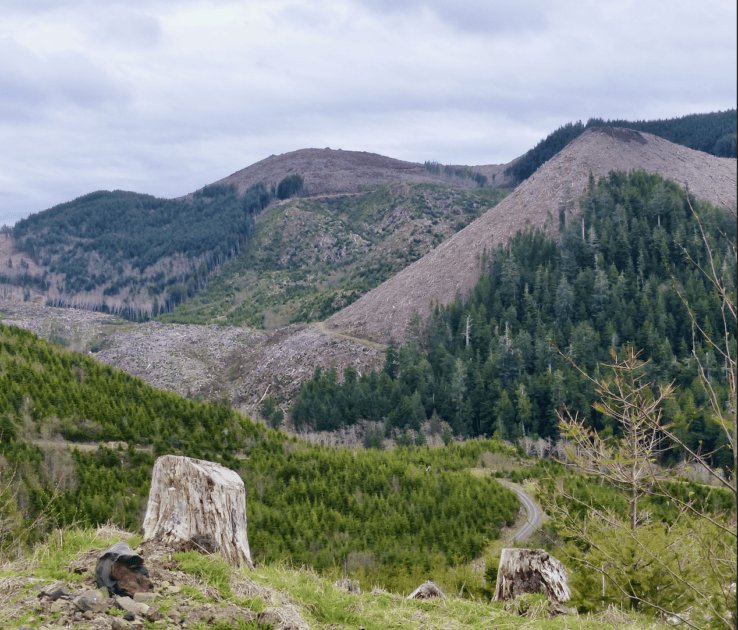
Industrial clearcutting in the Oregon Coast Range. Photo: Jeffrey St. Clair.
Last week, US Department of Agriculture (USDA) Secretary Brook L. Rollins moved forward on the agency’s promise to revoke the 2001 Roadless Rule, opening a public comment period on the proposal and a draft environmental statement on its impact. If this sounds familiar, that’s because we covered this almost a year ago during the scoping process.
So what’s changed, and what hasn’t?
First, it’s important to understand what the Roadless Rule does. Enacted at the end of the Clinton administration, the rule prohibits road construction, road reconstruction, and timber harvesting on 58.5 million acres of roadless areas within the National Forests. The environmental impact statement at the time argued that protecting these areas would maintain sources of clean drinking water for nearby communities, support habitats for native plant and animal species, and conserve biological diversity.
Since its passage, the rule has faced legal pushback from states and corporations, including mining and logging interests. And since 2001, some states have established their own regulations. More than 9 million acres in Idaho and over 4 million acres in Colorado are exempt from the rule because the states have passed specific legislation that supersedes the federal regulations. The state rules, however, protect some areas while opening up others to expanding recreation, like skiing, and logging and mining activities.
In June 2025, the USDA announced it would begin the process of revoking the rule. The administration claims roadless areas contribute to deadly wildfires. According to a statement from US Forest Service Chief Tom Schultz, “More than 40 percent of inventoried roadless areas, primarily in the West, have high or very high wildfire hazard potential. And only 5 percent of those areas have received hazardous fuels reduction treatments since 2014.” According to USDA, state-specific rules would not be affected by USDA’s decision.
But in an earlier memo from the US Forest Service, Acting Associate Chief Christopher French said the quiet part out loud. French echoed Trump’s call for the immediate expansion of timber production in these areas. By August, the agency had released rulemaking on the management of roadless areas on National Forest System lands, with public comments due by September 19 — a mere 21 days. Despite the short comment period, or perhaps because of it, the agency had received over 220,000 comments.
The agency released its draft environmental impact statement last week, which looked at three options: maintaining the existing Roadless Rule, rescinding the rule, or removing restrictions in roaded areas and the wildland-urban interface (WUI) while continuing to manage inventoried roadless areas outside those areas. That last option would remove prohibitions on 31 million acres, including 17.9 million acres that are within half a mile of existing roads or communities in the WUI, while continuing management of 13 million acres protected under the Roadless Rule. You can already guess which option the federal government is endorsing. Again, the public has less than a month to submit comments, which are due on September 21.
If that seems like a short amount of time to collect comments, it is. The time required to collect comments can vary, of course. According to the federal eRulemaking Program Management Office, “In a typical case, an agency will allow 60 days for public comment.” The Federal Register states that complex rulemaking processes — such as a decision that affects millions of acres across the US — may take more than 180 days. Shorter comment periods may be implemented if adequate justification exists. The administration hasn’t provided a justification.
The quick turnaround — less than a year — from the scoping process to the draft impact statement was also unusual. In theory, an environmental impact statement should take at least two years, as stipulated by the National Environmental Policy Act (NEPA) of 1969. The Council on Environmental Quality found in 2024 that the median time from notice of intent to final impact statement was 2.2 years. And as we noted last August, this is an incredibly complex issue that affects tens of millions of acres of forestland and watersheds across the US.
And then there are the issues with the Forest Service’s claims about wildfires. Schultz’s comment that only 5 percent of inventoried roadless areas have received fuels reduction treatment has less to do with access and more to do with funding. The US Forest Service has been chronically underfunded for decades, and Trump’s attempts to dismantle it through staffing and further budget cuts have not helped. Also, researchers have found that from 1992 to 2012, 84 percent of all wildfires were caused by people and that building roads in roadless areas is likely to increase the risk of fires.
Last week, the Firefighters United for Safety, Ethics, and Ecology released statements from experts who argue that smokejumpers, heli-rappelers, and helitack crews can manage fires in roadless areas and that the absence of communities or infrastructure in roadless wildlands actually provides more opportunities to safely manage fire, especially when it can be beneficial to the forest.
Rather than listening to experts on the matter, the administration appears focused on its corporate donors who will profit from this decision. Hopefully, at some point, states can implement their own roadless area regulations, making it harder for future administrations to give away the land to companies. In the meantime, we’ll probably see this battle play out in the courts. States can sue if federal mandates harm residents or infringe upon distinct state authorities. Under USDA’s proposal, industrial expansion could threaten clean air, water, and soil, while inadequate oversight of commercial forestry projects could increase wildfire risk. And with the rescission of the Roadless Rule, that’s a likely scenario.
First published by CEPR.
[ad_2]
Source link
