
[ad_1]
The White House has provided no federal data to support President Donald Trump’s claims that because of his “no tax on tips” policy, “440,000 tipped workers” in Nevada “saved an average of $10,000 on their taxes,” and “130,000 tipped workers” in Georgia “saved an average of more than $7,000 on their taxes.”
Instead of actual tax savings, the president may have been referring to the average amount some workers in those states were able to deduct from their federal taxable income in 2025. The actual savings would be a fraction of that, depending on a person’s tax rate.
The president also may be exaggerating the number of Nevadans and Georgians who were able to claim a tips deduction.
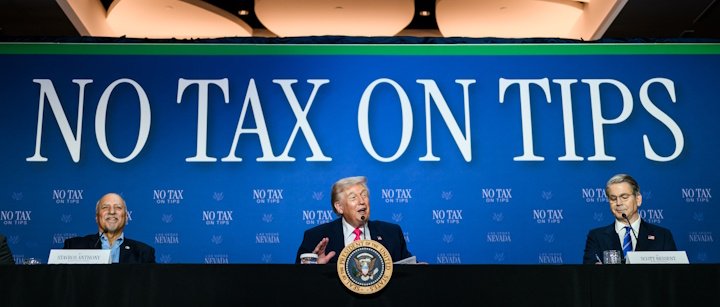
Trump talked about the savings for tipped workers in Nevada during an economic speech at the Red Rock Casino Resort and Spa in Las Vegas on Aug. 5.
“This past filing season, 440,000 tipped workers right here in Nevada saved an average of $10,000 on their taxes,” he said. “Think of that, just on the no tax on tips. So, that means every worker saved — this is put out by the government, check it out. … They say, ‘Oh, it wasn’t $10,000. It was $9,912.’ Think of it, every worker made $10,000 more money. That’s all because of the fact that I said I was going to do it and I got it done.”
He made a similar claim in a July 22 speech in Georgia, in which he said, “This past filing season, 130,000 tipped workers right here in Georgia saved an average of more than $7,000 on their taxes. And that’s because of no tax on tips.”
When we asked for supporting evidence, White House spokesman Kush Desai said that the administration’s tax policies were helping Americans nationwide save money – but he did not provide the “government” source for Trump’s figures.
“President Trump is right: tens of millions of working-class Americans are saving thousands of dollars on his signature no tax on tips, overtime, and Social Security provisions in the Working Families Tax Cut. That is especially true in Nevada, the birthplace of President Trump’s no-tax-on-tips pledge,” Desai said in an emailed statement.
However, we did not find support for the president’s claims.
A Deduction Isn’t the Amount Saved in Taxes
On July 4, 2025, Trump signed into law the One Big Beautiful Bill Act, which, among other things, created a temporary federal income tax deduction of up to $25,000 in qualified tips. The deduction – which is available each tax year from 2025 through 2028 – begins to phase out when modified adjusted gross income exceeds $150,000 for a single filer or $300,000 for a married couple filing jointly. The deduction is reduced by $100 for every $1,000 above those thresholds.
So, although Trump refers to this tax policy as “no tax on tips,” the law does not eliminate all taxes on tipped income. Social Security and Medicare payroll taxes still apply, for example.
More important, a federal tax deduction does not reduce taxes paid dollar for dollar. It reduces the amount of income on which the IRS calculates federal income tax, as Aparna Mathur, a senior fellow at the Urban-Brookings Tax Policy Center, explained to us in an email.
“What the President is referring to is not the actual tax savings from the tips deduction, but likely the average amount of income that a tipped worker is deducting from their taxable income,” Mathur wrote. “This is not a direct reduction in taxes but rather a reduction in income subject to taxes.”
For example, based on the federal tax brackets for 2025, if a tipped worker with taxable income between $11,926 and $48,475, with a 12% marginal tax rate, received a $10,000 deduction from their federal taxable income, the tax savings from that deduction would be about $1,200. If that same person received a $7,000 deduction, their federal income taxes would be reduced by $840.
In theory, as the deduction amount and marginal tax rate increase, so does the potential tax cut. As the Bipartisan Policy Center noted in February, the largest tax cut possible would be about $6,000 for someone in the 24% tax bracket with the highest gross income – $150,000 for a single filer and $300,000 for a married couple – allowed to claim the full $25,000 tip deduction.
But Mathur said the tax savings would be lower for people who already have little income tax liability due to claiming the standard federal tax deduction, which in 2025 was $15,750 for individual filers and $31,500 for married couples. “If their taxable income is already close to zero, there is no further tax liability to reduce, so the tips deduction provides them no additional value,” she said.
Meanwhile, the Tax Policy Center estimated in August 2025 that about 3% of U.S. households would benefit from the deduction of tipped income, and it estimated an average savings of about $1,400 among those households. Trump’s own White House Council of Economic Advisers had estimated in June 2025 that the tax provision for tipped income would increase affected workers’ average take-home pay by about $1,300 a year.
“It’s hard to think of a realistic scenario where the average tipped worker gets a tax savings equal to $7000 or $9000,” Mathur said. But she told us that the Tax Policy Center has not produced state-level estimates.
Notably, in a June 2 press release, the Treasury Department said that through the April tax-filing deadline, more than 7.5 million tax filers in the U.S. had used the tips deduction, and the department reported an “average deduction of over $7,000.”
The White House used similar language in an April news release in which it said 6 million tax filers nationwide had reported an average tips deduction exceeding $7,100 at that point in the filing season.
The Treasury and White House releases did not refer to the $7,000 figure as a tax cut, refund or the average amount saved by taxpayers.
Number of Beneficiaries Unknown
It’s also unlikely that 440,000 tipped workers in Nevada and 130,000 in Georgia claimed the tips deduction, as Trump said.
In a September 2025 analysis, the Nevada Independent, an online news outlet, reported that “approximately 444,000 Nevadans, or more than a quarter of the state’s workforce, could theoretically be covered by the No Tax on Tips provision of the Republican megabill.” But it said, “the number who will actually see more money in their pockets is likely far lower.”
The Nevada Independent calculated that large figure by taking a preliminary Treasury Department list of tipped professions affected by the tax policy and cross-referencing it with Bureau of Labor Statistics data on the estimated number of people in Nevada working in those occupations.
But Yale Budget Lab Associate Director of Policy Research John Ricco told the news outlet that the Treasury’s list was overly broad. “Not everyone who works in these occupations will get tips,” Ricco was quoted as saying.
In 2024, the Tax Policy Center estimated that the number of tipped employees in Nevada was much lower – about 5% of its workers, or about 80,000 people as of June.
Then in April, when the Treasury and the IRS finalized federal regulations defining qualified tips and listing the jobs “that customarily and regularly received tips” on or before Dec. 31, 2024, they noted that broad federal occupation codes sometimes combine tipped and non-tipped jobs. They also warned against using the provided occupation codes as the sole measure of whether workers customarily received tips. Tax-return data included in the regulation show why.
In the 2023 tax year, 82.8% of people in the relevant bartender category reported at least $100 in tips, according to a table that was included in the published regulations. The figure was 74.5% for wait staff and 70.9% for gambling dealers. The percentages fell sharply in other eligible professions. Only 11% of dishwashers, 2.7% of maids and housekeeping cleaners, and 0.1% of electricians reported at least $100 in tips, the data show.
So, counting every worker in those occupation groups would likely produce a much larger figure than the actual number of people who reported qualified tips.
It’s less clear where Trump may have gotten the figure of 130,000 Georgia workers claiming the tips deduction.
The Georgia Department of Labor reported 5.3 million employed state residents as of July. Trump’s 130,000 figure would be about 2.5% of that number.
In its 2024 analysis, the Tax Policy Center, citing the Yale Budget Lab, said that about 2% of workers nationally held jobs that regularly received tips. TPC found higher percentages in many Southern states.
That could support 130,000 as a rough estimate of Georgia workers in tipped occupations, but it still does not mean that 130,000 people in the state took the federal deduction and received tax savings as a result.
Editor’s note: FactCheck.org does not accept advertising. We rely on grants and individual donations from people like you. Please consider a donation. Credit card donations may be made through our “Donate” page. If you prefer to give by check, send to: FactCheck.org, Annenberg Public Policy Center, P.O. Box 58100, Philadelphia, PA 19102.
[ad_2]
Source link
