
[ad_1]

Odysseus, the Navigator.
Happy is he who, like Odysseus, made a beautiful journey, (…)
And then returned, full of experience and wisdom
To live among his relatives for the rest of his life!– French Renaissance poet Joachim du Bellay (1522-1560) [1]
The Odyssey is a Greek epic poem describing the decade-long peregrinations of one of the Greek heroes of the Trojan War, Odysseus, on his way back to his home on the island of Ithaca. Its twin opus is the Iliad, which focuses on the story of that war, a conflict involving the siege and eventual destruction by the Greeks of Troy, a city in northwestern Anatolia, whose location allowed it to control passage through the Dardanelles, the strategically and commercially important strait connecting the Aegean Sea, and the entire Mediterranean, to the Black Sea; Troy was also known as Ilion (or Ilium), hence the title Iliad, meaning “Saga of Troy.”
The Iliad and the Odyssey were long believed to have been the creation of a sole ancient Greek author named Homer; however, in the late 19th century historians became increasingly convinced that those two epic poems were likely the work of different authors who, sometime between 800 and 700 BCE, put into writing what had been orally transmitted stories inspired by a historic war that had been fought much earlier, namely around 1,200 BCE, that is, at the end of the Bronze Age. A poet named Homer, then, might never have existed: Homer was almost certainly a “composite character” or “personification” of the multiple anonymous poets and singers who created and popularized the orally transmitted stories that were eventually codified in the form of the Iliad and the Odyssey.
Be that as it may, the Iliad and the Odyssey are the oldest works of Western literature and, according to AI, are generally considered to be the “foundational texts of Western literature and consciousness” and even to constitute the “bedrock” of Greek culture and Western Civilization in general. This twin opus fits perfectly in the paradigm of the “Greek Miracle,” the “Eurocentric” theory, produced by European scholars in the 19th-century, that the civilization of Ancient Greece, the primordial Western Civilization, had originated virtually ex nihilo or, to use a Greek expression, had “sprang fully grown from the brow of Zeus,” like the goddess of wisdom, Athena.
In contrast, many if not most historians now recognize the enormous influence exerted on Greece by the ancient Mesopotamian Civilization, which originated in Sumer as early as the 5th millennium BCE but reached its zenith at the time of the rule of King Hammurabi (1792–1750 BCE), when the region’s metropolis was Babylon, whose architectural emblem, a ziggurat or step-pyramid with gardens on its terraces, the so-called “hanging gardens”, was to be declared by the Greeks themselves to be one of the Seven Wonders of the World. In that golden age of Mesopotamia, the leading language was no longer Sumerian but Akkadian.[2] In any event, the notion that the “light” of civilization had reached Western lands, including Greece, from the east, has been encapsulated in the aphorism, inspired by the sunrise, Ex Oriente Lux, “the light comes from the East.”
The “eastern” culture of Mesopotamia came to the “western” Greek world by sea, via Phoenicia, as well as by land, via Assyria, situated on the upper reaches of the Tigris River, and the vast highlands of the Anatolian Peninsula. A similar fecundation of Greece was triggered by impulses originating from Egypt, again with the Phoenicians functioning as intermediaries, and to a lesser extent from the Minoan Civilization on Crete, which was not Greek in the linguistic or cultural sense. It was in those historic circumstances that Greece’s Mycenaean bronze-age civilization, whose heartland was the Peloponnese Peninsula, arose in the middle of the second millennium BCE. Homer did not describe the warriors fighting the historic Trojan War as Greeks: that appellation did not yet exist in his time.[3] He referred to them by the name of specific “tribes”, primarily the Achaeans and Danaans (or Danaoi), who are considered to belong to the ethnicities collectively described as Mycenaeans.[4] It is also not a coincidence that in the Iliad the Greek commander, Agamemnon, was the king of Mycenae, a Peloponnesian city whose impressive ruins constitute one of modern Greece’s major tourist magnets today, more than 3,000 years after its Mycenaean heyday.
The transfer of Mesopotamian culture to Greece was multidimensional, and it also featured a very important linguistic component. Akkadian, an Afro-Asiatic language of the Semitic (as opposed to Hamitic) variety, exerted a considerable influence on Greek, a member of the Indo-European family (or “phylum”) of languages, especially on the lexical level. Also important in this respect was the language of the Phoenicians, who transmitted much Mesopotamian as well as Egyptian culture to Greece; their idiom also belonged to the Semitic branch of the Afro-Asiatic family; it was very similar to Hebrew and, like Hebrew, a close relative of Akkadian.
Ionian Greece, situated on the Aegean Sea at the western extremity of Anatolia, may be said to have been the hallway through which Mesopotamian as well as Egyptian cultural and linguistic influence entered the Greek world, to be diffused from there to the Greek mainland. Already in Antiquity, Ionia was associated with Homer, who was believed to have lived in Smyrna, or perhaps on the offshore island of Chios. And according to AI, the Iliad and the Odyssey were composed in “Homeric Greek,” also known as “Epic Greek” and defined as “a literary mixture of Ionic Greek and other dialects.” Consequently, it is not surprising to learn that the Iliad and the Odyssey are teeming with names that are almost certainly of Akkadian origin.
The name of Homer himself, for example, is almost certainly a form of the Akkadian term zammeru, which means “singer” or “bard,” as the Italian paleolinguist Giovanni Semerano (1913–2005), an expert in Mesopotamian languages, has argued.[5] This interpretation is convincing in light of the already mentioned fact that the Iliad and the Odyssey were very likely the fruit of an oral tradition, to be credited to one or more anonymous bards who had lived long before the epic was put to paper by “Homer or someone else with the same name,” as Mark Twain famously quipped. A perusal of Semeraro’s multiple, extensive as well as very thorough studies, especially his two-volume magnum opus, Le origini della cultura Europea, published in Florence in 1984 and 1994, yields countless other examples of Greek words in general, and names in particular, that appear to have an Akkadian or other Afro-Asiatic origin; and that includes lots of names associated with Homer, his world, and his epic poems. Let us examine some of them.
Homer presumably hailed from Ionian Greece, but what does “Ionia” mean? The name was of Afro-Asiatic origin: it was Jawan in Ancient Egyptian, Javan in Hebrew, and uwanu (or ummanu) in Akkadian, and it slipped into the Indo-European languages of India and Iran as yavana and yauna; its meaning was “crowd,” “people,” “humans.” Originally, the name seems to have had a rather pejorative connotation. The Mesopotamians used it to refer to the (from their viewpoint) culturally less advanced denizens of Anatolia in general, regardless of ethnicity or language; but the meaning gradually shifted to specifically designate the Greeks living along Anatolia’s Aegean coast and eventually all Greeks, wherever they lived. This explains why even the waters that stretch from the west coast of the Greek mainland to Italy are called the “Ionian” Sea, meaning the “Greek” Sea. However, it was the Greeks living in Anatolia who were commonly referred to as the Ionian Greeks and their Western Anatolian territory as Ionia. Greeks continued to live there until their expulsion in the 1920s in the wake of a war between Greece and Turkey. As for the Turks, when they migrated into the Middle East and all the way to Anatolia from their Central Asian homeland around 1,000 CE, they adopted a variant of the ancient Iranian appellation for Greece, and even today, they call Greece Yunanistan, “land [stan] of the Ionians.”[6]
It was likely in Ionia that the Greeks borrowed an Akkadian term to designate the lands to the west, on the far side of the Aegean Sea, namely ereb(u), which meant “[land of] the setting sun”, “sunset”, “evening”, and turned it into “Europe”.[7] In German and in Dutch, synonyms for Europe are Abendland and Avondland, respectively, meaning“land of the evening”: a perfect interpretation of ereb!
But let us focus on the theme of Homer and his famous epic poems about the Trojan War and its aftermath. The title Iliad refers to Ilion or Ilium which, as already mentioned, was another name used by the Greeks to designate Troy. Ilion is a toponym of Mesopotamian origin, it conjures up the Akkadian noun ilum or elum, meaning “upper part of a city,” “citadel.” As for the name Troy, it reflects the Akkadian verb tarum, “to circle [with a wall],” and therefore signifies “walled city.”[8] Both names essentially designated a fortified city on a hill, which corresponds to the topography of Troy.
Odysseus was one of the great heroes of the Trojan War, on the Greek side, that is. He was the brain behind the famous equine subterfuge that sealed the Greeks’ victory, and he was of course the protagonist of Homer’s second opus, which was even named after him, the Odyssey. He personified the intelligence, bravery, and personal integrity ascribed to the Greeks but, like Homer, he actually has a Mesopotamian pedigree. Why else would he have a name that cannot be interpreted with the help of the Greek language but can easily be deconstructed with a little knowledge of Akkadian? The first part of the hero’s name conjures up no less than a duo of terms from that Babylonian idiom, (w)udu, “wise person,” and edu or idu, “to be experienced”, “to know”, etc.; and the second part of his name echoes ussu, Akkadian for “guide” or “leader.”[9] That combination proclaims Odysseus to be a “wise leader”, wise, that is, from experiences in war and especially in travel. A plausible interpretation, is it not, particularly since in Homer’s epos as well as in the movie by Christopher Nolan, the hero’s wisdom is largely the fruit of his experiences during a long voyage?
In this context it is worth pointing out that Gilgamesh, the protagonist of a famous Mesopotamian epic story, who is often cited as a prototype for Homeric and other Greek heroes, likewise achieved great wisdom in the course of a long and perilous journey.[10] For comparison purposes, the story of Gilgamesh dates back to about 2,000 BCE, so it was already more than 1,000 years old when the Iliad and the Odyssey were put on papyrus! Odysseus, the traveler, was also known in Greek as Oulixeus, which produced Ulixes in Latin, Ulysse in French and Ulysses in English; that term conjures up the Akkadian verb alik(su), which signified… “to move about,” “to travel.”[11]
As for Odysseus’ wife, her name, Penelope, can also be interpreted as an echo of Akkadian terms. Semerano argues that the name would originally have started not with pene- but with kene-, and that kene- corresponds to the Akkadian kenu, meaning “true, faithful feelings”. The Italian paleolinguist interprets the name’s second part as a form of the Akkadian libbu, “heart” or “sentiment.”[12] Penelope thus comes to mean “faithful heart.” It is an appellation she richly deserved, waiting faithfully for a decade for her warrior husband to return home.
In the movie, but not in Homer’s story, Penelope finds herself under pressure to marry so that Ithaca may be more effectively defended by a male leader against a potential attack by shadowy foreign marauders known as the Sea Peoples. This is a subplot invented by Christopher Nolan and its purpose is revealed at the end of the movie. Nolan was inspired by the historic fact that the end of the Bronze Age featured violent incursions into that era’s leading empires by hitherto unknown but very warlike folks from distant overseas lands, referred to as the “Sea Peoples.” These marauders were expelled from Egypt by Pharaoh Rames III, though not without difficulty, but they are believed to be responsible for the collapse of the Anatolia-based empire of the Hittites.
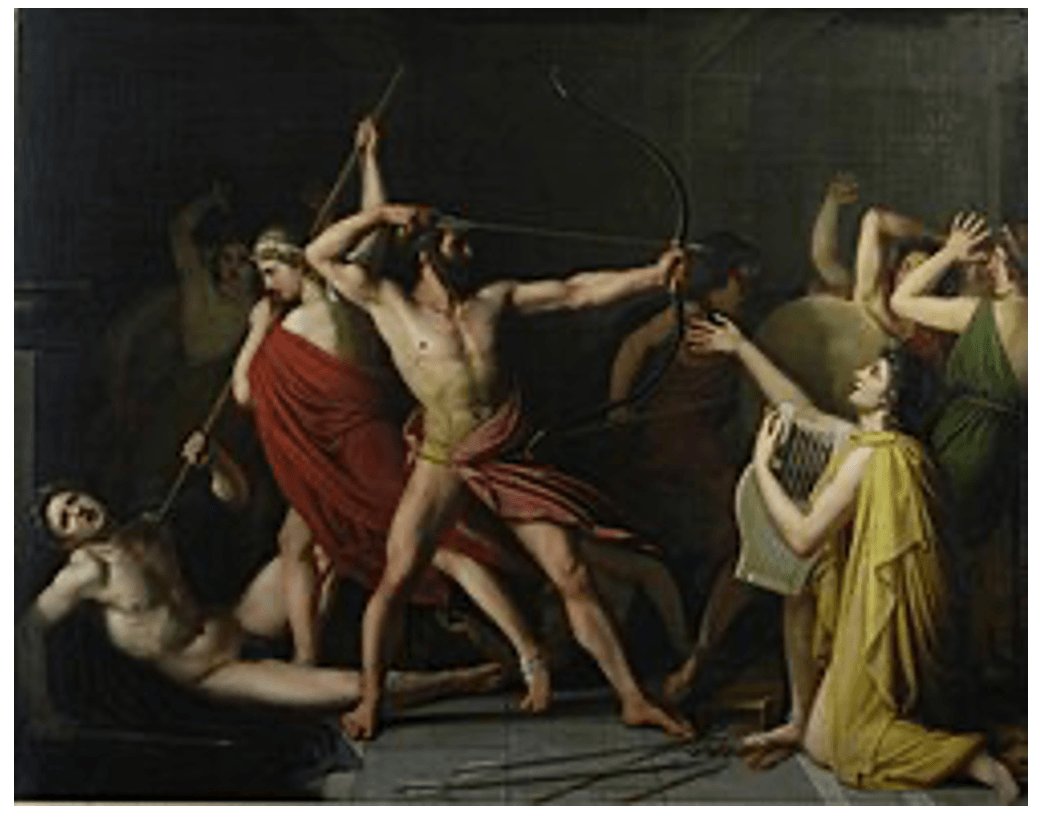
What about Telemachus, the brave son of Odysseus and Penelope? AI would have us believe that the name “combines [the Greek term] tele, meaning ‘far off’ . . ., and makhe, meaning ‘battle’ or ‘fight,’…which translates to ‘far-fighter,’ or ‘distant warrior,’ whatever that may mean. Semerano, on the other hand, while not referring to Telemachus by name, provides clues for a different and more convincing interpretation. Both parts of the name Telemachus appear to be derived from the Akkadian language. The first one reflects the term tele’u, meaning “competent” and “brave”, which Semerano claims to recognize in the name of the mythological hero Telephus, a son of Heracles (Hercules); and the second part is a form of the verb mahasu, “to fight” or “to kill,” a verb from which the Greek term makhe was derived. Telemachus did indeed prove to be an efficient fighter/killer, assisting his father in the massacre of his mother’s suitors [13]

Odysseus and Telemachus slaughter the suitors of Penelope on a painting by Thomas Degeorge.
Let us accompany Odysseus to some of the intriguing places he visited during his long and adventurous journey throughout the Mediterranean. The hero was held captive for many years by the nymph Calypso, whose name is known to reflect an Ancient Greek verb kalypto, meaning “to conceal” or “to hide”, making her “she who hides [in a cave].” What is less known, however, is that this Greek verb was nothing other than a variant of the Akkadian halapu, with the same meaning.[14]
As for the sirens, whose seductive but fatal songs Odysseus was eager to hear but could only hold out against because his men had tied him to the mast of his ship, their name can likewise be deconstructed and interpreted with the help of the Afro-Asiatic language of Babylon and Mesopotamia in general. The word “siren” appears to be a combination of the root sur, “rocks”, and (w)enu, “source”, “river”, “water,” and alludes to rocks lurking just below or above the water surface, a grave threat to inattentive sailors; in addition, the first part of “siren” conjures up two Afro-Asiatic terms, the Sumerian sir and the Aramaic sar, respectively meaning ‘song” and “to sing.” The story of the sirens has often been associated with the Italian town of Sorrento and the homonymous peninsula, separated from the island of Capri by a narrow strait of tumultuous and dangerous waters that also feature two rocky islets responsible in the past for numerous shipwrecks; now called the Galli, they were known in the past as the Sirene, Italian for “Sirens.”[15]
The toponym Sorrento – Surrentum in Latin – clearly also contains the term sur, “rock,” which simultaneously conjures up another Akkadian word, saru, “high”; and the name also seems to hide the Akkadian word for “water,” (w)enu. As for the final syllable of Sorrento, it is likely a variant of an Afro-Asiatic term designating a land or locality, ta in Ancient Egyptian and etu in Semitic idioms such as Akkadian.[16] This produces the very plausible meaning of “town on the high rocks overlooking the water,” it happens to be a perfectly accurate description of Sorrento’s picturesque site on top of lofty cliffs rising perpendicularly from the blue waters of the Bay of Naples.
En route to Sorrento to hear the Siren songs, Odysseus and his band of brothers slipped through the Strait of Messina, which separates the tip of the Italian boot from the island of Sicily; this narrow stretch of water features cliffs and rocks as well as dangerous currents, including whirlpools, undertows, and such, and is believed to have provided the inspiration for the story of the terrifying monsters Scylla and Charibdys. In Nolan’s film, Odysseus narrowly avoids being swallowed in toto by a gaping vortex, but a good number of his men are subsequently snatched and devoured by a cliff-dwelling monster. The vortex is the monster Charybdis and the terrifying creature with multiple necks and heads is Scylla, and their names reflect Akkadian terminology: the former conjures up haribtu, “womb” or “uterus”, and the latter, kullu, “to snatch.”[17]

Odysseus passes Scylla and Charybdis and is tied to the mast of his ship while sailing by the Sirens on a lithograph by Theodoor van Thulden, Paris, 1633.
Odysseus returned from his decade-long voyage “full of experience and wisdom” (plein d’usage et raison), as a French poet of the Renaissance, Joachim du Bellay, wrote in a beautiful poem quoted earlier and as Christopher Nolan emphasizes in his own cinematographic way towards the end of his production. That is when the hero shares with Penelope something he had come to understand during his long and arduous homeward voyage, namely that the Greeks’ triumph over Troy, made possible by his ruse with the horse, had not been a glorious affair but a terrible massacre, a feat warranting not pride, but remorse. The Greeks, he confides to Penelope, were in fact the Sea Peoples, or a host similar to the Sea Peoples, the shadowy marauders who had struck fear in the hearts of the denizens of Ithaca, a fear that triggered pressure on her to marry one of the suitors. The writer-director makes his point cinematographically by having the Trojan Horse dragged into Troy directly from the sea.

Sea Peoples fighting Egyptians on a wall of the temple of Ramses III in Medinet Habu near Luxor, Egypt.
Nolan’s notion that the Greeks besieging and destroying Troy were part of the infamous Sea Peoples is far from outlandish. Homer’s epic was inspired by a real war, fought around 1,200 BC, exactly at the time of the traumatic end of the Bronze Age, when “peoples from the sea” raided Egypt and ruined the empire of the Hittites based in Anatolia. Egyptian records contain lists with names of ethnicities belonging to that infamous horde, and they include Bronze-Age Greeks such as the Achaeans of the Iliad and the Odyssey, who are also believed to be the Ahhiyawa mentioned in contemporary Hittite texts.[18] And many historians equate Troy with Wilusa, a city in northwestern Anatolia that was part of, or perhaps a satellite, of the Hittite Empire.[19] These data do not prove, but certainly suggest, that the Trojan War may have been an operation carried out by Mycenaean Greeks within the general context of the destruction, by marauders from overseas, of the once-mighty state of the Hittites
According to an ancient proverb, those who “live by the sword,” will also “die by the sword,” and this is what eventually happened to the Mycenaean Greeks. Their civilization, like that of the Hittites, also collapsed in the twilight of the Bronze Age, and its demise is certain to have involved armed conflict, although it is not clear with whom. The Mycenaeans left behind impressive ruins that were also excavated by Schliemann and yielded treasures such as a wonderful golden mask the German antiquarian wrongly believed to represent Agamemnon, the Greek commander who, in the movie, is dressed in a jet-black suit of armor and looks like Darth Vader; described as the “Mona Lisa of prehistory,” the mask is now on display in the National Archaeological Museum of Athens.
As for Odysseus, no golden mask seems to exist, even though he was indisputably not only a great hero like Agamemnon, Achilles, etc., but also a decent and smart “good guy,” the “golden boy” of Homer’s opus. Maybe he was not considered to be sufficiently Greek to be receive such a high honor? Indeed, as we have seen, for his post-war adventures, Homer had him sailing off to western lands before finally returning to his island on the west coast of Greece, but the cunning hero’s origins were in the east: Ex Oriente Odysseus!

The so-called Mask of Agamemnon.
Sources.
“Achaean,” Britannica.
Bernal, Martin. Black Athena: The Afroasiatic Roots of Classical Civilization, New Brunswick,
NJ, 2 vols, 1996. (originally published in 1987)
Burkert, Walter. Babylon – Memphis – Persepolis: Eastern Contexts of Greek Culture,
Cambridge and London, 2004.
“Calypso (mythology).” Wikipedia.
Castleden, Rodney. Mycenaeans, London and New York, 2005.
“Epic of Gilgamesh,” Wikipedia.
“Gilgamesh. Mesopotamian mythology,” Britannica.
Hall, Jonathan M. Hellenicity: Between Ethnicity and Culture, Chicago and London, 2002.
Latacz, Joachim. Troya y Homero: Hacia la resolución de un enigma, Barcelona, 2003. (Originally published in German in 2001)
Pauwels, Jacques R. Beneath the Dust of Time: A History of Ancient Languages and Names of Peoples and Places, Walterville, OR, 2025.
Semerano, Giovanni. Le origini della cultura Europea: Vol. I. Rivelazioni della linguisticastorica, Florence, 1984.
Semerano, Giovanni. Le origini della cultura Europea. Vol. II: Dizionari Etimologici. Basi semitiche delle lingue indeuropee, Florence, 1994.
Semerano, Giovanni. La favola dell’indoeuropea, Milan, 2005.
Notes.
[1] Original French text: “Heureux qui, comme Ulysse, a fait un beau voyage, / (…) / Et puis est retourné, plein d’usage et raison, / Vivre entre ses parents le reste de son âge. ”
[2] See e.g. the books by Martin Bernal, Black Athena, Walter Burkert, Babylon – Memphis – Persepolis: Eastern Contexts of Greek Culture, and Jonathan M. Hall, Hellenicity: Between Ethnicity and Culture.
[3] The terms Greece and Greeks as well as Hellas and Hellenes are discussed in detail in Pauwels, pp. 95-97, 163-64.
[4] “Achaean”; Latacz, pp. 186-90.
[5] Semerano (1994), p.207.
[6] Semerano (1984), pp.437-39. See also Hall, pp.70-71; Bernal. Vol. I, p.83.
[7] Semerano (1994), p.102; Semerano (2001), pp.85, 128, 242 footnote; Semerano (2005), pp.81-82.
[8] Semerano (1984), p.692; Semerano (1994), p.126; Semerano (2005), p.33.
[9] Semerano (1984), p.247.
[10] Burkert, pp. 21-48; “Gilgamesh. Mesopotamian mythology”; “Epic of Gilgamesh.”
[11] Semerano (1984), p.247.
[12] Semerano (1984), p.254.
[13] Semerano (1984), p.890; Semerano (1994), pp.185, 288, 464.
[14] “Calypso (mythology)”; Semerano (1994), p. 131.
[15] Semerano (1984), pp.265-66, 601; Semerano (2003), p. 53.
[16] Semerano (1984), pp.197, 466, 509, 598, 644. For an etymology of the ancient name of Egypt, Kemit or Cham-ta, “Black Land,” see Pauwels, pp.28-36.
[17] Semerano (1984), pp.263-64.
[18] “Sea People”, Britannica.
[19] Latacz, pp.110-11, 115-19, 175; Bernal, vol. II, pp.512-13.
[ad_2]
Source link
