
[ad_1]
One would think that delivery drivers would be natural supporters of delivery services. Not if you’re the International Brotherhood of Teamsters.
Through lobbying efforts and lawsuits, the union has made itself the primary enemy of any business or industry that might ship goods or drop off packages without employing unionized drivers (or any drivers, for that matter).
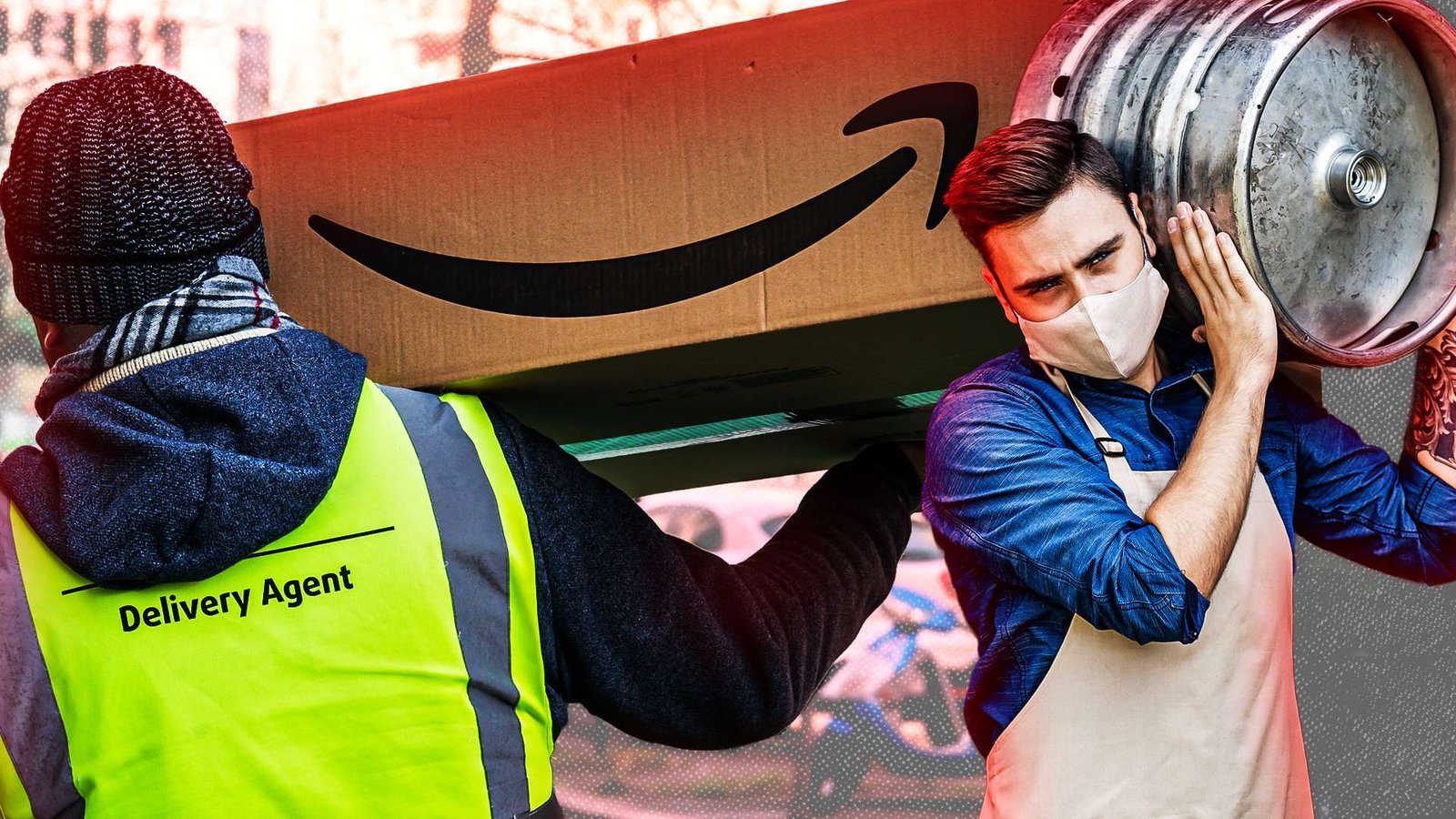
The Teamsters have come out in force to support New York City’s Delivery Protection Act (DPA), which would require companies like Amazon to hire delivery drivers as full-time employees—an effective ban on the company’s current practice of hiring out deliveries to smaller subcontracting firms.
Proponents of the bill, including New York Mayor Zohran Mamdani, allege that Amazon’s use of subcontractors enables it to avoid various worker protections guaranteed to full-time employees.
Amazon counters that contracted delivery workers are amply compensated and covered by a range of worker protections. Eliminating its subcontracting model, the company argues, would raise delivery costs for consumers and incentivize it to move more of its operations out of New York City.
One study commissioned by a New York business advocacy group, partially funded by Amazon, found that the DPA would increase annual consumer costs by $664.
The Wall Street Journal Editorial Board notes that federal labor law doesn’t allow subcontractors and independent contractors to unionize. The Teamsters have been in a years-long effort to unionize Amazon contractors. Banning the company’s subcontracting model would be a necessary step to bring its delivery drivers into its union.
As one of the country’s largest companies, Amazon makes for an easy populist target. But small businesses that contract out delivery services have not been spared from Teamster activism.
By the end of the year, California’s COVID-era rule changes allowing craft distillers to ship directly to consumers will expire. Efforts to extend this deregulation have stalled in the Legislature.
CalMatters reports that a major opponent of extending the status quo has been the California Teamsters.
“We are absolutely not opposed to the little guys being able to ship directly to consumers,” a Teamsters lobbyist told the publication. “We have a track record of supporting the proposal but with meaningful guardrails that protect our members and protect the public.”
Those guardrails would include requiring distilleries to hire established shipping companies, which employ Teamsters members as drivers.
In all these cases, the union cites some public-spirited justification for opposing companies’ deployment of nonunionized delivery services: reducing traffic accidents in New York, preventing underage alcohol sales in California.
Even when public safety would seem to be enhanced by new forms of delivery service, the Teamsters still find themselves in opposition.
Across the country, policymakers are considering regulatory updates that would allow autonomous vehicles onto the road. Preliminary data suggests these vehicles are safer than the human drivers they’d replace.
Nevertheless, the Teamsters are leading the charge against any rollout of autonomous vehicles.
Earlier this month, the California Teamsters sued the state’s Department of Motor Vehicles to block new regulations that allow companies to test larger driverless trucks on the state’s roads.
The two companies that have received testing permits thus far must still have a human safety operator behind the wheel.
But the Teamsters complain that this limited advancement for autonomous vehicles will only invite greater economic disruption.
“Self-Driving Truck prospectors are rushing to strike it rich in California, and will soon spend hundreds of millions of dollars within the state to comply with the Amended AV Regulations, giving them the ability to operate fully in the state and achieve what they have long been wishing for—the elimination of the human driver and their attendant needs from their logistics networks,” reads their petition.
It is, of course, understandable why a union representing truck drivers would care about whether freight companies employ human drivers or if delivery companies farm out their last-mile operations to subcontractors.
But the point of production is consumption, not employment.
Delivery services exist to deliver things to customers, not employ unionized delivery drivers.
If Amazon’s subcontracting model or Aurora’s driverless trucks can realize more frequent, lower-cost deliveries, the public’s interest is served.
People of good faith can debate how stringent safety regulations for delivery services need to be. It’s telling that none of the regulatory proposals supported by the Teamsters stop at raising safety standards.
Instead, they all aim to shift companies to using unionized labor on the stated assumption that this will be better for safety.
One doesn’t have to be a cynic to see the cynicism at play.
[ad_2]
Source link
